Your bathroom scale is the worst coach you’ve ever hired. It doesn’t know the difference between a gallon of water and five pounds of new muscle. If you’re obsessed with that single number, you’re likely sabotaging your own growth. You step on that plastic square every morning, hoping for a change, yet your lifts are stalling and your motivation is tanking. It’s a frustrating cycle that holds back even the most dedicated athletes.
Stop measuring your gravity and start measuring your power. You need a high-performance weight lifting tracker app that prioritizes performance over body mass. This article reveals why tracking body weight alone stalls progress and how the right data transforms your training into muscle. We’ll show you how to identify zero-friction tools that save you time between sets and provide the clear visualization of strength gains you’ve been missing. It’s time to stop guessing and start growing.
Key Takeaways
- Ditch the scale obsession. Learn why tracking strength metrics provides a more accurate picture of progress than body mass alone.
- Identify the “Complexity Trap.” Discover why a high-speed weight lifting tracker app beats clunky, social-heavy alternatives every time.
- Predict your next PR with precision. Use your volume trend data to determine exactly when your body is primed for heavier loads.
- Master body recomposition. Understand the science of losing fat while gaining muscle and why your gym log is the only proof you need.
- Achieve zero-friction logging. See how a native iOS design eliminates distractions so you can focus entirely on your next set.
The Weight App Misconception: Scale Weight vs. Strength Weight
The word “weight” is the most misunderstood term in fitness. When you search for a “weight app” on the App Store, you’re usually met with a sea of calorie counters, BMI calculators, and restrictive diet logs. These tools are designed to help you shrink. If your goal is to build power and muscle, these apps are actually your biggest distraction. You don’t need to monitor how much of you exists. You need to track how much you can move. This is where a dedicated weight lifting tracker app becomes your most valuable piece of equipment.
There are two distinct categories of data in your fitness journey: body trackers and gym logs. Body trackers focus on your relationship with gravity. Gym logs focus on your relationship with performance. We call this “Performance Weight.” It’s the ultimate metric for anyone serious about growth. Shifting your psychology from losing mass to gaining capability changes everything. It turns your phone from a source of anxiety into a technical precision tool for progress.
Why Gravity is a Poor Metric for Progress
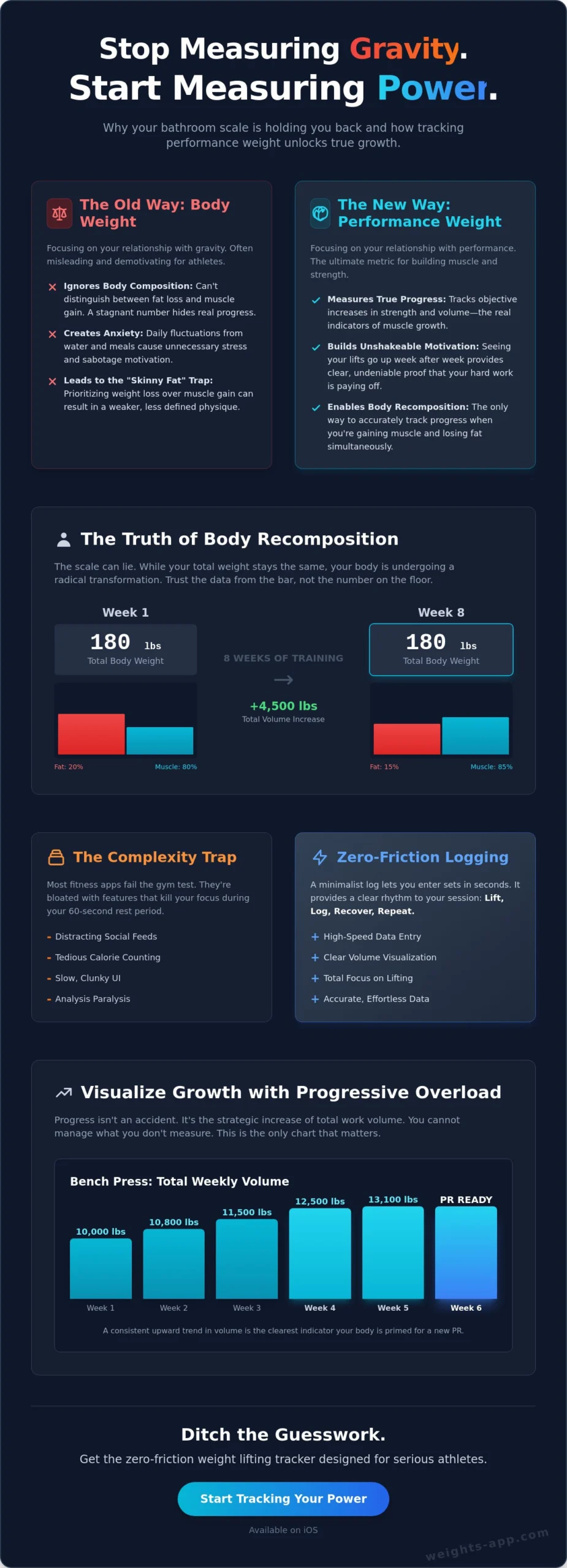
Your bathroom scale is a blunt instrument. It can’t distinguish between a gallon of water, a heavy meal, or two pounds of new lean tissue. Relying on it leads straight into the “Skinny Fat” trap. This happens when you focus solely on weight loss and end up with a smaller, weaker version of your previous self. To truly understand the mechanics of growth and What is Strength Training?, you have to look past the total body mass.
Muscle growth often happens while the scale stays stagnant. This is the science of body recomposition. You’re burning fat and building muscle simultaneously. Visualizing your strength level through data is a far more reliable indicator of your body composition than a morning weigh-in. If your lifts are going up, your body is changing. Trust the data on the bar, not the number on the floor.
The Rise of the Minimalist Gym Log
The 2026 athlete has no time for bloated software. We’ve seen a massive shift away from tedious calorie counting toward high-speed volume tracking. Modern training is built on “time-under-tension” and progressive overload. You need to know your total volume for the week, not just your body mass index. A streamlined weight lifting tracker app removes the friction that causes analysis paralysis.
Most apps fail because they’re too slow to use during a sixty-second rest period. If you’re fumbling with menus, you’re losing focus. A minimalist log allows you to enter your sets in seconds and get back to the work. It provides a clear, staccato rhythm to your session: lift, log, recover, repeat. By prioritizing speed and clarity, you ensure that your data is accurate without sacrificing the intensity of your workout.
Myth: Tracking Your Body Weight is the Only Way to Measure Fitness
The Body Mass Index (BMI) is a relic of 19th-century statistics. It was never designed for people who move heavy iron. For an athlete, BMI is a lie. It sees muscle density as a liability and categorizes lean, powerful lifters as “overweight” simply because muscle weighs more than fat. If you’re building a physique, you’ve moved past the need for generic averages. You need a weight lifting tracker app that understands the difference between mass and power.
Body recomposition is the gold standard of fitness. It’s the process of simultaneously burning fat and building lean tissue. During this phase, your total body weight might not move an inch. The scale stays stagnant, yet your clothes fit better and your muscles look harder. A standard weight app will tell you that you’ve stalled. It’s wrong. You’re actually making the most significant gains of your life, but you need the right data to prove it.
Compare the emotional toll of these two metrics. Stepping on a scale and seeing the same number for three weeks is demotivating. It feels like wasted effort. Now, look at your gym log. You’ve added ten pounds to your bench press and two reps to your deadlift. That is objective, undeniable proof of progress. Beyond the aesthetic changes, the health benefits of strength training include increased bone density and improved metabolic rate, none of which show up on a bathroom scale.
The Science of Progressive Overload
Progress is not an accident. It’s the result of progressive overload. You cannot manage what you don’t measure. If you’re walking into the gym without a plan, you’re just exercising; you aren’t training. Training requires a precise record of every set and rep. Progressive overload is the strategic increase of total work volume, load, or frequency over time to force your muscles to adapt and grow. Without a weight lifting tracker app, you’re leaving your results to chance. Precision is the only path to power.
Visualizing Growth Beyond the Mirror
Your brain needs proof to stay focused. Mirrors are subjective. Lighting changes, and so does your perception. Data is different. It’s cold and honest. History logs and volume charts provide the “proof” your mind requires to stay disciplined when the mirror isn’t cooperating. Personal records (PRs) serve as the ultimate fuel for consistency. Every time you beat your past self, you build momentum. Check out the ultimate workout tracker for a complete framework on how to stop guessing and start growing. If you want to see real results, it’s time to start tracking your lifts at weights-app.com and leave the scale behind.
The Complexity Trap: Why Most Weight Apps Fail the Gym Test
The biggest enemy of your workout isn’t a heavy plate. It’s a slow app. Most fitness software is designed by committees who have never broken a sweat. They load their products with features that look good in a boardroom but fail on the gym floor. You’re in the middle of a heavy session. Your heart rate is up. You have sixty seconds to rest. The last thing you need is a weight lifting tracker app that takes thirty seconds just to load a menu. Speed is the only metric that matters when you’re between sets.
Your gym log should not be Instagram. Social feeds, likes, and community challenges are distractions that kill intensity. Real progress happens in the zone. If you’re scrolling through a feed while you should be recovering, you’ve already lost your momentum. High-performance training requires a “Zero Friction” environment. Every extra tap is a barrier to your consistency. Independent developers understand this better than massive corporations. They build tools for lifters, not for data-hungry advertisers. They prioritize the user experience because they use the tools themselves.
If you’re just getting started with strength training, don’t get lured in by flashy, corporate apps. They want your attention; you want results. Choose a tool that stays out of your way and lets you focus on the iron. Precision and speed are the hallmarks of a professional setup.
The Problem with Feature Bloat
Feature bloat is a performance killer. Unnecessary ads and news feeds don’t just clutter the screen. They drain your battery and slow down load times. A minimalist UI is a technical advantage. It ensures that the app is ready the moment you pick up your phone. Speed is a feature. Clarity is a feature. Anything that doesn’t help you log your next set is just noise that needs to be cut. You need a weight lifting tracker app that respects your time and your battery life. Before committing to any platform, it’s worth consulting the best workout tracker definitive roundup for serious lifters to compare your options and find the right fit for your training style.
Privacy and Data Ownership in 2026
Your health data is valuable. The hidden cost of “free” apps is often your personal privacy. In 2026, data security is a non-negotiable requirement for serious athletes. You need a solution that keeps your history private and accessible. Local storage and a reliable icloud sync weightlifting app ensure your progress is never lost or sold. Supporting independent developers means you’re paying for a superior product, not becoming the product yourself. Keep your data where it belongs: in your own encrypted storage.
How to Use a Weight App to Predict Your Next PR
Data is only as good as the action it inspires. Most lifters use a weight lifting tracker app as a digital diary; they log a set and never look at it again. This is a massive waste of potential. Your training history is a predictive engine. It tells you exactly when you are primed for a breakthrough and when you need to pull back. By analyzing your “Volume Trend” line, you can visualize the relationship between work and recovery. If your volume is climbing while your rest times stay consistent, you aren’t just working hard. You’re building the capacity to smash your previous limits.
Estimated 1RM (One Rep Max) data is your secret weapon for goal setting. You don’t need to risk an injury by testing your absolute max every week. Instead, use the math provided by your gym log to track your theoretical power. When your estimated 1RM on a high-rep set exceeds your previous heavy single, it’s time to put more plates on the bar. Precision beats ego every time. Custom routines further streamline this process by removing the mental load of decision-making. You walk into the gym with a plan already loaded. No thinking. Just lifting.
Step 1: Establishing Your Baseline
Precision starts with a foundation of truth. Log your first three sessions with absolute accuracy to create your data baseline. This isn’t just about the numbers on the plates. You must log your “Rate of Perceived Exertion” (RPE) for every top set. RPE is a scale of one to ten that measures how hard the set felt. An RPE of eight means you had two reps left in the tank. This context is vital. Consistency in logging these details is more important than the weight itself during the first week. You’re calibrating your tracker to your unique physiology.
Step 2: Analyzing the Velocity of Progress
Identify plateaus before they stall your motivation. Visual charts allow you to see the velocity of your progress in real time. If you notice your strength gains are slowing down, you can adjust variables like rest times or set counts based on your historical performance. A strength plateau manifests as a flat horizontal line on your volume trend chart, indicating that your current training stimulus has reached a point of diminishing returns. Spotting this early allows you to pivot your program before you waste a month of training. Upgrade to Weights Pro to unlock the advanced predictive analytics you need to own your progress and never stall again.
Weights Pro: The Zero-Friction Weight App for iOS
Weights is the antidote to the cluttered, social-heavy gym logs that plague the App Store. It’s built for the athlete who values time and precision over likes and comments. Most software tries to be a social network; Weights is a high-performance utility. It’s the weight lifting tracker app that stays out of your way so you can stay in the zone. Every pixel is optimized for one goal: turning your training data into muscle.
This is an iOS-exclusive tool. It doesn’t just run on your iPhone; it feels like it belongs there. The design follows the clean, minimalist aesthetic of native Apple utilities. It’s fast. It’s stable. It requires iOS 18.0 or later to ensure you’re using the latest technical advancements in mobile performance. You won’t find a clunky port of a generic web app here. You get a streamlined experience built specifically for the hardware in your pocket. It’s technical precision meets athletic grit.
Subscription fatigue is real. Most competitors lock your own data behind an endless monthly fee. Weights offers a different path. While you can choose Weights Pro Monthly or Weights Pro Yearly, serious athletes often opt for Weights Pro Lifetime. This one-time purchase gives you permanent access to premium features without the recurring drain on your bank account. It’s a professional investment in your long-term strength. You own your progress. You own your data. No recurring fees. No noise. Just results.
Built for the Gym Floor
Usability is a performance feature. Weights features large, easy-to-tap buttons designed for sweaty hands and fast-paced sets. You don’t have to squint at the screen between heavy lifts. Custom routine creation allows you to build a plan that adapts to your specific equipment and goals. Whether you’re in a high-end facility or a garage gym, the app scales with you. Visual data charts make your progress undeniable. They provide the instant feedback needed to maintain momentum when the training gets tough.
The Weights app Philosophy
The philosophy is simple: Zero friction. There are no ads to close. There are no social feeds to scroll. There are no distractions to break your concentration. The app was designed in Riga, Latvia, by Edgars Jaudzems, an independent developer who actually lifts. He understands the frustrations of traditional methods and engineered a superior, modern alternative. It’s built by a lifter, for lifters. Download Weights app on the App Store and start tracking real progress today. Get in. Log your weight. Get stronger. Get out.
Own Your Progress. Stop Chasing Gravity.
The scale doesn’t define your fitness. Your performance does. You’ve seen why tracking body mass alone stalls your growth. You know why “Performance Weight” is the only data that matters. Ditch the social feeds and the feature bloat. They distract you from the iron. True transformation requires a high-performance weight lifting tracker app that respects your time and your privacy.
Weights Pro delivers exactly what you need to break through plateaus. You get a no-nonsense minimalist design. It keeps you focused on your next set. Your data stays secure with seamless iCloud sync. Best of all, you can opt for Weights Pro Lifetime access and own your training history forever. Trade your anxiety for technical precision. Start your 2026 strength journey with Weights app and prove that you’re getting stronger every single day. The bar is waiting. Let’s get to work.
Frequently Asked Questions
Is a weight app better than a paper notebook for the gym?
Digital logs beat paper every time. A dedicated weight lifting tracker app provides instant volume calculations and historical charts that a notebook simply can’t match. You get real-time feedback on your progress without doing manual math between sets. It’s faster, more durable, and fits perfectly in your pocket. Stop flipping pages and start analyzing your actual performance data instantly.
Do I need a weight app if I am just a beginner?
Beginners need tracking more than anyone. You’ll experience rapid strength gains in your first few months, and documenting these wins is vital for long-term motivation. Using a weight lifting tracker app ensures you’re following the principles of progressive overload from day one. It builds a foundation of precision and discipline before you ever hit your first plateau.
Can a weight app help me lose fat and gain muscle at the same time?
Tracking your lifts is the secret to successful body recomposition. By monitoring your strength, you ensure that you’re maintaining or building lean tissue while in a calorie deficit. If your gym numbers are rising or steady, you’re losing fat rather than muscle. The data provides the objective proof of progress that your bathroom scale often hides.
What is the best weight app for iPhone users who want simplicity?
The Weights app is specifically engineered for iOS users who value a zero-friction experience. It avoids the clutter of social feeds and ads, focusing entirely on your workout data. The design feels like a native Apple utility, ensuring a seamless and professional user interface. It requires iOS 18.0 or later to leverage the latest mobile performance standards.
Why should I track my strength weight instead of just my body weight?
Body weight is a blunt instrument influenced by water, salt, and digestion. Strength weight is an objective measure of your physical capability and muscle density. Tracking the load on the bar tells you if you’re actually becoming more powerful. It’s the most reliable metric for judging your body composition and athletic growth over time.
Does the Weights app sync with my Apple Watch or iCloud?
Weights uses secure iCloud sync to keep your training history safe and accessible across your Apple devices. Your data remains private and encrypted within your own account. This ensures that your years of hard work are never lost if you upgrade your hardware. It’s a professional-grade solution built exclusively for the Apple ecosystem’s technical precision.
Is there a one-time purchase option for a pro weight app?
Yes. Weights Pro Lifetime is the premier choice for serious athletes who want to avoid subscription fatigue. You can also choose Weights Pro Monthly or Weights Pro Yearly if you prefer a different billing cycle. This flexibility allows you to unlock premium features and advanced analytics in a way that best fits your financial strategy.
How does tracking my gym sets help me reach my fitness goals faster?
Tracking eliminates the guesswork that stalls most training programs. You know exactly what you lifted last session and precisely what you need to beat today to force adaptation. This creates a constant state of progression and accountability. By reviewing your history, you can identify weaknesses and adjust your volume to ensure every minute in the gym counts.
Ready To Get Started?
Everything you need. Nothing you don’t.
Weights adapts to your goals today and scales with the strength you’ll have tomorrow.