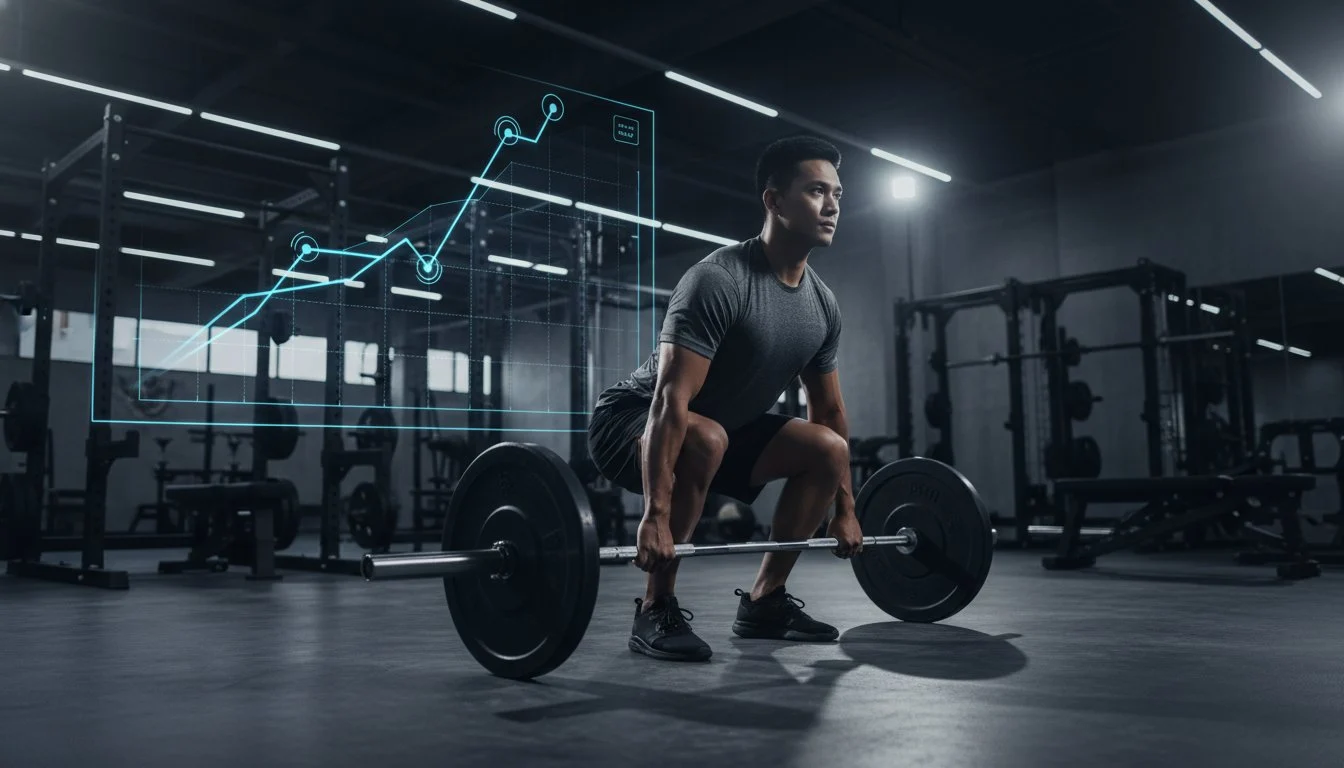
Your search for the best workout tracker ends here. This is your definitive guide to finding the perfect digital gym partner—one that logs your sets, tracks progressive overload, and visualizes your strength gains without the clutter. In a world of distracting social feeds and bloated interfaces, the most powerful tool is the one that gets out of your way and lets you lift.
Clutter kills momentum. The best workout tracker is the one that stays invisible until you need the data. It’s a silent partner in your pocket, built for one purpose: to ensure the work you put in today translates to a stronger you tomorrow. Forget endless scrolling and complicated setups. It’s time for a focused, data-driven approach to getting stronger.
Why Your Gym Progress Depends on a Data-Driven Workout Tracker
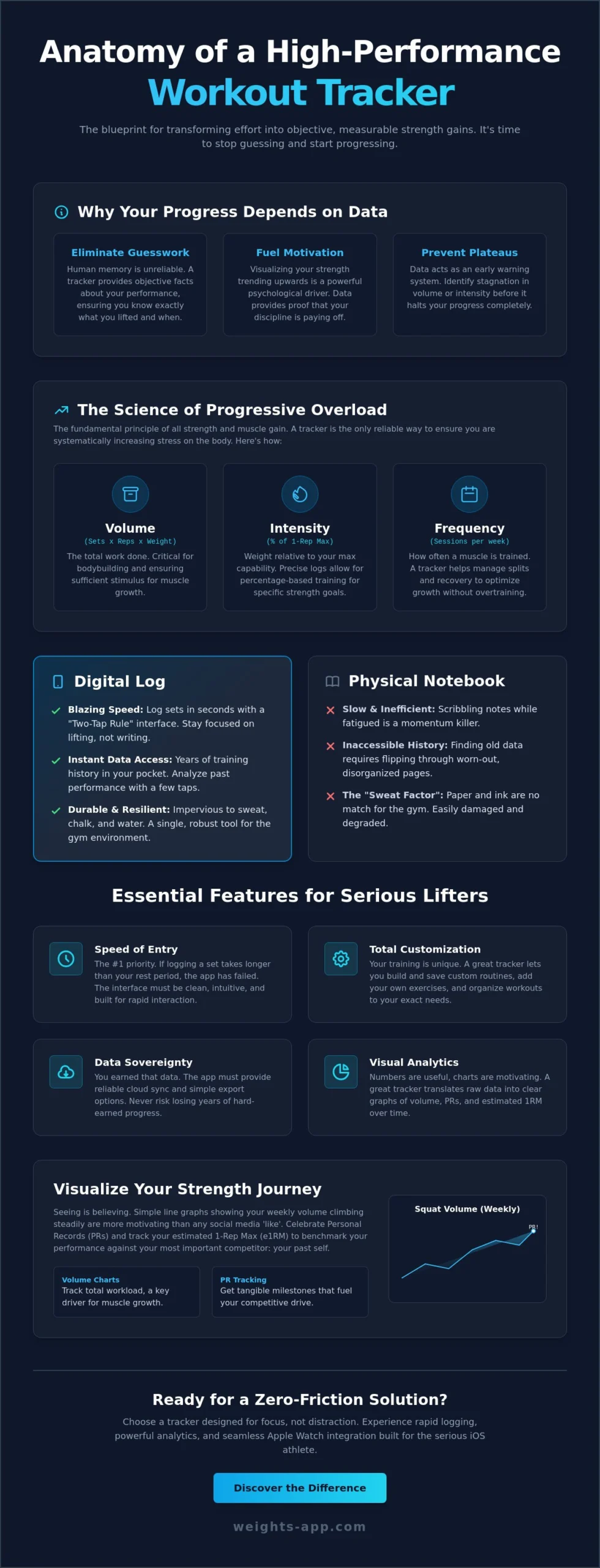
A workout tracker is more than a digital diary; it’s a tool for objective performance measurement. It transforms your training from a series of disconnected sessions into a calculated, forward-moving mission. The core philosophy is simple: Stop Guessing. Human memory is notoriously unreliable, especially in the middle of a grueling workout. Did you lift 225 for 5 reps last week, or was it 4? Was your total volume on squats higher or lower last month? Guesswork is the enemy of gains.
This is where data becomes your most valuable asset. A high-performance tracker provides clear, visual feedback on your progress. Seeing your strength trend upwards on a chart is one of the most powerful long-term motivators an athlete can have. It provides the proof that your discipline is paying off, fueling your drive to push harder. More importantly, it acts as an early warning system, helping you identify stagnation before it turns into a frustrating plateau.
The Science of Progressive Overload Tracking
Progressive overload is the gradual increase of stress placed upon the body during exercise. It’s the fundamental principle of all strength and muscle gain. To grow, your muscles must be forced to adapt to a tension they haven’t previously experienced. A workout tracker is the only reliable way to ensure this happens systematically. By logging every set and rep, you can precisely manipulate the key variables that drive hypertrophy:
- Volume: The total amount of weight lifted (sets x reps x weight). Tracking volume over time is critical for bodybuilding and ensuring you’re doing enough work to stimulate growth.
- Intensity: The amount of weight lifted relative to your maximum capability. Accurate logs allow you to program percentages of your one-rep max (1RM) for specific strength goals.
- Frequency: How often you train a muscle group. A tracker helps you manage your training split and recovery schedule to optimize frequency without overtraining.
Your 1RM is a vital metric for intelligent programming. While you may not test your true max often, a good tracker uses your recent performance to calculate an estimated 1RM (e1RM). This number becomes a powerful benchmark, guiding your weight selections for future workouts and ensuring you’re always lifting in a productive intensity range.
Digital Log vs. Physical Notebook
The old-school notebook has a certain romantic appeal, but it fails in the high-performance environment of a serious gym. A modern digital log is superior in every practical way.
- Speed: Tapping a screen to log a set takes seconds. Scribbling reps, weight, and notes with a pen while fatigued and breathing heavily is slow and inefficient. The best apps are designed for the “Two-Tap Rule”—log a set in two taps and get back to your workout.
- Data Accessibility: A digital log puts years of training history in your pocket. Want to see what you benched this time last year? It’s a few taps away. This historical context is impossible to manage with a stack of old, worn-out notebooks.
- The “Sweat Factor”: Paper and ink are no match for sweat, chalk, and the occasional spilled water bottle. A smartphone is a durable, single piece of equipment. A paper log is a fragile liability that degrades with every intense session.
Essential Features of a High-Performance Exercise Tracker
Not all trackers are created equal. While many apps boast massive exercise libraries or social communities, serious lifters have a different set of priorities. The features that truly matter are those that reduce friction and enhance focus.
- Speed of Entry: The single most important feature. If logging a set takes longer than your rest period, the app has failed. The interface should be clean, intuitive, and built for rapid interaction between heavy sets.
- Data Sovereignty: You earned that data. The best workout tracker gives you ownership of your history with reliable cloud sync (like iCloud) and simple data export options. You should never be at risk of losing years of progress if you switch devices.
- Visual Analytics: Numbers in a list are useful, but charts are motivating. A great tracker translates your raw data into clear, actionable visualizations—graphs that show your volume, intensity, and personal records trending in the right direction.
*Customization: Your training program is unique to your goals. A high-performance tracker must allow you to build and save custom routines, add your own exercises, and organize your workouts exactly as your program demands.
Visualizing Your Strength Level
Seeing your progress is the ultimate reward. Volume charts are particularly crucial for bodybuilders, as they provide a clear indicator of total workload—a key driver of muscle growth. A simple line graph showing your weekly squat volume climbing steadily upwards is more motivating than any social media “like.” Furthermore, the celebration of personal records (PRs) is a powerful psychological tool. Earning digital badges or seeing a “PR” icon next to a lift fuels the competitive drive and provides tangible milestones on your strength journey. This is about benchmarking your performance against your most important competitor: your past self. To truly understand where you stand, you need to benchmark your gym progress against objective standards.
Wearable Integration and Apple Watch Synergy
For the ultimate in-gym focus, wearable integration is a game-changer. An Apple Watch app allows you to leave your phone in your locker or bag, eliminating a major source of distraction. Logging sets, checking exercises, and managing rest timers directly from your wrist keeps you in the zone. Haptic feedback is a subtle but powerful feature; instead of staring at a clock, your watch can simply tap you when your rest period is over. This seamless synchronization between devices ensures your recovery is just as precise as your lifting.
Comparing the Top Workout Apps for Strength and Bodybuilding
The market is crowded, but a few key players stand out for serious lifters. Each has a different philosophy, catering to a different type of athlete.
- Hevy: The social giant. If you thrive on community engagement, sharing workouts, and getting “fist bumps” from friends, Hevy is a strong contender. Its massive exercise library and robust social features are its main draw, but the social feed can be a major distraction for those who prefer to focus.
- Strong: The established veteran. Strong has been a go-to for years, offering a deep feature set that appeals to data-loving lifters. It has a solid interface and a loyal user base, but its development has slowed and it lacks some of the modern, streamlined feel of newer apps.
- Weights App: The minimalist choice. Built for focused, distraction-free lifting, Weights prioritizes speed and clarity above all else. It strips away social feeds and unnecessary features, delivering a pure, performance-oriented experience for iOS athletes who just want to log their work and see their progress.
- JEFIT: The library-heavy option. JEFIT is often recommended for beginners due to its enormous database of exercises, complete with instructions and animations. While helpful for learning form, its interface can feel dated and cluttered for experienced lifters who already know their way around a gym.
Minimalist vs. Feature-Heavy Trackers
The central conflict in the world of workout trackers is “everything but the kitchen sink” versus “zero friction.” Feature-heavy apps try to be your all-in-one coach, social network, and exercise encyclopedia. Minimalist apps have a singular focus: to be the fastest, most reliable way to get data from your muscles into a log. The winner is always the lifter who spends more time lifting and less time scrolling. A simple, elegant interface respects your time and protects your focus, which are your most valuable resources during a workout. Ultimately, you must trust that your gym log is the truth, and a minimalist log makes recording that truth effortless.
Pricing Models: Subscription vs. Lifetime Purchase
Many lifters are experiencing “Subscription Fatigue.” The thought of another monthly charge for a tool you plan to use for years is unappealing. While subscriptions are the norm, some forward-thinking apps offer a lifetime purchase option. This is the “Gold Standard” for serious athletes. A one-time payment aligns the app’s success with your long-term satisfaction, not with its ability to keep you on a recurring payment plan. When evaluating an app’s value, consider the cost-per-workout over a 5-year period. A lifetime purchase often proves to be the most economical and psychologically rewarding investment in your training career. For those who want to own their progress outright, exploring a one time payment workout app is a smart financial move.
How to Choose Between Minimalist Logs and Social Fitness Platforms
The right choice depends entirely on your “Gym Persona.” Are you in the gym to socialize and share, or are you there to execute a plan with maximum efficiency? Be honest with yourself about what drives you and what distracts you.
- The “Distraction Tax”: Every notification, every scroll through a feed, every moment spent composing a post is time and mental energy stolen from your workout. A minimalist app eliminates this tax entirely.
- Privacy Concerns: Do you want your personal records, workout schedule, and progress photos broadcast to a network? Or is your training data a personal asset for your eyes only?
- The “Flow State” Argument: Elite performance happens in a state of deep focus, often called “flow.” A simple, non-intrusive interface helps you achieve and maintain this state. A busy, social interface actively works against it.
The Case for the Simple Gym Log
For the dedicated athlete, less is more. A simple log leads to better consistency because it removes all barriers to entry. When an app is lightning-fast and intuitive, you are far more likely to use it for every single set, every single workout. This unwavering consistency is what builds momentum and produces extraordinary results over time. An offline workout tracker further enhances this focus, ensuring a dropped Wi-Fi signal never interrupts your session. The goal is to make logging an automatic, thoughtless part of your routine, like racking your weights.
Data Reliability and iCloud Security
Your workout history is a priceless record of your hard work. The safest architecture for this data is a “local-first” approach with reliable cloud backup. This means your data lives on your device, ensuring it’s always fast and available, even without an internet connection. It then syncs seamlessly and securely to a private cloud service like Apple’s iCloud. This gives you the peace of mind that comes with knowing your history is safe, private, and protected from server outages or company shutdowns. When you secure your progress with iCloud Sync, you’re investing in the long-term integrity of your athletic journey.
Weights App: The Zero-Friction Solution for iOS Athletes
For the lifter who values focus, speed, and a clean aesthetic, Weights App is the definitive choice on iOS. It was built from the ground up by an independent developer who actually lifts, with a “No-Nonsense” philosophy at its core. It’s not trying to be a social network; it’s engineered to be the most efficient performance tool in your gym bag.
The experience is 100% native to iOS, making it fast, fluid, and deeply integrated with the Apple ecosystem, including Apple Health. Every screen, every button, and every animation is designed to be instantly understandable, allowing you to log your data and get back under the bar. With flexible pricing—including Monthly, Annual, and the highly-coveted Lifetime Pro access—it respects your wallet as much as it respects your time.
Custom Routines and Visual History
Weights App allows you to build a precise blueprint for your gains. You can create unlimited custom routines, add any exercise you can imagine, and organize your training days exactly how you want them. Before each session, a quick glance at your exercise history shows you exactly what you lifted last time, giving you a clear target to beat. After the workout, the satisfaction of seeing a “Green Trend” on your volume and strength charts provides the objective validation that you are, without a doubt, getting stronger.
Start Your Data-Driven Journey Today
The time for guessing is over. The path to your next personal record is paved with accurate, consistent data. Take the first step toward a more intelligent and effective training process. Stop leaving your progress to chance and start logging with purpose.
Download Weights App and Start Your Minimalist Log Now
Frequently Asked Questions (FAQ)
What is the best workout tracker for someone who hates social media features?
The best choice is a minimalist tracker like Weights App, which is specifically designed without social feeds, likes, or friend requests to provide a distraction-free logging experience focused purely on your personal performance.
Can I use a workout tracker app without an internet connection?
Yes, high-quality apps with a “local-first” data model, such as Weights App, allow you to log your entire workout offline. Your data is stored on your device and syncs to the cloud later when you have a connection.
How does a workout tracker help with progressive overload?
A tracker helps by recording every set, rep, and weight you lift. This data allows you to see exactly what you did in previous sessions, making it easy to plan for a small, incremental increase in weight, reps, or sets for your next workout to ensure you’re consistently challenging your muscles.
Is it better to track workouts on an Apple Watch or an iPhone?
It depends on your preference for focus. Tracking on an Apple Watch is excellent for minimizing distractions, as it allows you to leave your phone in your bag. An iPhone offers a larger screen for viewing detailed history and charts, but presents a higher risk of distraction from other apps and notifications.
Are free workout tracker apps actually worth using?
Free apps can be a good starting point, but they often come with significant limitations, such as a cap on how many routines you can save, intrusive ads that disrupt your workout, or a lack of advanced analytics. Serious lifters usually find that a premium app is a worthwhile investment for its superior features and focus-oriented design.
Do I need to pay for a subscription to track my gym progress effectively?
Not necessarily. While many top apps use a subscription model, some, like Weights App, offer a one-time lifetime purchase option. This allows you to get all premium features for a single payment, which can be more cost-effective and desirable for long-term users.
How do I export my data from a workout tracker app?
The best tracker apps prioritize data ownership. They typically include a function in the settings menu to export your entire workout history as a CSV file or another common format, which you can then save to your computer or cloud storage for backup and analysis.
What features should I look for in a strength training log?
Look for speed of entry, the ability to create and save custom routines, clear charts for visualizing progress (especially volume and 1RM), reliable cloud sync (like iCloud), and an Apple Watch app for distraction-free logging.
Ready To Get Started?
Everything you need. Nothing you don’t.
Weights adapts to your goals today and scales with the strength you’ll have tomorrow.