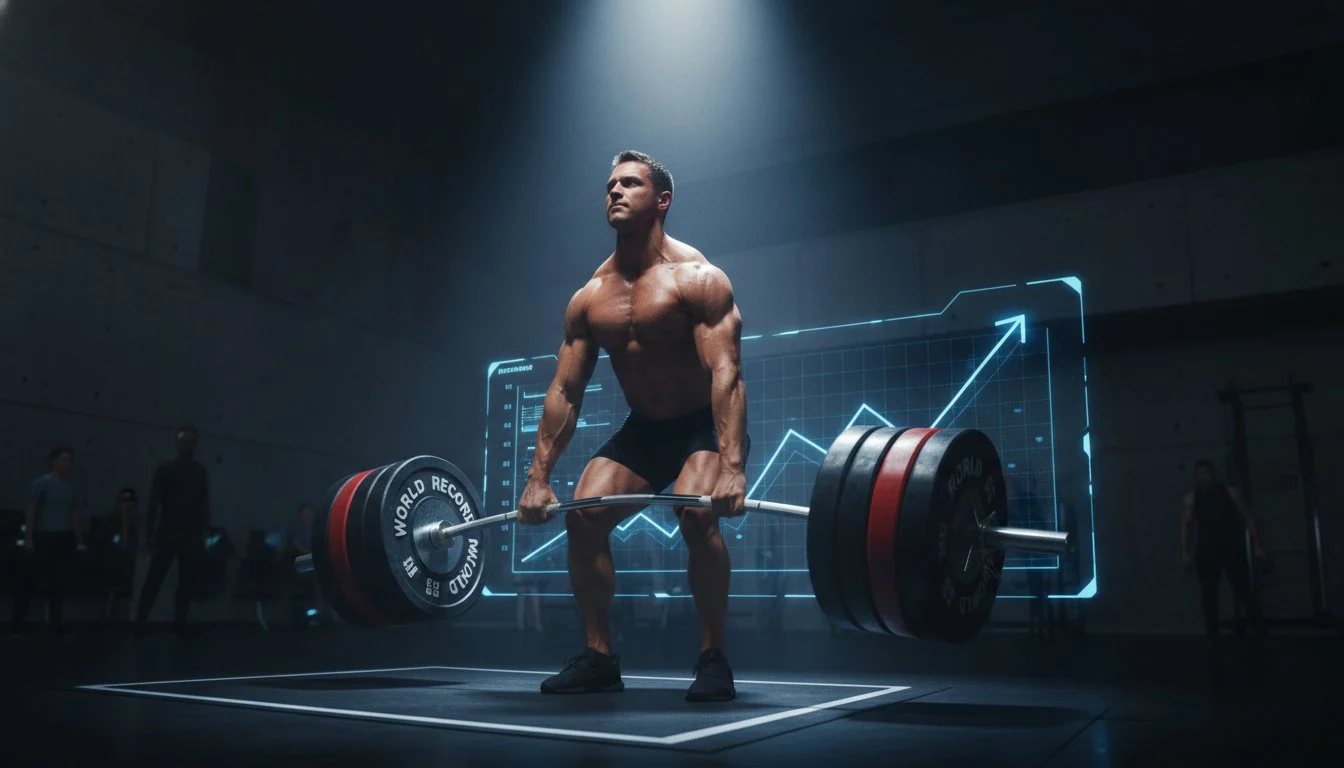
Lifting 510kg isn’t just a display of raw grit; it’s a calculated engineering feat that redefined human limits in 2025. You understand that every plate added to the bar represents a battle against physics and your own central nervous system. It’s frustrating when the search for a definitive deadlift world record leads to a mess of conflicting federation rules and confusing gear terminology. You want clarity on what’s actually possible and the technical edge to get there yourself.
This article delivers the precise data behind the world’s heaviest pulls while stripping away the friction of inconsistent record-keeping. You’ll gain a clear understanding of current benchmarks, from Hafþór Björnsson’s massive 510kg equipped lift to Lucy Underdown’s 325kg strongwoman standard. We’ll break down the specific equipment allowed in elite circles and provide the motivational blueprint to track your own path to a new personal best. Focus on the numbers that matter and start your evolution today.
Key Takeaways
- Master the elite landscape by distinguishing between strongman absolute records and raw powerlifting benchmarks.
- Unpack the technical science behind the deadlift world record, including the impact of bar whip and suit elasticity on pull speed.
- Optimize training volume with periodization strategies that prevent burnout while pushing your central nervous system to new peaks.
- Build a bulletproof lockout by targeting specific accessory movements designed to strengthen the glutes and lats under extreme tension.
- Upgrade tracking from simple notebooks to visual performance data to see your progress curve and predict your next personal best.
The Current Deadlift World Records: Who Holds the Crown in 2026?
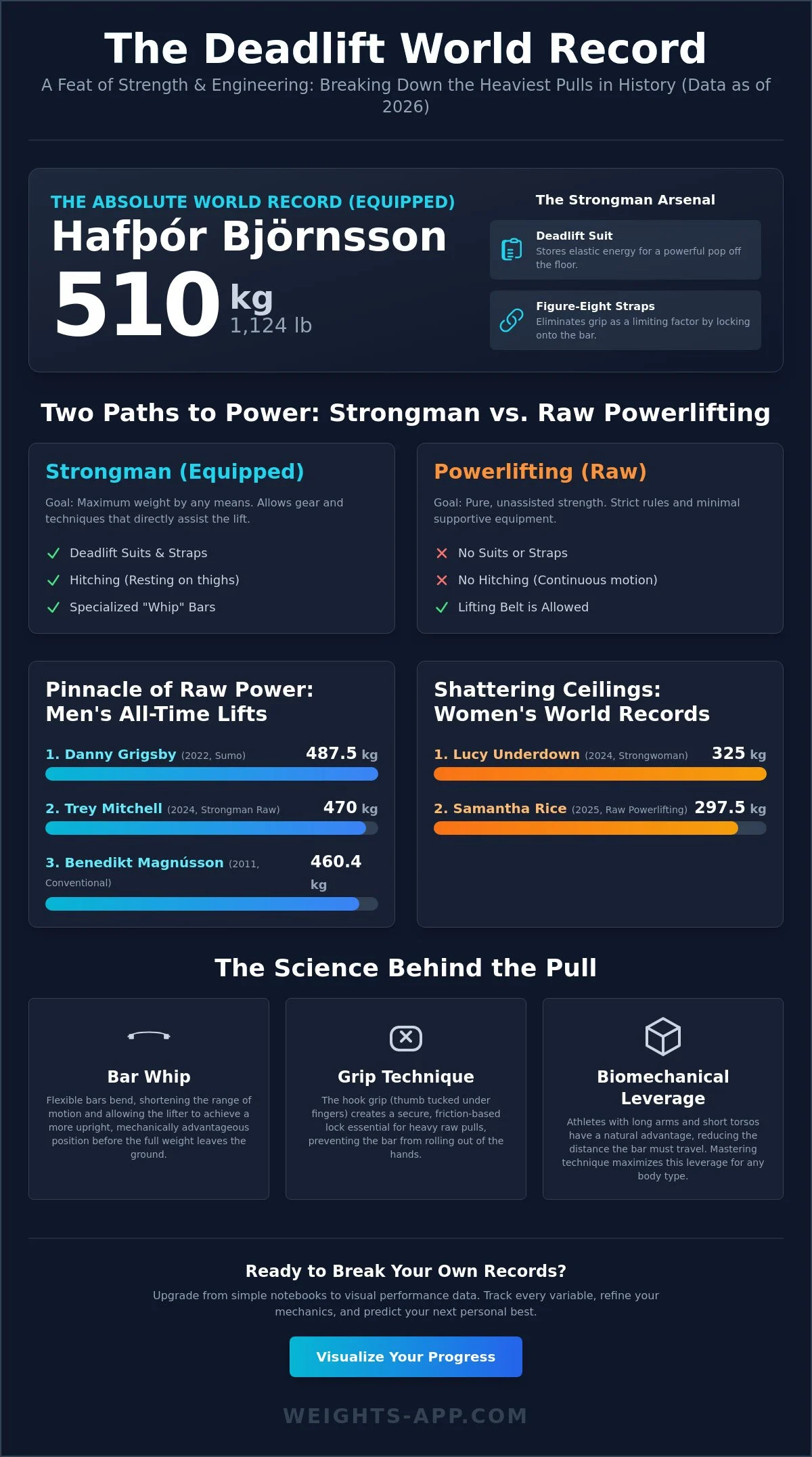
Human strength reached a staggering new peak in 2025. Hafþór Björnsson reclaimed his dominance by pulling a massive 510kg (1,124 lb), setting the definitive deadlift world record for equipped lifting. This feat didn’t happen in a vacuum. It’s the result of a decade-long arms race that began when Eddie Hall first cracked the 500kg barrier in 2016. Today, the elite landscape is split between those who use supportive gear and those who rely on pure, unassisted power. Understanding these distinctions is the first step toward mastering your own performance data.
Strongman vs. Powerlifting: Defining the “Absolute” Record
The rules define the result. In Strongman, the goal is total poundage by any means necessary. Athletes use figure-eight straps to lock their grip to the bar and are permitted to “hitch” or rest the bar on their thighs during the ascent. Many of these records occur on the Elephant Bar at the Arnold Classic. This specialized bar is longer and creates more whip, allowing the plates to stay on the floor longer while the athlete reaches a more advantageous mechanical position. The Progression of the Deadlift World Record reveals that Björnsson’s 510kg pull and his previous 501kg gym lift have set a standard that traditional powerlifting cannot match due to stricter equipment bans. Powerlifting requires a single, continuous motion with no straps and no hitching.
The Raw Deadlift: Pure Human Power
Raw lifting is the ultimate test of biological force. In 2026 standards, “Raw” typically means using only a lifting belt, though some federations allow knee sleeves. There are no suits to provide elastic assistance and no straps to compensate for grip fatigue. The equipment matters here too. Most raw records are set on a deadlift bar, which is thinner and more flexible than a stiff competition bar. This flexibility allows the center of the bar to rise before the full weight leaves the floor. The current top three heaviest raw pulls include:
- Danny Grigsby: 487.5 kg (1,075 lb) using a sumo stance in 2022.
- Trey Mitchell: 470 kg (1,036 lb) in a 2024 Strongman Raw category.
- Benedikt Magnússon: 460.4 kg (1,015 lb) conventional pull from 2011.
Women’s strength sports are seeing even faster progression. Lucy Underdown shattered expectations in September 2024 with a 325kg (716 lb) strongwoman pull. On the powerlifting side, Samantha Rice moved 297.5kg (655.9 lb) in December 2025. These athletes don’t just lift; they analyze. They use technical precision to turn every training session into a data point. Whether you’re chasing a 500kg milestone or your first 100kg pull, the logic is the same. Track the variables, refine the mechanics, and move the weight.
The Mechanics of a World Record: Gear, Grip, and Grit
The deadlift looks like a simple test of “pick it up and put it down,” but at the elite level, it’s a complex game of physics and engineering. To chase a deadlift world record, athletes must master the interplay between gear, biology, and timing. It’s not just about raw power. It’s about exploiting every millimeter of leverage and understanding how different equipment changes the lift’s difficulty profile. Every record-breaking pull is a masterpiece of technical precision.
Standard Olympic bars are stiff and unyielding. Deadlift bars, however, are designed to flex. This “bar whip” occurs when the center of the bar rises while the plates stay pinned to the floor. This flex shortens the total range of motion. It allows the lifter to reach a more upright, mechanically advantageous position before the full weight leaves the ground. Mastering this whip is what separates a 400kg puller from a 500kg legend.
Supportive equipment adds another layer of complexity. Multi-ply deadlift suits act like a loaded spring. These suits are so tight they often require two people to help the athlete into them. At the bottom of the movement, the compressed fabric stores massive amounts of elastic energy. This provides a vital “pop” off the floor, helping the lifter blast through the hardest part of the movement. Without this gear, the absolute numbers would be significantly lower.
Grip is often the first point of failure. While strongmen use figure-eight straps to lock themselves to the bar, powerlifters rely on the hook grip or a mixed grip. The hook grip involves tucking the thumb under the fingers, creating a friction-based lock that prevents the bar from rolling. It’s painful, but it’s the gold standard for heavy raw pulls. When combined with long arms and a short torso, these technical choices create the perfect environment for a record-breaking performance.
The Elephant Bar Controversy
The Rogue Elephant Bar remains a polarizing tool in strength sports. Critics argue it’s “easier” because its 9.5-foot length creates extreme oscillation, allowing the lifter to be nearly at lockout before the outer plates leave the ground. Supporters argue the resulting vibration makes the bar much harder to stabilize at the top. The Rogue Elephant Bar is a 9.5-foot long specialty barbell with a weight capacity exceeding 1,000 pounds and a unique shaft diameter that maximizes vertical whip. Timing the pull with the bar’s natural rhythm is a skill that only the strongest athletes master.
Conventional vs. Sumo: The Efficiency Debate
The Current Deadlift World Record holders in the absolute category almost exclusively pull conventional. This style is back-dominant and requires massive spinal erector strength to succeed. Sumo, while often criticized as “cheating,” is a hip-dominant movement that reduces the distance the bar travels by widening the stance. Data shows sumo is technically more efficient for lifters with specific hip anatomy, but it rarely produces the 500kg+ numbers seen in conventional strongman pulls. Both styles require immense discipline to perfect.
Understanding these mechanics is vital for your own progress. If you want to see how your leverages affect your strength curve over time, you can track your lift data with professional precision. Focus on the data, and the results will follow.
Breaking the 500kg Barrier: A Trend Analysis of Human Strength
The 400kg deadlift used to be the absolute ceiling. For decades, it was the ultimate test of human capability that few dared to challenge. Then, the data changed. The deadlift world record stopped being a static number and became a moving target. In 2016, Eddie Hall didn’t just lift a half-ton; he shattered the collective belief of what the human spine could endure. This breakthrough triggered a decade of rapid evolution in strength sports, moving us from the era of “strongmen” to the era of “strength engineers.”
The Exponential Growth of Strength
In the 20 years leading up to 2026, the rate of progress has accelerated at an unprecedented pace. We moved from Andy Bolton’s 457.5kg in 2009 to the current 510kg standard. This isn’t just about better genetics. It’s about a technological shift in how we measure force production and central nervous system fatigue. Modern athletes use force plates and high-speed motion capture to optimize every rep. This creates a “sub-4 minute mile” effect in the gym. Once the 500kg barrier fell, the psychological ceiling vanished. Now, elite lifters don’t ask if it can be done. They ask how quickly they can adapt their biology to meet the demand.
Lessons from the 500kg Pull
Success at this level requires more than just grit. Eddie Hall and Hafþór Björnsson revolutionized their preparation by treating their bodies like high-performance machines. They moved away from traditional “ego lifting” and embraced strict progressive overload to ensure consistent, measurable gains. This methodical approach allows for higher volume without the risk of catastrophic injury. In the context of a world record attempt, peak intensity is the precise moment where neurological drive and muscular recruitment reach 100% capacity under a maximal load. It’s a state that takes months of data-driven peaking to achieve and only seconds to execute.
Modern records rely on more than just the gym floor. Specialized nutrition and recovery protocols, such as hyperbaric therapy and precision macronutrient timing, allow athletes to train at higher frequencies. A biomechanical analysis of deadlift techniques shows that even minor adjustments in hip height or foot angle can be the difference between a failed lift and a new world standard. Athletes in 2026 use this scientific data to shave milliseconds off their pull speed and optimize their leverages. The path to 520kg is already being mapped out through data, one kilogram at a time.
From World Records to Personal Records: Training Strategy
You don’t need to be Hafþór Björnsson to train like a scientist. While the deadlift world record involves extreme genetics and specialized gear, the underlying principles of strength remain constant. Success is built on structure, not just sweat. If you pull at 100% every week, you aren’t training; you’re just testing. This leads to stagnation and injury. Elite performance requires a calculated approach to volume, intensity, and recovery.
The mental game is just as technical as the physical one. Elite lifters visualize the pull before their hands touch the knurling. They see the lockout. They feel the tension in their hamstrings. This mental rehearsal primes the motor units for maximal recruitment. Combine this with technical precision, and you create a blueprint for consistent gains. Stop guessing and start pulling with intent.
The Hierarchy of Deadlift Progress
Mastering the pull happens in stages. You can’t skip the foundation if you want to reach the peak. Follow this data-driven path to your next PR:
- Step 1: Form mastery. Bracing is everything. Learn to create internal pressure to protect your spine and transfer force efficiently.
- Step 2: Consistent volume. Hypertrophy builds the engine. Use sub-maximal loads to build the muscular endurance needed for heavy blocks.
- Step 3: Intensity blocks. This is where you test your one rep max using structured peaking cycles.
Accessory Lifts for a Monster Pull
Don’t just deadlift to improve your deadlift. Use specific variations to attack your weak points. Deficit deadlifts are essential for building speed off the floor by increasing the range of motion. Rack pulls allow you to overload the lockout and build a thick upper back without the fatigue of a full pull. For leg drive, Bulgarian Split Squats are the secret weapon for unilateral stability and quad strength. These movements turn your weaknesses into your greatest assets.
Ready to see your strength curve climb? Track your evolution and crush your limits when you upgrade to Weights Pro today.
Visualize Your Progress: The Data Behind Your Personal Records
Memory is a poor coach. If you’re serious about adopting a deadlift world record mindset, you need more than a crumpled notebook or a basic notes app. Paper logs are static. They don’t show you the velocity of your progress or the hidden fatigue patterns in your training cycle. You need a digital engine that transforms raw numbers into actionable intelligence. Precision is the difference between a frustrating plateau and a massive breakthrough.
Visual data is a psychological weapon. Seeing a 12-month strength curve provides a level of confidence that a single high-intensity rep cannot match. Weights Pro analyzes your past performance to forecast your future capacity. It uses your historical volume and intensity data to predict when you’re ready for a new personal best. This removes the guesswork from your peaking phase. You’ll know you have the strength to lock out the lift before you even step onto the platform.
Friction is the enemy of consistency. You shouldn’t spend more time looking at your phone than you do gripping the bar. Logging your sets should take seconds, not minutes. By eliminating the clutter of traditional tracking methods, you stay in the zone. Modern lifting is about efficiency. The faster you can record your data, the sooner you can focus on the next heavy pull. Momentum is everything in the gym.
Tracking Every Plate with Weights Pro
Tracking every plate should be a seamless experience. Weights Pro allows you to build custom routines tailored to your specific technique, whether you’re perfecting a wide-stance sumo or a narrow conventional pull. Your data stays secure and accessible across your devices with automatic iCloud sync. The interface is built specifically for the gym floor. It’s a minimalist, high-speed UI that stays out of your way during your heaviest sets. No distractions. No friction. Just pure performance tracking.
The Path to Your Own World Record
Your journey toward elite strength is built on a series of small, measurable wins. You might not be chasing a 510kg deadlift world record yet, but your personal records deserve the same level of technical scrutiny. Setting realistic milestones is easier when you can see your progress mapped out on a clear, visual roadmap. These charts turn boring spreadsheets into a motivational engine that keeps you hungry for the next plate. Whether you choose Weights Pro Monthly, Yearly, or Lifetime, you’re investing in a system that values your time and your results.
Ready to crush your next PR? Start tracking with Weights app.
Own Your Strength Evolution
The 510kg mark stands as the current peak of human capability. You’ve seen how the deadlift world record evolved from a static psychological barrier into a data-driven engineering feat. Success at this level requires more than just grit; it demands technical precision, smart periodization, and the right tools to monitor every training variable. Don’t leave your gains to chance or messy notebooks that fail to show the big picture.
Efficiency is the core of elite performance. You need a system that matches your intensity without adding friction to your session. Weights app delivers a no-nonsense minimalist design built specifically for iOS power users who value speed and clarity. You get detailed progress visualization that turns raw workout numbers into a clear, motivational roadmap for your next breakthrough. It’s time to stop guessing and start pulling with professional intent.
Log your next PR on Weights app to take absolute control of your training data. Every plate counts and every rep is a vital data point in your evolution. Build the momentum you need to crush your limits. Your next personal best is waiting for the right strategy.
Frequently Asked Questions
Who holds the absolute deadlift world record in 2026?
Hafþór Júlíus Björnsson holds the absolute deadlift world record with a massive 510kg (1,124 lb) pull achieved in 2025. This lift surpassed his own previous 501kg mark and solidified his position as the strongest deadlifter in history. It was performed under strongman rules, which allow for the use of a deadlift suit and figure-eight straps to maximize force production. This benchmark represents the highest weight ever moved from the floor to a locked-out position by a human.
Is the 501kg deadlift by Thor Björnsson considered a “real” world record?
Yes, the 501kg lift is recognized as the definitive breakthrough that moved the sport past the Eddie Hall era. While it was performed in a private gym during 2020, it was overseen by official referees and broadcast globally under strict conditions. It served as the technical blueprint for his later 510kg pull. While some purists prefer competition-setting lifts, the strength community accepts these marks as legitimate displays of absolute human power.
What is the difference between a raw and equipped deadlift record?
Equipped records allow supportive gear like multi-ply suits and straps to maximize the weight moved. These tools provide elastic assistance off the floor and eliminate grip as a limiting factor. Raw records are performed with minimal assistance, usually just a lifting belt. In powerlifting, “raw” means no suits or straps are permitted, making the lift a pure test of unassisted muscular force and manual grip strength.
How much weight can a human actually deadlift? Is there a limit?
The theoretical limit is still being tested as sports science and recovery protocols evolve. Experts once believed 500kg was the human ceiling, but recent 510kg pulls proved that threshold was largely psychological. Continued improvements in biomechanical analysis and data tracking suggest that 520kg or higher may be possible. The ultimate limit is determined by the structural integrity of the human skeleton and the capacity of the central nervous system to recruit motor units under extreme load.
Why do strongmen use straps for their world record pulls?
Strongman competitions prioritize total weight moved over grip endurance. Straps allow the athlete to focus entirely on the power generated by the posterior chain without the bar slipping. This ensures the deadlift world record is a true test of the legs and back. In contrast, powerlifting forbids straps, requiring the athlete to maintain a manual hold on the bar throughout the entire range of motion, which significantly lowers the total weight possible.
What kind of barbell is used for deadlift world records?
Most absolute records use a specialized deadlift bar or the Rogue Elephant Bar. These bars are longer and more flexible than standard stiff competition bars. This flexibility creates “whip,” allowing the center of the bar to rise higher before the plates leave the floor. This reduced range of motion and improved starting position are critical for moving loads exceeding 500kg. Using the right bar is a technical requirement for elite performance.
How can I calculate my own deadlift potential based on my current lifts?
You can estimate your potential by analyzing your current one-rep max (1RM) and your rate of progress over time. Use a one rep max calculator to project your max based on sub-maximal sets using proven formulas like Brzycki or Epley. Tracking these trends digitally helps you identify the exact moment your central nervous system is ready for a new peak without risking injury.
Does the Sumo deadlift count for world records?
Sumo deadlifts count for world records within powerlifting federations but are generally banned in strongman absolute record attempts. Powerlifting allows both conventional and sumo styles because they are both valid ways to move the weight from floor to lockout. Strongman traditionally mandates a conventional stance to test the specific spinal and hip mechanics associated with the sport’s history. Both styles require immense technical precision to master at a high level.
Ready To Get Started?
Everything you need. Nothing you don’t.
Weights adapts to your goals today and scales with the strength you’ll have tomorrow.