
Your max effort isn’t a trophy. It is the raw data point that dictates every single set you perform. Most lifters treat the 1RM as a vanity metric, yet they’re often terrified of actually testing it. You’ve likely felt that hesitation under a heavy bar or felt lost trying to calculate 85% of a number you haven’t hit in months. Guesswork is the enemy of progress. Using a precision one rep max calculator changes the game. It replaces fear with data and confusion with a clear roadmap for growth.
We know you want results without the risk of injury. You are here to master your training intensity and track your strength evolution using data-driven insights. This guide provides the framework you need for consistent progressive overload. We are breaking down the science behind the Brzycki and Epley formulas, how to estimate your strength safely using the three to eight rep range, and the best methods to track your gains over time. It’s time to turn your raw effort into measurable power.
Key Takeaways
- Define your absolute strength baseline. Use the 1RM benchmark to anchor your entire training program for maximum efficiency.
- Estimate your capacity safely. Input your sub-maximal lifts into a one rep max calculator to get an accurate strength profile without the risk of failure.
- Execute with technical precision. Follow a no-nonsense testing protocol that focuses on form over ego to ensure long-term lifting health.
- Optimize your training intensity. Use 1RM data to calculate exact percentages for hypertrophy or strength phases, removing all guesswork from your load management.
- Visualize your evolution. Turn every logged set into a clear chart of progress using the streamlined interface of Weights Pro.
Defining Your One Rep Maximum: The Gold Standard of Strength
Your One-repetition maximum is the ultimate benchmark for absolute strength. It represents the absolute ceiling of your physical capacity in a specific movement. If you want to know exactly what your body can handle, this is the metric that matters. It isn’t just a number for your ego. It is the foundational data point used to calibrate every training session you perform. Without an accurate 1RM, you are essentially training in the dark.
Testing your max is critical across all strength disciplines. Powerlifters use it to measure competitive readiness. Bodybuilders use it to ensure they are hitting the specific intensity zones required for muscle growth. Even general fitness enthusiasts need it to benchmark their progress against standardized strength levels. It provides a clear, objective answer to the question: “Am I getting stronger?”
Directly testing a true max can be dangerous and exhausting. That’s why smart athletes rely on an “estimated 1RM” (e1RM). By using a one rep max calculator, you can input your performance from a heavy set of three to eight reps to predict your top-end strength. This data-backed alternative provides the precision you need without the high risk of a technical breakdown under a maximal load. You get the insights. You skip the injury.
Absolute Strength vs. Relative Strength
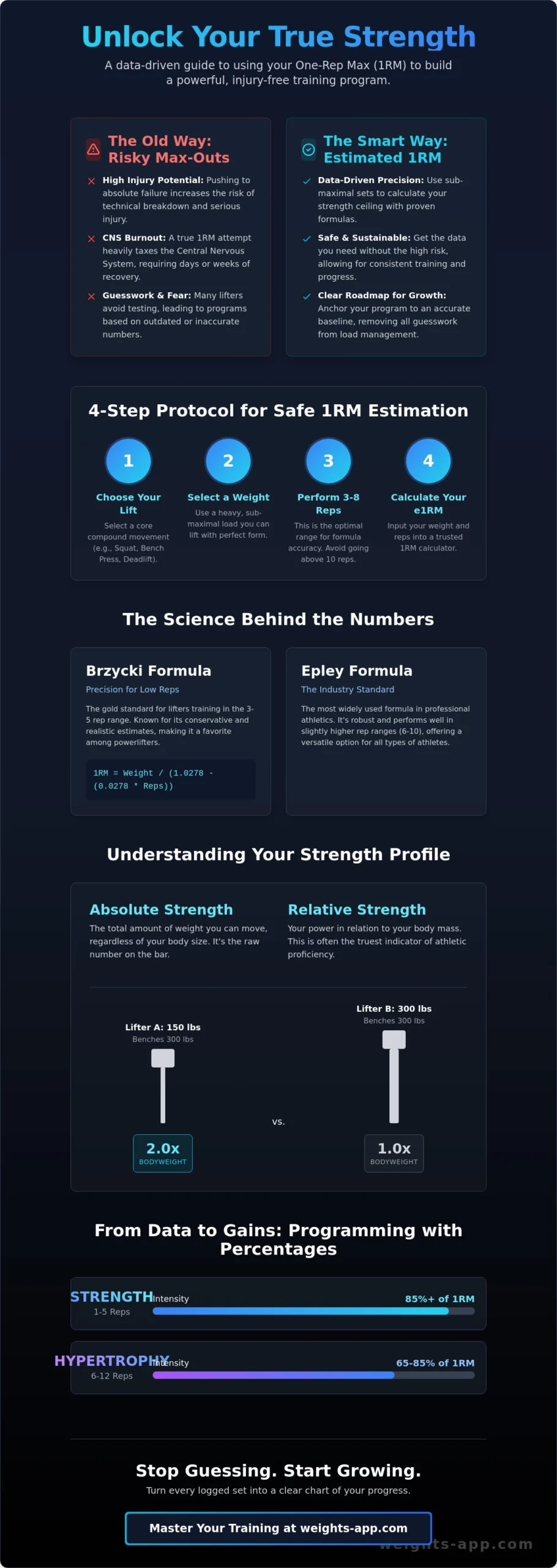
Absolute strength is the total amount of weight you can move, regardless of your size. It’s the raw number on the bar. Relative strength is different. It measures your power in relation to your body mass. This is the true indicator of athletic proficiency for most gym-goers. A 150-pound lifter who can bench press 300 pounds has a 2.0x bodyweight ratio, demonstrating superior relative strength compared to a 300-pound lifter moving the same weight. Tracking both metrics ensures your gains are functional, not just heavy.
The Role of the Central Nervous System
A true 1RM attempt taxes your Central Nervous System (CNS) far more than a standard set. It isn’t just about muscular fatigue; it’s about your brain’s ability to recruit every available motor unit simultaneously. This high-intensity effort requires a significant recovery window, often lasting several days or even weeks before you can perform at peak levels again. Precision tools like the ones found at Weights Pro help you avoid CNS burnout. By using sub-maximal data to calculate your limits, you keep your nervous system fresh while maintaining a clear trajectory for your progressive overload.
How the One Rep Max Calculator Works: Brzycki vs. Epley Formulas
Stop guessing. Start calculating. You don’t need to load every plate in the gym to find your limit. Sub-maximal testing uses the proven relationship between load and fatigue to project your absolute capacity. By pushing a heavy but manageable weight for several reps, you provide the data points needed to map your strength ceiling. It’s a “test without the mess” approach. You avoid the physical toll of a failed max attempt while gaining the precision required for elite programming.
Accuracy is the priority. Research confirms that these formulas are most reliable when you stay under 10 repetitions. Ideally, you should test in the three to eight rep range. Once you cross the double-digit threshold, a mathematical “decay” sets in. Factors like muscular endurance and individual muscle fiber composition begin to skew the results. A one rep max calculator is a precision tool, but it requires high-quality, high-intensity input to deliver a valid output. Garbage data in means garbage data out.
Using these metrics allows you to pivot your training based on real-time performance. If you’re hitting new rep PRs in your working sets, your estimated max is climbing. You can track these strength shifts automatically to ensure your training percentages stay aggressive and effective.
The Brzycki Formula: Precision for Low Reps
Matt Brzycki developed this equation to prioritize heavy, low-rep sets. It’s the gold standard for lifters who live in the three to five rep range. The math is straightforward: 1RM = Weight / (1.0278 – (0.0278 * Reps)). Because it’s more conservative, many powerlifters prefer Brzycki for its “real-world” accuracy. It doesn’t inflate your ego; it gives you a number you can actually hit on the platform.
The Epley Formula: The Industry Standard
Boyd Epley, the founder of the NSCA, created what is now the most widely used formula in professional athletics. It’s robust and handles slightly higher rep ranges (6-10) better than most alternatives. The calculation is simple: 1RM = Weight * (1 + (Reps / 30)). When you compare the two, Epley often yields a slightly higher estimate for higher-rep sets. It’s the ideal choice for athletes focusing on a mix of hypertrophy and explosive power. Choose the formula that aligns with your current training block to maintain data integrity.
Step-by-Step Guide: How to Calculate Your 1RM Without Injury
Get in. Test. Get out. Efficiency is the only priority when measuring your top-end capacity. You don’t need a three-hour session to find your limits. A no-nonsense approach means you warm up with intent, execute your heavy set, log the data, and move on. Ego has no place here. If you prioritize the number on the bar over the quality of the movement, you’ve already lost. Technical proficiency is your primary safeguard against the injuries that sideline most lifters.
Adopt the “Technical Failure” rule immediately. Your set ends the moment your form breaks, not when the bar stops moving. If your hips rise too fast in the squat or your back rounds during a deadlift, the rep doesn’t count. Testing for a 1RM is about finding your true capacity, not seeing how much weight you can move with ugly mechanics. Stick to big compound movements for these tests. The squat, bench press, and deadlift are the gold standards because they recruit the most muscle mass and provide the most reliable data for your overall strength profile.
The Sub-Maximal Testing Protocol
- Step 1: Choose a weight you can lift for 3-6 reps with perfect form. This weight should feel heavy but manageable. It should represent roughly 85% of what you think your max might be.
- Step 2: Perform the set with maximum intent. Every rep must be explosive on the concentric (upward) phase. Stop the set as soon as you feel your technique start to waver.
- Step 3: Input your weight and reps into the one rep max calculator. The algorithm will handle the math, giving you a precise estimate without the systemic fatigue of a true maximal effort.
Safety Checklist for Heavy Sessions
Never test your limits without a plan. If you are benching or squatting, use a spotter or set the safety pins in the power rack. These are non-negotiable tools for high-intensity training. A one rep max calculator reduces the need for frequent max-effort attempts, but when you do go heavy, the environment must be controlled. Zero friction. Zero excuses.
Mental preparation is just as vital as physical safety. Stop focusing on the total weight. Focus on the cue. Whether it’s “drive the floor away” for deadlifts or “bend the bar” for bench, specific cues keep your CNS focused on execution. When you eliminate the distraction of the heavy load, your body performs more efficiently. Professional strength programming is built on this foundation of logic and measurable results.
Beyond the Number: How to Use 1RM for Progressive Overload
Data is useless without a plan. Knowing your max is step one. Step two is putting that number to work. Professional strength programming relies on percentage-based training to ensure every rep has a purpose. If you’re chasing muscle growth, aim for the hypertrophy zone of 70-85% of your 1RM. To build raw power, push into the 85% and above range. This isn’t guesswork. It’s a systematic approach to load management. Even when looking at the Deadlift World Record: The Evolution of Human Strength and Performance for inspiration, remember that elite athletes start by mastering these specific intensity zones.
Strength fluctuates based on sleep, nutrition, and stress. Your 1RM today might not be your 1RM tomorrow. Auto-regulation allows you to adjust your load based on daily performance. If a sub-maximal warm-up set feels exceptionally light, use a one rep max calculator to update your training intensity on the fly. This keeps you in the optimal stimulus zone without overtraining. Stop relying on intuition. Upgrade to Weights Pro and turn your 1RM data into a foolproof training plan.
Programming Your Weekly Blocks
Structure your 4-week cycle with intent. Start week one at a conservative 70% of your max. Move to 75% in week two and 80% in week three to build momentum. The fourth week is your deload. Drop your intensity to 50-60% of your max to allow your central nervous system to fully recover. You can simplify this entire process by using an exercise tracking app to automate your percentages. It removes the friction of manual math so you can focus on the bar.
Predicting Your Next Personal Record
Data predicts the future. You don’t need to max out every week to know you’re getting stronger. Incremental gains in your working sets tell the story. A 5lb increase in a heavy 5-rep set shifts your estimated 1RM by nearly 6lbs, signaling a successful training block. This provides a massive psychological benefit. You step up to the platform with the confidence that the weight is already yours because the numbers have already confirmed it. Logic beats luck every time. Pairing your 1RM data with a dedicated exercise tracker app ensures every incremental gain is captured and converted into smarter programming decisions.
Master Your Progress: Visualizing Strength Gains with Weights Pro
Execution is everything. You’ve mastered the science behind the one rep max calculator and learned how to structure your training blocks. Now you need a command center to manage that data without the clutter of traditional fitness apps. Weights Pro is built specifically for the high-intensity environment of the gym floor. It is a streamlined utility designed to log every set with surgical precision. We’ve eliminated the social feeds and the wellness fluff. You get a professional-grade tool that respects your time and prioritizes your performance.
Visual charts turn your raw training numbers into a vivid strength trajectory. Seeing a line graph trend steadily upward provides a psychological edge that no motivational notification can match. This is the “Zero Friction” philosophy in action. You enter your reps. The app handles the historical analysis. Stop wrestling with tattered paper logs or complex spreadsheets that break on mobile. Embrace high-performance strength level tracking on iOS to ensure your data is always accessible and actionable.
Minimalist Tracking for Maximum Gains
Effective tracking requires focus. Weights Pro centers its entire experience around the three metrics that actually drive progress: weight, reps, and time. This minimalist interface ensures you stay in the zone between sets. You won’t find yourself scrolling through a feed when you should be preparing for your next heavy attempt. Every feature is engineered to remove resistance. Your entire 1RM history is secured via iCloud sync. Your data moves with you, ensuring your records are never lost. You can also build custom routines to test your one rep max calculator predictions across any movement, allowing you to track specialized strength gains in real-time.
The Weights Pro Advantage
Serious athletes demand superior tools. Weights Pro provides unlimited routines and advanced data visualization for lifters who want to analyze every trend in their performance. While we offer flexible options like Weights Pro Monthly and Weights Pro Yearly, the Weights Pro Lifetime purchase represents the ultimate value for dedicated lifters. It is a one-time commitment to your long-term growth. You gain a proactive partner in your training that values logic and measurable results over aesthetic clutter. Download Weights for iOS and start tracking your true strength today.
Calibrate Your Path to Power
Your training is only as effective as the data behind it. You’ve learned that defining your absolute ceiling is the first step toward professional-grade programming. By utilizing a one rep max calculator, you replace the danger of ego-lifting with the precision of mathematical formulas like Brzycki and Epley. This isn’t just about a single lift. It is about establishing the specific intensity zones that drive hypertrophy and raw strength.
Stop leaving your progress to chance. You need a streamlined tool that handles the data while you handle the iron. Weights Pro offers a minimalist design with zero ads, ensuring your focus remains on the workout. Turn your raw numbers into clarity with advanced visual progress charts and keep your history secure with built-in iCloud sync. It is time to outpace your yesterday.
Get Weights Pro for iOS and visualize your strength gains. The bar is waiting. Step up with the data to back your drive and watch your true strength evolve.
Frequently Asked Questions
Is a one rep max calculator accurate?
Accuracy depends entirely on your rep range. A one rep max calculator is highly reliable when your input data comes from a set of three to eight repetitions. Once you exceed ten reps, muscular endurance begins to skew the math and reduces the precision of the estimate. Stick to heavy, low-rep sets for the most valid results.
What is the best formula for calculating 1RM?
Use the formula that matches your specific training data. The Brzycki formula is superior for heavy sets under five reps because it is more conservative. The Epley formula is the industry standard for sets in the six to ten rep range. Choose the one that aligns with your most recent heavy set to ensure data integrity.
How often should I test my one rep max?
Limit your testing to once every eight to twelve weeks. True maximal efforts or high-intensity sub-maximal tests require significant recovery for your central nervous system. Testing at the end of a structured training block allows you to measure your progress without stalling your next phase due to systemic burnout.
Can I use a 1RM calculator for any exercise?
Prioritize compound movements for 1RM calculations. Squats, deadlifts, and presses provide the most actionable data for your programming. Using a one rep max calculator for isolation exercises like bicep curls or lateral raises is less effective. Technical failure often occurs too early in isolation moves to provide a valid strength estimate.
Why does my 1RM estimate change from day to day?
Daily readiness dictates your peak strength. Your 1RM estimate fluctuates based on sleep quality, nutritional status, and systemic stress levels. These shifts are a natural part of auto-regulation. Use these daily data points to adjust your training load and stay within your optimal intensity zones for that specific session.
Is it better to test a true 1RM or use a calculator?
Use a calculator for the vast majority of your training. It provides the precision you need with zero risk of a catastrophic miss or injury. Reserve true 1RM testing for powerlifting competitions or the final week of a peaking program where specific platform practice is a requirement.
How do I use my 1RM to build muscle?
Target the 70-85% intensity range for hypertrophy. Once you have your max, calculate the exact weight needed for sets of eight to twelve reps. This ensures you are providing enough stimulus to trigger muscle growth. It removes the guesswork that often leads to under-training or premature plateaus.
What is the difference between Brzycki and Epley formulas?
Mathematical structure is the main distinction. Brzycki uses a linear subtraction model that is generally more conservative for heavy lifters. Epley adds a percentage of the weight lifted back to the total. Brzycki usually predicts a slightly lower, more realistic number that is easier to hit on the gym floor.
Ready To Get Started?
Everything you need. Nothing you don’t.
Weights adapts to your goals today and scales with the strength you’ll have tomorrow.