The smartest AI coach on the planet is still second-best to your own drive and data. Most fitness tech focuses on flashy social feeds or automated plans that ignore your actual recovery needs. You’re likely tired of navigating cluttered interfaces that stall your momentum between heavy sets. You need a workout routine planner app that stays out of your way while providing the technical precision your training demands. It’s about stripping away the noise to focus on the iron.
We know the frustration of scrolling through endless menus just to log a single set of squats. You want clear visual proof of your muscle growth and long-term strength trends without the digital friction. This article shows you how to master your training in 2026 by choosing a tool built for pure efficiency. We’ll explore how to maximize your gains, cut down on gym time, and manage your routines with zero distractions. It’s time to stop fighting your phone and start crushing your PRs.
Key Takeaways
- Stop guessing and start tracking. Learn why a digital architect is essential for long-term strength gains and data-driven progress.
- Master the numbers that matter. Discover how to manage training volume and intensity using RPE and 1RM percentages for consistent overload.
- Reclaim control from “black box” algorithms. Understand why custom-built routines outperform generic AI plans and social-heavy distractions.
- Streamline your sessions with a high-performance workout routine planner app. Eliminate friction with a native iOS interface designed for speed and clarity.
- Build your ultimate training blueprint. Follow a five-step strategy to select compound movements and set a frequency that fits your lifestyle.
Why a Workout Routine Planner App is Your Most Valuable Gym Tool
Stop treating your training like a series of random events. Strength is built on precision. A workout routine planner app acts as your digital architect. It maps out your path to hypertrophy before you even touch a barbell. Without a structured plan, you are just exercising. With a plan, you are training. This shift in mindset is the difference between a plateau and a personal record. Your app should do more than just store numbers. It should eliminate the mental load of gym logistics.
Many modern apps try to replace your brain with “black box” AI. They promise to think for you. For the dedicated lifter, this is a mistake. Advanced training requires a deep understanding of the principles of strength training like specific periodization and exercise selection. You don’t need an algorithm to guess your fatigue levels. You need a high-performance tool that executes your specific strategy with zero friction. It is about data-driven mastery, not automated guesswork.
The Death of the Paper Gym Log
Physical notebooks are relics of a slower era. They fail in high-intensity environments. Sweaty palms smudge ink. Pages tear. Pens go missing. Beyond the physical hassle, paper is static. It won’t calculate your total weekly tonnage. It won’t show you a graph of your squat progress over six months. Transitioning your legacy data into a digital format allows for instant analysis. You can view your entire lifting history in seconds. This speed allows you to make informed adjustments to your intensity on the fly. Digital tracking provides the clarity paper simply cannot match.
Consistency Through Digital Architecture
Decision fatigue is the silent killer of gym consistency. If you walk into the weight room wondering what to do, you’ve already lost. A workout routine planner app creates a “Open and Lift” philosophy. Your routine is set. Your weights are pre-calculated. Your rest timers are ready. This structure reduces the time between sets and keeps your heart rate in the target zone. It turns every session into a mission with clear performance benchmarks. You aren’t there to browse your phone or chat. You are there to execute the architecture you built. This level of organization breeds a professional athletic mindset. It ensures that every rep moves you closer to your goal.
The Science of Effective Planning: Volume, Intensity, and Overload
Muscle growth in 2026 isn’t a guessing game. It’s an equation. You need a workout routine planner app that understands the math of hypertrophy. Random effort yields random results. High-performance training requires specific control over volume, intensity, and frequency. This is how you build a well-rounded fitness routine that actually delivers. You aren’t just moving weight. You are managing data.
Tracking Total Work Volume Effortlessly
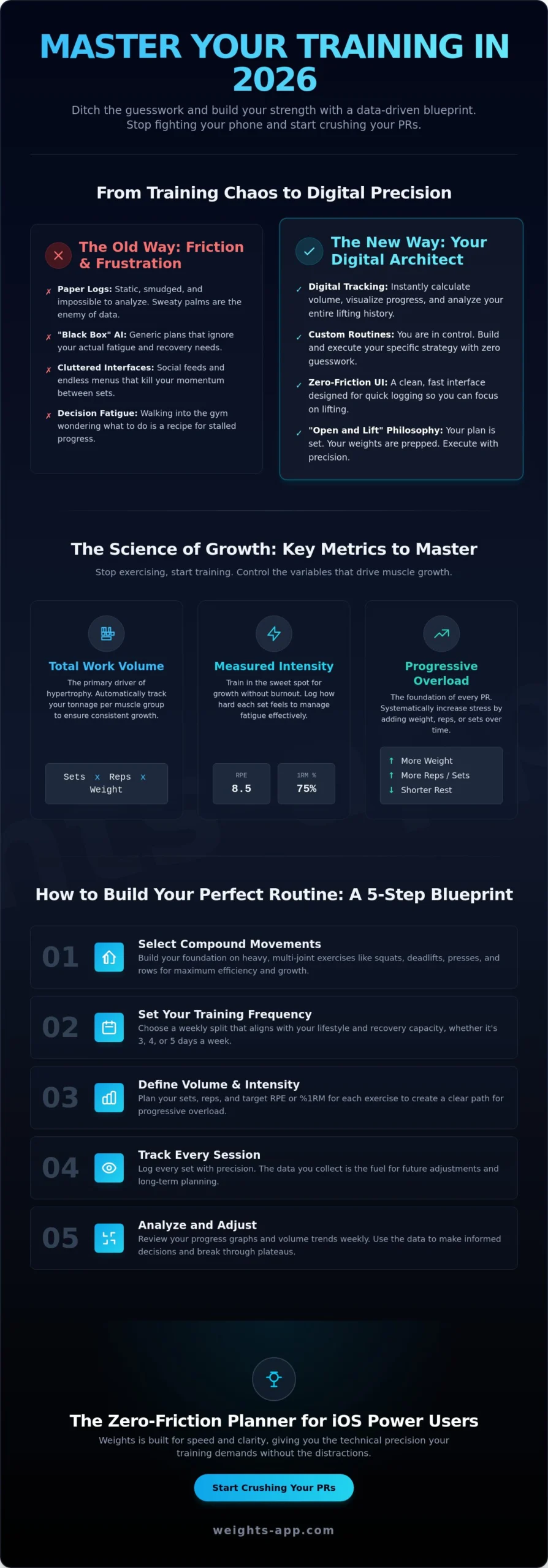
Work volume is your primary driver of growth. The formula is non-negotiable: Sets x Reps x Weight. Calculating this manually during a heavy session is a total distraction. It kills your momentum. Your app must handle this heavy lifting automatically. It tracks the total tonnage moved per muscle group across your entire week. It identifies gaps in your programming. It shows you the trends before you even feel the fatigue. If your volume isn’t climbing over months, your progress is stagnant. Automated tracking turns raw numbers into a clear roadmap for size.
Mastering Progressive Overload Data
Progressive overload is the systematic increase of stress on the body. It is the foundation of every PR. You have three main levers to pull: more weight, more reps, or shorter rest periods. Without a log, you are guessing. History logs are your best defense against ego lifting. They show you exactly what you achieved in your last session. They force you to beat your past self by a single pound or a single rep. This is how you turn a high-performance strategy into physical reality. Precision beats intensity every single time.
Intensity tracking adds another layer of control. You need to know your RPE (Rate of Perceived Exertion) and your percentage of 1RM (One-Rep Max). A workout routine planner app allows you to log how hard a set actually felt. This data helps you avoid burnout. It tells you when to push and when to pull back. It ensures you are training in the “sweet spot” for growth without overtaxing your central nervous system. Data visualization then takes these numbers and turns them into a visual story. You spot plateaus before they stall your progress. You see the dip in the graph and adjust your plan immediately. This is proactive training. It is the future of strength.
AI-Generated vs. Custom-Built: Choosing Your Planning Philosophy
Automation is the loudest trend in 2026. Data from recent industry reports shows that 49% of consumers now use AI-powered fitness apps daily. These “black box” algorithms promise to think for you. They offer a hands-off approach that appeals to the masses. But for the serious athlete, this automation is often a cage. You don’t need a machine to guess your fatigue levels. You need an expert manual tool that executes your specific vision. A workout routine planner app should be a high-performance extension of your own strategy, not a digital coach that ignores your unique recovery needs.
Choosing the right philosophy is about control. AI thrives on variety to keep users entertained. For a seasoned lifter, variety is often the enemy of progress. You build elite strength through movement mastery and specific neurological adaptations. This requires doing the same compound lifts week after week with calculated increases. A manual planner allows for this rigid continuity. It respects the logic of your programming. It provides the technical precision required for long-term growth without the interference of a randomized algorithm. If you want to see how the top-performing tools stack up against each other, a comprehensive look at the best apps for working out at the gym can help you make a fully informed choice before committing to a platform.
The Pitfalls of AI Fitness Trainers
Random workouts produce random results. AI trainers often suggest irrelevant exercises just to keep the “experience” fresh. This breaks the chain of progressive overload. If you are constantly changing your primary movements, you can’t accurately track your strength trends. Mastery comes from repetition. Beginners might need the hand-holding of an AI coach. Intermediates and experts need a dedicated workout routine planner app. You need to own your data. You need to be the one pulling the levers of volume and intensity.
Minimalism: Why Less is More in the Weight Room
Modern fitness tech is bloated. Many apps have transformed into social networks, filled with feeds, “likes,” and community challenges. This is digital friction. It leads to “gym-timidation” and massive distractions during your rest periods. Social features don’t build muscle. They steal your focus. The minimalist movement in 2026 is a direct response to this clutter. It prioritizes a zero-friction interface that stays out of your way. High-performance lifters value speed and clarity above all else. Your focus belongs on the barbell, not a social feed.
Efficiency is your primary goal. A minimalist tool focuses on the only metric that matters: your Personal Record (PR). It strips away the noise to show you your history and your next target. This “Open and Lift” approach ensures you spend your time moving weight, not navigating menus. By choosing a streamlined interface, you protect your momentum. You enter the gym with a mission. You execute. You leave. That is how elite physiques are built.
How to Build Your Perfect Routine: A 5-Step Blueprint
Stop copying generic plans from social media. You need a system that fits your life and your recovery. Building a high-performance routine is a tactical process. It requires a clear blueprint. Use your workout routine planner app to anchor your strategy. This is where your growth begins. Follow this five-step framework to transition from random lifting to elite training.
- Determine Frequency: Audit your schedule. Decide if you can realistically hit the gym 3, 4, or 5 days per week. Consistency is the only metric that matters.
- Select ‘Big Rocks’: Choose your primary compound movements. Squats, deadlifts, and presses are your foundation. These lifts drive the most volume and hormonal response.
- Add Accessory Work: Fill the gaps. Select isolation exercises that target your specific weak points or aesthetic goals. This is where you customize your physique.
- Build Your Template: Input every detail into your workout routine planner app. Create a repeatable structure that eliminates decision fatigue on the gym floor. If you want a head start, exploring a pre-made workout plans app can give you a proven framework to build from.
- Calibrate Intensity: Don’t guess your starting point. Use a one rep max calculator to set accurate weights for your first week. Precision prevents injury and ensures immediate overload.
Selecting the Right Split for Your Schedule
Your split determines your recovery. A Full Body split works best for three-day schedules. Upper/Lower splits provide more volume for four-day lifters. If you have five days, a Push Pull Legs Routine is the gold standard for hypertrophy. It allows for high frequency while giving each muscle group enough time to recover between sessions. To get the most from this split, you need a technically precise pull day workout that targets your posterior chain with the right exercise order and volume. Adjust your frequency based on your recovery capacity. If you feel sluggish, pull back. If you are fresh, push harder.
Template Creation and Routine Management
Organization is a performance enhancer. Use the ‘Supersets’ and ‘Drop Sets’ features within your app to increase training density. Name your routines for quick access. Labels like ‘Heavy Pull A’ or ‘Volume Push B’ save time and keep you focused. Don’t ignore the ‘Rest Timers’ feature. Controlled rest periods ensure your intensity stays high and your sessions stay efficient. Take the guesswork out of your first session. Build your first routine template now and dominate your next workout.
Weights app: The Zero-Friction Planner for iOS Power Users
Clutter is the silent killer of gym performance. If you have ever fumbled with a complex interface while your heart rate dropped between heavy sets, you know the cost of poor design. Weights app is the technical antidote. It is a workout routine planner app engineered specifically for the iOS ecosystem. It prioritizes rapid data entry over unnecessary features. It chooses clarity over social distractions. This is a tool for lifters who value their time as much as their total tonnage. It is built to stay out of your way while you work.
Visual progress is the ultimate driver of momentum. Weights app takes your raw lifting data and transforms it into high-impact charts and trends. You don’t have to squint at spreadsheets to see if your bench press is moving in the right direction. The app provides instant visual proof of your muscle growth and strength gains. It turns every logged set into a data point for your future success. This clarity keeps you focused on the objective. You see the growth. You feel the momentum. You stay hungry for the next personal record.
Built for the Modern Athlete
Distraction-free training is a massive competitive advantage. Weights app features no ads and no social feeds. Your focus stays entirely on the iron. This is a professional utility, not a social network. For those who demand elite-level tracking, Weights Pro Monthly, Weights Pro Yearly, and Weights Pro Lifetime tiers offer the full power of the platform. These pro versions unlock unlimited routine storage and advanced data analytics. You get deep insights into your performance without the noise of a community feed. It is a professional-grade experience built by an independent developer who understands the grit of the weight room. The latest version, 2.16.30, continues to refine this streamlined approach for May 2026.
Seamless Apple Ecosystem Integration
Speed is a core feature. Weights app leverages native iOS design principles to ensure every interaction is lightning-fast. It feels like a part of your iPhone, not a third-party add-on. This native integration means less lag and more lifting. Security is also a priority. The app utilizes iCloud sync to keep your data safe and accessible across all your Apple devices. Your history is future-proofed. If you upgrade your phone, your PRs and routines follow you instantly. For lifters who train in basement gyms or areas with spotty connectivity, using a dedicated offline workout tracker app for iOS ensures your sets are captured instantly with zero-latency logging regardless of signal strength. This seamless synergy allows you to focus on the barbell while the technology handles the logistics. Stop fighting your phone and start mastering your data. Download Weights app and start planning your 2026 gains today.
Dominate Your Training in 2026
Success in the weight room isn’t about luck. It’s about the technical precision of your workout routine planner app. You’ve learned how to manage volume, master progressive overload, and strip away digital clutter. High-performance training requires a tool that respects your focus and executes your specific strategy without friction. It’s about owning your data and moving with intent every single session. You have the blueprint. Now you need the engine.
Weights app is engineered for this exact purpose. It’s built specifically for iOS and Apple Watch to ensure a native, lightning-fast experience. With a 4.8+ Star Rating on the App Store, it delivers zero distractions. You won’t find ads or social feeds here. It’s just you, the iron, and the visual proof of your progress. Stop fighting bloated interfaces and start crushing your PRs with a tool designed for the modern athlete. Efficiency is your new competitive advantage.
The architecture for your strongest year is ready. It’s time to execute. Build your perfect routine with Weights app for iOS and take control of your gains. You’ve got the plan. Now go lift.
Frequently Asked Questions
What is the best workout routine planner app for beginners in 2026?
The best workout routine planner app for beginners is one that prioritizes simplicity over complex algorithms. Weights app provides a clean, intuitive interface that lets you focus on learning form rather than navigating menus. Beginners often quit due to tech friction. Starting with a minimalist tool ensures you build the habit of logging before moving to advanced analytics.
Can I use a workout planner app offline in the gym?
You can absolutely use a high-quality planner app offline. Weights app stores your data locally on your device, allowing you to log sets in basement gyms or areas with zero cell service. If you train in low-connectivity environments regularly, a purpose-built offline workout tracker app for iOS gives you ironclad data reliability and zero-latency logging no matter where you lift. Your data syncs to iCloud automatically once you reconnect to a network. This ensures your progress is never lost due to a poor connection or dead zone.
Should I use an AI-generated workout or build my own routine?
Build your own routine if you want elite results. AI-generated plans often lack the specificity required for movement mastery and long-term strength. Custom routines allow you to pull the levers of volume and intensity based on your actual recovery. Beginners might enjoy the variety of AI, but intermediates need the consistency of a manual planner to break plateaus.
How do I track progressive overload in a workout app?
Track progressive overload by comparing your current session against your history logs. Weights app shows your previous weight and reps for every exercise as you train. To grow, you must beat those numbers by adding weight, increasing reps, or decreasing rest time. Visual charts then turn this raw data into clear proof of your strength trends.
Are there any workout routine planner apps without social features?
Weights app is specifically designed without social features to eliminate gym distractions. Many modern apps are cluttered with feeds and “likes” that steal your focus between sets. By removing social integration, you protect your momentum and stay in the zone. Your only competition is the version of yourself that walked into the gym last week. For a broader comparison of distraction-free options, reviewing the best apps for working out at the gym gives you a clear picture of how each tool handles focus and data entry.
Does Weights app sync with my Apple Watch?
Yes, Weights app features deep integration with the Apple Watch. It is built natively for the Apple ecosystem to provide a seamless experience from your wrist to your iPhone. You can log sets, check rest timers, and track your heart rate without ever reaching for your phone. It is the ultimate tool for hands-free training on the gym floor.
Is it worth paying for a Pro subscription for a gym log?
A Pro subscription is a high-value investment for serious lifters. Weights Pro Monthly, Yearly, and Lifetime tiers unlock unlimited routine storage and advanced data analytics. These tools help you identify plateaus and optimize your training volume. If you are committed to long-term muscle growth, the depth of data provided by a Pro account is essential.
How many routines can I store in the Weights app?
You can store unlimited routines when you upgrade to Weights Pro. The free version allows you to test the interface with a limited number of templates. Once you commit to a Pro tier, you can build separate routines for every training split, including Heavy Pull, Volume Push, or specialized leg days. This flexibility is key for advanced programming. For your heavy pull sessions specifically, following a structured pull day workout ensures your posterior chain development keeps pace with the rest of your programming.
Ready To Get Started?
Everything you need. Nothing you don’t.
Weights adapts to your goals today and scales with the strength you’ll have tomorrow.