
Your pull day workout is failing because you’re treating it like a guessing game instead of a data entry project. Most lifters hit a plateau not because they lack effort, but because they lack technical precision. You’ve likely experienced the frustration of bicep fatigue redlining before your lats even start to fire. It’s an inefficient way to train. It leaves your posterior chain underdeveloped and your progress stalled. You want growth, but the confusion over exercise order and volume is holding you back from your potential.
We’re here to strip away the noise and remove the friction from your training. You deserve a routine that values your time and prioritizes measurable results over gym-floor myths. This guide provides a clear list of high-ROI exercises and the technical form required to execute them perfectly. You’ll master the mechanics of every pull and implement a framework for tracking strength gains with surgical precision. We’re delivering a data-driven blueprint for back and bicep growth that turns every set into a win. It’s time to stop guessing and start building with Weights Pro Monthly. Let’s get to work.
Key Takeaways
- Master the primary drivers of your posterior chain. Identify how to engage the lats and traps effectively for a more powerful pull.
- Build a high-ROI pull day workout using a strategic exercise hierarchy. Separate movements into power and pump categories to trigger maximum muscle growth.
- Optimize recovery with the Push-Pull-Legs framework. Sequence heavy compound lifts before isolation work to maintain high intensity throughout your session.
- Fix common technique errors that stall progress. Stop the “body swing” and learn to pull with your elbows to ensure your back does the heavy lifting.
- Leverage data-driven tracking to guarantee strength gains. Use visual charts to monitor your volume and intensity for a friction-free path to a stronger back.
The Mechanics of the Pull: Why Your Posterior Chain Matters
A pull day workout is more than a collection of exercises. It is a movement-pattern-based training session designed to recruit your body’s most powerful engine. You are pulling weight toward your center of mass. This specific action engages the Latissimus dorsi, rhomboids, and trapezius while utilizing the biceps as essential stabilizers. Understanding these Posterior Chain Muscles is the first step toward total physical dominance. It’s about efficiency. It’s about precision.
Vertical vs. Horizontal Pulling
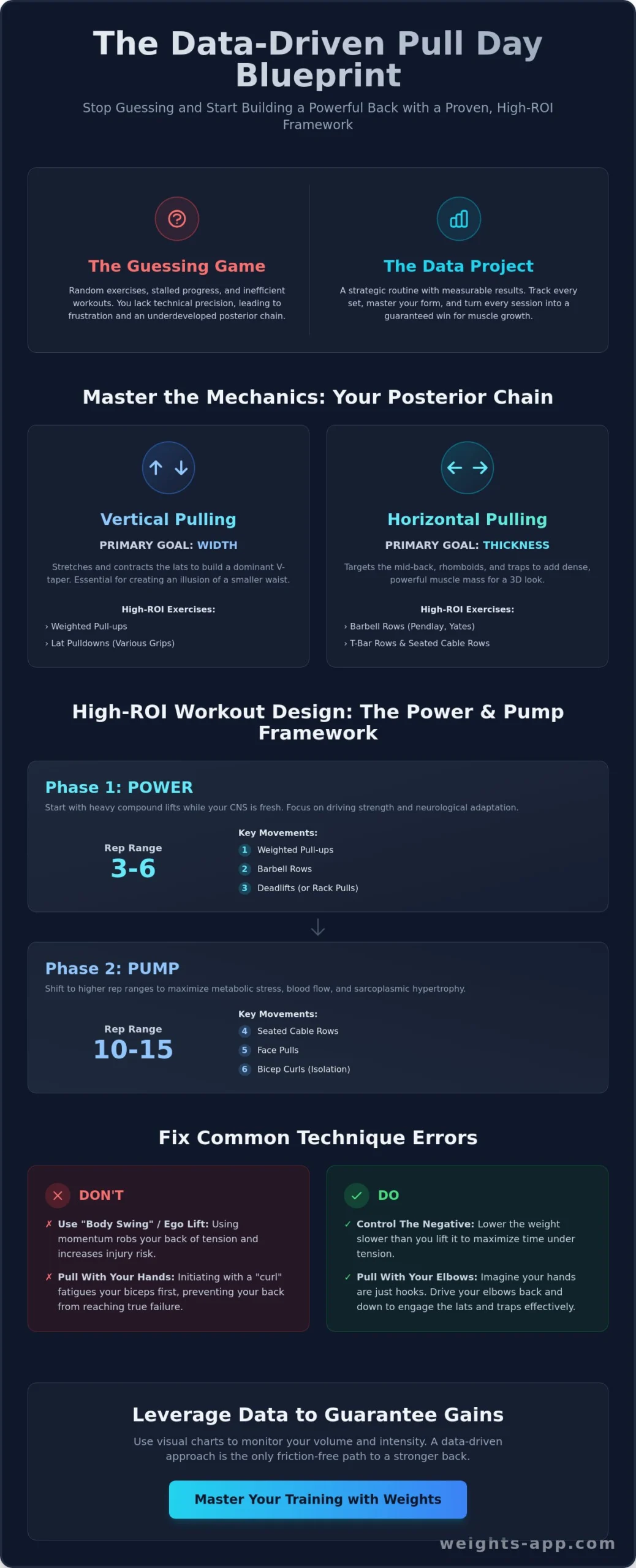
Attack your back from every angle. You need both vertical and horizontal planes to build a complete posterior chain. Vertical pulling movements, such as pull-ups or lat pulldowns, are the primary drivers of width. They stretch and contract the lats to create that sought-after V-taper. Horizontal pulling, like barbell rows or T-bar rows, focuses on thickness. These movements target the mid-back and rhomboids, adding the density needed for a powerful profile. Neglecting one plane results in a lopsided physique. Train both to ensure your back looks as strong as it feels.
The Role of the Biceps and Forearms
Stop letting your grip limit your gains. In many pulling movements, the biceps and forearms act as secondary movers. They are often the first muscles to fatigue, creating a bottleneck that prevents your larger back muscles from reaching true failure. You must learn to bypass this. Use a “hook” grip or visualize your hands as simple connectors. Initiate every movement by driving your elbows back rather than curling the weight with your hands. This technical shift ensures the tension stays where it belongs. If you want to eliminate the guesswork and start seeing measurable improvement, read The Ultimate Workout Tracker Guide. Precision is the only path to growth.
Essential Pull Day Exercises for Hypertrophy and Strength
Maximize your energy expenditure. Start with high-ROI compound movements while your central nervous system is fresh. Your pull day workout succeeds or fails based on exercise selection. Don’t waste prime strength on isolation moves. Categorize your session into two phases: Power and Pump. Power movements utilize low rep ranges (3-6) to drive neurological adaptations and raw strength. Pump movements shift to higher rep ranges (10-15) to maximize metabolic stress and sarcoplasmic hypertrophy. You must attack different muscle fibers to see real results. The trapezius and lats require a mix of angles to reach full development. This isn’t just about moving weight. It’s about moving weight through the correct plane of motion.
Vertical pulling targets the lats for width. Horizontal pulling targets the rhomboids and mid-traps for thickness. Competitors often ignore this distinction, but your growth depends on it. Balance your volume across both planes to avoid a flat or lopsided back. Your pull day workout needs this structural balance to build a complete posterior chain. For a comprehensive breakdown of how to structure every movement for maximum results, the pull day workout ultimate guide to data-driven muscle growth provides the exact framework you need.
The Heavy Hitters: Compound Pulling Moves
Weighted Pull-ups: Crush vertical resistance to expand your upper body width. These are the gold standard for lat development. Add weight to keep the rep range challenging. This vertical mechanic is what creates the V-taper. Barbell Rows: Drive your elbows back to forge mid-back thickness. This is your primary weapon for raw pulling power. By pulling in the horizontal plane, you hit the muscle fibers that vertical moves miss. Deadlifts: Anchor your posterior chain with this total-body strength builder. They recruit everything from your hamstrings to your traps. Place these at the start of your routine if you want maximum total-body strength. Move them to the end if you want to focus energy on back-specific hypertrophy. Logging your volume with Weights Pro Monthly ensures you never stall on these heavy hitters. It removes the friction of manual tracking and keeps your progress visible.
Isolation and Accessory Movements
Face Pulls: Retract your scapula to bulletproof your shoulders and fix your posture. These are essential for rear delt health and maintaining an upright profile. High reps work best here to build endurance in the small stabilizing muscles of the rotator cuff. Barbell Curls: Torch your biceps with direct isolation for maximum peak development. Direct arm work is necessary to ensure your biceps don’t become the weak link in your heavier pulls. Control the eccentric phase to maximize time under tension. Don’t swing the weight. Lat Pulldowns: Hammer your lats with high-volume sets to trigger sarcoplasmic growth. These provide a high-volume alternative to pull-ups. Use them to reach failure safely without the technical breakdown often seen in bodyweight moves. They allow for precise incremental loading which is crucial for hypertrophy. Focus on the squeeze at the bottom of every rep to fully engage the lower lats. This variety ensures every fiber is stimulated for maximum growth.
Designing Your Routine: Programming for Progress
Precision programming is the difference between a stagnant physique and a dominant one. Your pull day workout requires a logical structure to maximize output. Adopt a Heavy-to-Light hierarchy. This means placing your most taxing compound lifts at the start of the session. You have the most neurological energy early on. Use it. As fatigue sets in, transition to lighter, isolation-based movements. This approach ensures you don’t compromise form on the big lifts that drive the most growth. It keeps your intensity high where it matters most.
Recovery is the silent partner of progress. The Push Pull Legs Routine: The Ultimate Guide to Data-Driven Muscle Growth provides the ideal framework for this. It allows 48 to 72 hours of rest between hitting the same muscle groups. This frequency is the sweet spot for natural hypertrophy. Aim for 15 to 20 total sets per session if you are an intermediate lifter. Any more often leads to junk volume. Any less might not provide enough stimulus to force adaptation. Balance is your lever for long-term success.
The Beginner Pull Day Template
Master the fundamentals before you add complexity. A streamlined routine removes friction and builds a solid base. Start with a four-exercise sample: Lat Pulldowns, Seated Cable Rows, Face Pulls, and Dumbbell Curls. Perform three sets of 10 to 12 reps for each. Focus on form mastery for the first four weeks. Don’t worry about the weight on the bar. Worry about the tension in your lats. Use a fitness plan app: The Blueprint for Data-Driven Gains to log your sessions. Tracking reps and sets creates a digital trail of your progress. It turns effort into measurable data and guarantees you are moving in the right direction.
Advanced Intensifiers for Muscle Growth
Break through plateaus with tactical intensity. Supersets are your best tool for efficiency and metabolic stress. Pair a heavy row with Face Pulls to keep the heart rate up and the stimulus high. When strength stalls, implement Rest-Pause sets. Perform a set to failure, rest for 15 seconds, and then squeeze out three to five more reps. This technique forces your body to recruit dormant muscle fibers. Always track your effective reps. These are the final, difficult reps in a set that occur near failure. They are the primary drivers of muscle growth. If you aren’t tracking them, you’re just guessing. Precision wins every time. Stay disciplined and let the data guide your next move.
Avoiding the Ego Pull: Common Technique Errors
Ego is the primary bottleneck in any pull day workout. You see it every session. Lifters load the bar with weight they cannot control. This leads to the “Body Swing.” When you use your lower back and momentum to jerk the weight upward, you offload tension from your lats. You are trading muscle growth for a vanity number. Stop it. Keep your torso stationary. Force your back to do the work. If you cannot hold the contraction at the top for a split second, the weight is too heavy. Decrease the load and increase the precision. Quality reps drive quantity gains.
Bicep dominance is another progress killer. It happens when you pull with your hands instead of your back. Your biceps are smaller and weaker than your lats. They will redline first. This leaves your back under-stimulated and your growth stalled. Similarly, a lack of full range of motion (ROM) in pull-ups ruins the movement. A half-rep is a wasted rep. You need the full stretch at the bottom and the chin over the bar at the top to recruit the maximum number of muscle fibers. Eliminate the friction of poor form by tracking your technical wins with Weights Pro Lifetime.
Success requires technical discipline. Your pull day workout should be a masterclass in control, not a display of frantic movement. Every rep is a data point. If the form breaks, the data is corrupted. Focus on the mechanics described below to ensure every set moves you closer to your goal.
The “Elbow-First” Cue
Master the mental imagery of the “Elbow-First” cue to isolate your lats. Imagine your hands are merely hooks. Drive your elbows toward your hips rather than pulling the bar toward your chest. This shift in focus bypasses the biceps and forces the back to initiate the movement. Use a thumbless grip to further reduce forearm involvement and hand fatigue. The mind-muscle connection is a measurable focus tool that quantifies your ability to neurologically activate a specific target muscle during a lift. Use it to ensure the right muscles are doing the heavy lifting.
Grip Strength and Straps
Don’t let a weak grip limit your back growth. Your lats can handle far more weight than your forearms can hold. When your grip fails, the set ends prematurely. This leaves potential gains on the table. Use lifting straps strategically. Build raw grip strength during your warm-up and moderate-weight sets. Switch to straps for your top-end, heavy sets where the load exceeds your holding capacity. This ensures your back reaches true failure before your hands give out. It is an efficiency play. Use the right tool for the right load to keep your momentum moving forward.
Data-Driven Gains: Mastering Your Pull Day with Weights app
Effort is wasted without a record. Every pull day workout creates a stream of data; reps, sets, and weight increments that dictate your future. If you aren’t logging these variables, you’re just moving weight, not building a physique. The Weights app provides a friction-free environment to capture every set. It removes the clutter of bloated fitness platforms. You need a tool that operates at the speed of your training. Precision is the only way to ensure growth.
Progressive overload requires absolute clarity. You must know exactly what you lifted in the previous session to beat it today. By logging specific barbell weights and RPE, you ensure every set is a step forward. This isn’t about guessing. It’s about engineering a stronger posterior chain through measurable increments. Using an offline workout tracker app ios ensures your focus remains on the barbell, not your notifications. No signal; no problem. Your data stays local.
Growth is a game of inches. When you track every set, you identify the exact moment a movement pattern becomes stale. You can see when your volume peaks and when your intensity needs a reset. This level of technical precision separates elite lifters from the rest of the gym floor. Stop leaving your results to chance. Start treating your training like the high-performance project it is.
Visualizing Your Strength Curve
Identify plateaus before they stall your progress. The Weights app transforms raw numbers into visual progress charts that reveal your true strength curve. Seeing a 1RM trend line move upward provides a psychological edge that a simple list of numbers can’t match. It validates your hard work. It proves the system is working. Adopt a “log and forget” mindset. Enter your data immediately after the set and clear your mind for the next heavy pull. Let the app handle the analytics while you handle the intensity.
Zero Distraction, Maximum Momentum
Eliminate the bloat. Most fitness apps are cluttered with social feeds and intrusive ads that break your rhythm. Weights app is built for the minimalist athlete who values efficiency. With seamless iCloud sync and Apple Watch integration, your data is always where you need it. It’s professional-grade utility without the friction. You’ve mastered the mechanics and the routine. Now, master the data. Download Weights app and start logging your pull day today. Choose between Weights Pro Monthly, Weights Pro Yearly, or Weights Pro Lifetime to unlock the full potential of your training.
Execute with Precision: The Path to a Dominant Posterior Chain
You now possess the technical framework to transform your training from random effort into a calculated progression. By mastering vertical and horizontal planes and implementing the “elbow-first” cue, you’ve removed the biomechanical friction that stalls growth. Every pull day workout is an opportunity to test these mechanics against the iron. Consistency is the engine; data is the fuel. It’s time to stop guessing and start executing with the discipline of an elite athlete.
Take control of your progress with a tool designed for zero-distraction focus. The Weights app offers a streamlined iOS interface that eliminates social noise and intrusive ads. With visual progress charts and comprehensive history logs, you can see your strength gains in real time. Log your next Pull Day with Weights app. Whether you choose Weights Pro Monthly, Weights Pro Yearly, or Weights Pro Lifetime, you are investing in a system that values your time and your results. Step into the gym with a plan. Finish with the data to prove it.
Frequently Asked Questions
How often should I do a pull day workout?
Perform your pull day workout twice per week for optimal hypertrophy. This frequency aligns with the Push-Pull-Legs framework, allowing for 48 to 72 hours of recovery between sessions. Training each muscle group twice every seven days maximizes protein synthesis and ensures consistent strength gains. If you’re a beginner, start with once per week to master form before increasing the volume.
Can I do deadlifts on a pull day?
Yes, deadlifts are a foundational movement for any pull day workout. They recruit the entire posterior chain, including the hamstrings, glutes, and spinal erectors. Place them at the beginning of your session if your goal is raw power. Move them to the end if you prefer to save your central nervous system energy for back-specific isolation and hypertrophy work.
Should I train back or biceps first in my routine?
Always prioritize your back movements before moving to biceps. Back exercises are high-ROI compound lifts that require the most energy and neurological focus. Your biceps act as secondary movers in every row and pull-up. If you fatigue them first with curls, they will become a bottleneck. This prevents you from reaching true failure in your larger, more powerful back muscles.
What is the best rep range for pull day muscle growth?
Use a hybrid rep range to trigger maximum growth. Target 5 to 8 reps for heavy compound lifts like barbell rows to build structural strength. Shift to 10 to 15 reps for accessory moves like face pulls and lat pulldowns to maximize metabolic stress. This dual approach hits both myofibrillar and sarcoplasmic hypertrophy, ensuring your back develops density and width simultaneously.
How do I know if I am pulling with my back and not just my arms?
Focus on the “elbow-first” cue to ensure back engagement. If your biceps burn out before your lats feel a pump, your technique is likely arm-dominant. Visualize your hands as hooks and drive your elbows toward your hips. You should feel a distinct squeeze in your scapula at the peak of the contraction. A thumbless grip can also help reduce forearm involvement.
Is it okay to do pull-ups every pull day?
Yes, pull-ups are the gold standard for building vertical pulling strength and width. They are highly effective for lat development and should be a staple in your routine. To avoid overuse injuries, rotate your grip styles. Switch between wide-grip, neutral-grip, and chin-ups. This variation shifts the emphasis across different muscle fibers while keeping the stimulus fresh for every session.
What should I do if my grip strength fails before my back does?
Use lifting straps for your heaviest sets to bypass grip limitations. Your lats are significantly stronger than your forearms. If your hands give out first, you’re leaving back gains on the table. Train your raw grip strength during warm-ups and moderate sets. Switch to straps only when the load exceeds your holding capacity. This ensures your back reaches true failure every time.
Ready To Get Started?
Everything you need. Nothing you don’t.
Weights adapts to your goals today and scales with the strength you’ll have tomorrow.