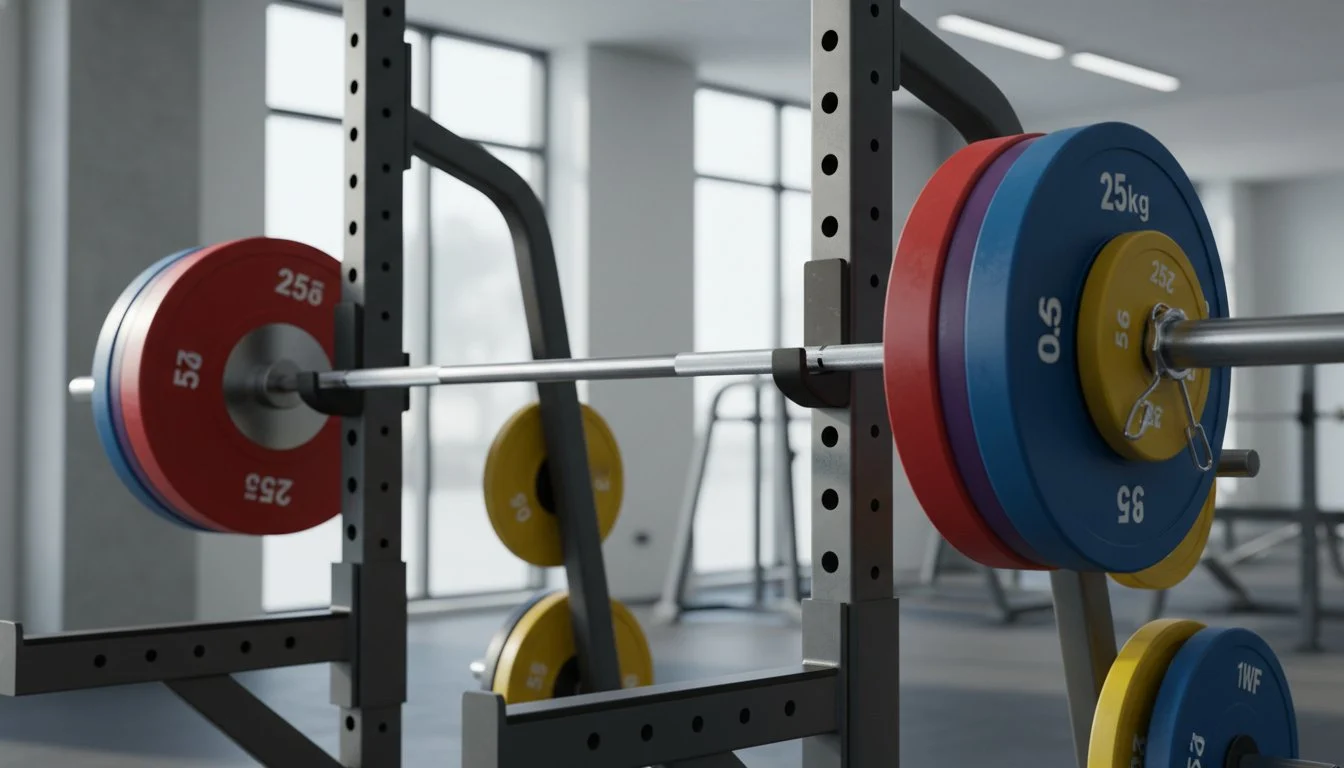
Mental fatigue is the silent killer of your next PR. You shouldn’t need a PhD in mathematics to finish a heavy set of squats. Learning how to calculate weight on barbell setups shouldn’t feel like a mid-workout exam. You’ve been there. You’re staring at a stack of plates, gasping for air, and trying to remember if that yellow plate is 15 or 25 kilograms. It’s frustrating. It’s distracting. Worse, miscalculating in a crowded gym is an embarrassment nobody wants.
We believe your focus should be on the lift, not the logic. This guide eliminates the friction. You’ll master the essential math of the weight room so you can focus on your sets, not your phone’s calculator. We’re stripping away the confusion by breaking down IWF plate color codes, standard barbell specs, and the shortcuts to instant totals. Whether you’re navigating 20kg men’s bars or 15kg women’s bars, you’ll gain the confidence to track your progress with absolute precision. Stop guessing. Start lifting. Let’s get to work.
Key Takeaways
- Always include the barbell weight in your total; standard Olympic bars add an immediate 45 lbs or 20 kg to your load.
- Learn how to calculate weight on barbell setups using the “Pair Method” to slash math time and maintain training intensity.
- Decode the IWF color hierarchy to identify plate values instantly, ensuring you grab the right weight even when fatigued.
- Master the 2.2 conversion multiplier to stay precise when switching between metric and imperial gym equipment.
- Leverage Weights Pro to automate your plate loading and tracking, keeping your focus on the lift instead of the numbers.
The Golden Rule of Gym Math: The Barbell Always Counts
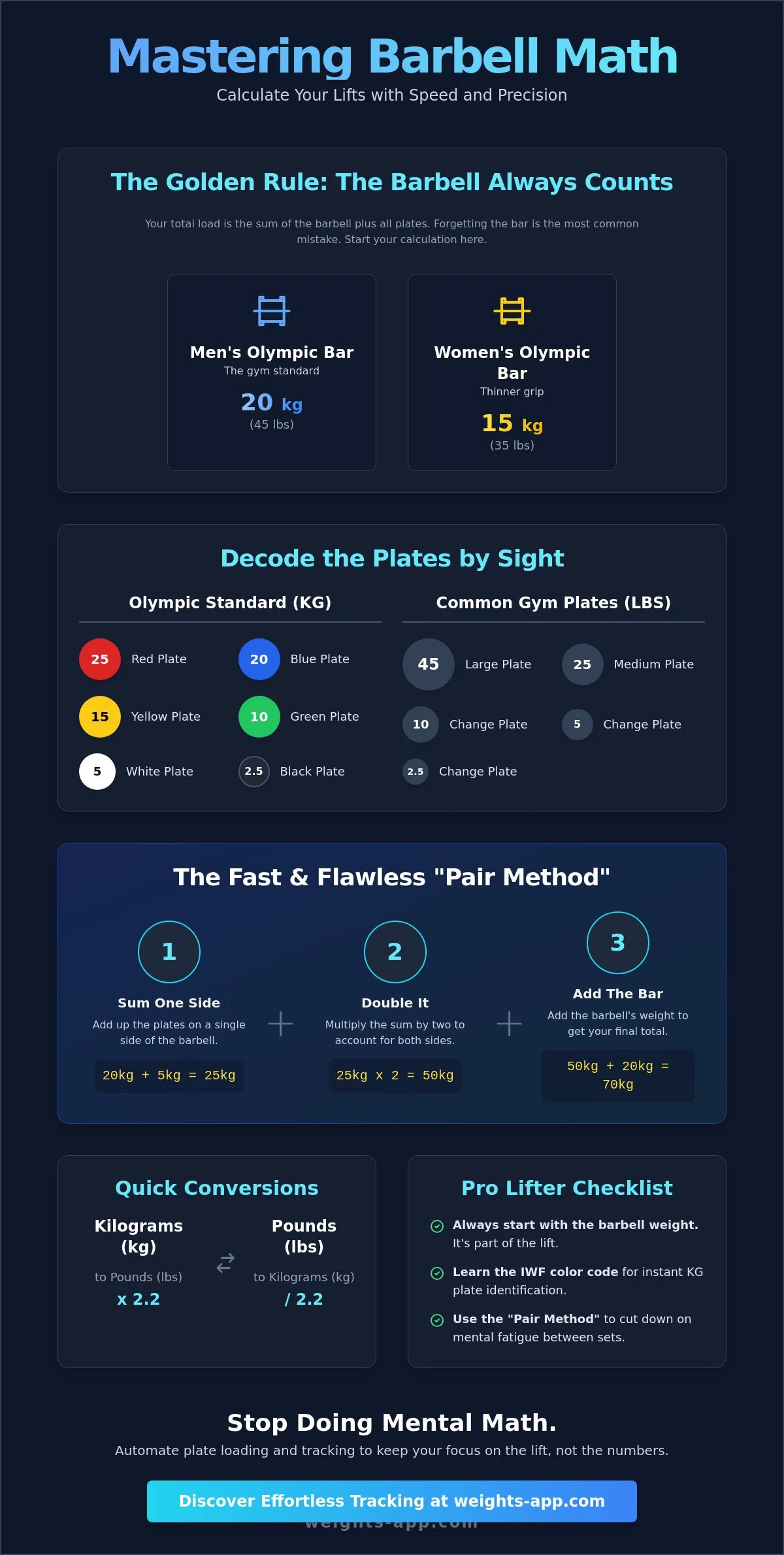
Precision is power. The barbell is not a weightless handle. It is a precision-engineered, load-bearing tool. If you ignore the steel in your hands, your data is garbage. Mastering how to calculate weight on barbell setups begins with one non-negotiable fact: the bar always counts. Total Load is the sum of the barbell weight plus every weight plate attached to it.
Skipping the bar weight is a rookie mistake that kills your progression. It leads to inaccurate tracking and, eventually, failed PR attempts because you don’t actually know your baseline. If you want to lift like a pro, you have to account for every ounce of resistance. Professional athletes don’t guess. They measure. Every pound matters when you’re chasing elite results.
Why We Count the Bar
Consistency drives results. Counting the bar ensures your numbers stay valid whether you’re at your home gym or a high-end training facility. It provides the raw data needed for strength-to-weight ratios. Safety is the ultimate benefit. You need to know the true load on your spine and joints to prevent overreaching. Precision builds confidence. Guesswork leads to injury. Accuracy is the only path to sustainable, high-performance training.
Standard Barbell Weights You Must Know
You can’t learn how to calculate weight on barbell loads if you don’t know your starting point. Most commercial and competitive facilities follow International Weightlifting Federation (IWF) standards. Use these benchmarks to anchor your math:
- The 20kg (45lb) Men’s Bar: The universal standard for squats, deadlifts, and bench presses. It typically features blue markings on the end caps for easy identification.
- The 15kg (35lb) Women’s Bar: Designed with a thinner 25mm grip. These bars feature yellow markings and are the official standard for women’s Olympic lifting.
- Specialty Bars: EZ-bars usually range from 15 to 25 lbs. Trap bars (or hex bars) are significantly heavier, often weighing between 45 and 60 lbs depending on the manufacturer.
Verify your equipment before you load. Many high-end bars have the weight stamped directly into the end caps. If you want to remove the friction entirely, Weights Pro allows you to save your specific equipment specs. Log the bar weight once and never think about it again. Your time is valuable. Your progress is the only priority. Stop doing math in your head and start moving the weight that matters.
Understanding Standard Weight Plates and Color Coding
Speed requires pattern recognition. In a high-intensity session, you don’t have time to squint at small embossed numbers. You need to know your load by sight. Mastering how to calculate weight on barbell setups involves learning the visual hierarchy of the weight rack. Whether you are using traditional iron or professional bumpers, the layout follows a logical progression designed for efficiency and safety.
Physics dictates your loading strategy. Always slide the heaviest plates toward the center of the bar first. This keeps the center of gravity stable and prevents the bar from tipping if you’re loading one side at a time. It also reduces the whip of the bar during heavy squats or deadlifts. Standard iron plates vary in diameter, getting smaller as the weight decreases. In contrast, Olympic bumper plates maintain a uniform 450 mm diameter. This consistency ensures the bar stays at the correct height for every pull, regardless of the weight on the sleeves.
The Standard Pound (LB) Plate Set
Most commercial gyms in the US rely on the imperial system. The 45 lb plate is your anchor. It’s the “big” plate that defines most baseline lifts. The 25 lb plate serves as a transition, often used when jumping between major sets. Then come the “change” plates: 10s, 5s, and 2.5s. These smaller increments are vital for progressive overload. They allow you to add weight without compromising form. If you’re stuck between major plates, these small additions are how you break through plateaus without the mental fatigue of complex math.
The Olympic Color Code (KG)
Professional environments and international competitions use a strict color system for instant recognition. This allows coaches and athletes to verify a load from across the room. The most reliable way to learn how to calculate weight on barbell loads in a metric gym is to follow the official IWF specifications. The code is universal:
- Red: 25 kg (55 lbs). The heaviest standard plate.
- Blue: 20 kg (45 lbs). Equivalent to a standard large iron plate.
- Yellow: 15 kg (33 lbs). A common mid-range jump.
- Green: 10 kg (22 lbs). The lightest full-size bumper.
Using these color cues eliminates the friction of manual counting. You can verify your math mid-set just by glancing at the colors on the sleeve. If you want to stop guessing entirely, using Weights Pro can automate this process by showing you exactly which colors to grab. It turns a confusing rack of plates into a streamlined checklist. Focus on the effort. Let the system handle the specs. This is how you maintain momentum and keep your training data clean.
The 45-Pound Shortcut: How to Calculate Weight Fast
Speed wins in the weight room. When your heart rate is redlined and your grip is failing, complex addition is a liability. Math kills momentum. Most lifters struggle because they attempt to add every individual plate in a long, linear string. It is a slow, clunky process that invites error. To maintain your flow state, you must upgrade your mental software. Use the “Pair Method” to streamline your logic and keep your focus on the upcoming set.
Efficiency starts with symmetry. Since barbells are symmetrical, you only need to calculate half the load to find your total. This simple shift in perspective slashes your calculation time in half. You aren’t just adding weights; you’re recognizing patterns. Mastering how to calculate weight on barbell loads is about removing cognitive friction so you can get back under the bar faster. Don’t let a simple addition error ruin a potential PR or lead to an unbalanced lift.
The Mental Math Algorithm
Follow a consistent three-step process to eliminate guesswork. First, anchor your math with the bar weight, which is 45 lbs for a standard Olympic bar. Second, calculate the total weight on exactly ONE side of the bar. Third, double that number and add it to your 45 lb anchor. For example, if you have a 25 and a 10 on one side, that’s 35. Double it to 70. Add 45. Your total is 115 lbs. It’s fast, logical, and leaves no room for “gym brain” to sabotage your tracking.
Common Weight Milestones to Memorize
Elite lifters don’t do math for standard loads; they use pattern recognition. Memorizing these “Milestone Weights” allows you to skip the calculation step entirely for your primary sets. If you see these plate configurations, you should know the total instantly:
- One 45lb plate per side: 135 lbs. The baseline for serious strength training.
- Two 45lb plates per side: 225 lbs. The “two-plate” milestone.
- Three 45lb plates per side: 315 lbs. A standard benchmark for advanced squatting and deadlifting.
- Four 45lb plates per side: 405 lbs. The elite “four-plate” club.
Internalizing these totals builds your gym IQ and keeps your training sessions sharp. While some apps leave you dependent on a screen, Weights Pro is designed to reinforce these standards while automating the heavy lifting of data entry. Use the app to track your history and plan your jumps, but keep these milestones in your head to stay agile on the gym floor. Accurate data is the foundation of progressive overload. Know your numbers, trust your math, and keep the bar moving.
Handling Conversions and Specialty Equipment
Precision doesn’t stop at the barbell. You will eventually face a gym equipped in kilograms or a specialty machine with a non-standard sled. Chaos is the enemy of progress. If you don’t know your exact load, you’re just exercising; you aren’t training. Mastering how to calculate weight on barbell setups in these environments requires a mental toolkit for conversions and machine specs. Stop guessing and start measuring.
Fractional plates are the secret weapon of elite lifters. These tiny discs allow for micro-loading in increments as small as 0.5 lbs. When a 5 lb jump feels like a mountain, fractional plates keep the momentum moving forward. Don’t ignore the collars either. While standard spring clips are negligible, professional competition collars weigh exactly 2.5 kg (5.5 lbs) each. That is an extra 11 lbs on the bar that most lifters forget to count. Every ounce of resistance contributes to your total volume. Account for it all.
The Quick KG-to-LB Conversion
Stop using a calculator mid-set. Use the “Double + 10%” rule for rapid estimation. Take the kilogram weight, double it, and add 10% of that result. For a 20 kg bar, double it to 40. Add 10% (4). The result is 44 lbs. This is close enough to the standard 45 lb bar for most training purposes. Most commercial gyms treat 20 kg and 45 lb bars as interchangeable, but knowing the difference is vital for high-stakes PR attempts. Watch out for “fake” weights in budget gyms where plates might be cast inconsistently. Always verify your equipment to ensure your data remains clean.
Calculating Non-Standard Bars
Machines introduce variables that can skew your progress. A Smith Machine is often counterbalanced, meaning the “effective load” of the bar might only be 15 or 25 lbs instead of 45. Always check the manufacturer sticker on the frame for the starting weight. Leg press sleds are even more varied. These usually range from 45 to 100 lbs. To stay accurate across different facilities, use a workout tracker to store the specific sled weight of your local equipment. This removes the guesswork from your logbook and ensures your progressive overload is based on facts, not assumptions.
Eliminate the mental clutter of specialty equipment math. Upgrade to Weights Pro Yearly to customize your equipment profiles and automate every conversion instantly. Stay focused on the movement. Let the tech handle the math. Success is found in the data. Your only job is to move the weight.
Stop Doing Mental Math: Effortless Tracking with Weights Pro
Mental math is the enemy of the flow state. When you are deep into a heavy session, your brain should be focused on muscle recruitment, not arithmetic. Attempting to figure out how to calculate weight on barbell loads between gasping breaths drains your cognitive battery. It creates friction. It slows you down. While a manual notebook might record your numbers, it doesn’t solve the plate math in real-time. You need a tool that thinks as fast as you train. Precision requires automation. If you’re serious about finding the best strength training apps for iPhone that deliver speed, precision, and zero-friction logging, the right choice will eliminate gym-floor friction and turn your raw numbers into measurable strength gains.
Transition from calculating to training. Weights Pro eliminates the mid-set pause by doing the heavy lifting for you. Our minimalist iOS interface is designed for athletes who value speed and technical precision. See your total weight, your plate breakdown, and even your estimated One Rep Max (1RM) without ever opening a calculator app. This is data-driven performance. This is zero friction. Learning how to calculate weight on barbell setups is a foundational skill, but relying on it every set is a bottleneck you don’t need. If you’re tired of paying monthly fees just to access your own training history, explore a one time payment workout app that gives you permanent ownership of your data without the recurring subscription drain.
Data-Driven Gains Without the Clutter
Log your sets in seconds. The streamlined Weights interface removes the digital noise that plagues other apps. You get clear, actionable data that drives progressive overload. Visualize your strength journey with charts that automate the math for you. If you want to master your training environment and stop leaving gains to chance, check out The Ultimate Workout Tracker Guide. Stop guessing. Start growing. High-performance training requires high-performance data management.
Never Lose a Personal Record
Your progress is permanent. Weights Pro syncs your lifting data via iCloud, ensuring you never lose a PR, even if you upgrade your hardware. This allows you to focus on the nuances of your form, from the strict execution of lateral raises to the grinding intensity of a heavy deadlift. We built an Offline Workout Tracker App iOS users trust because gains don’t wait for a signal. No distractions. No social feeds. Just you and the iron.
Own your data. Master your math. Choose Weights Pro Monthly for short-term focus, Weights Pro Yearly for sustained growth, or Weights Pro Lifetime for a permanent commitment to excellence. Your next PR is waiting. Let us handle the numbers while you handle the weight.
Own Your Numbers and Dominate Your Sets
Gym math shouldn’t be the hardest part of your workout. You’ve mastered the fundamentals of counting the bar and identifying the visual cues of IWF color coding. You know the symmetry shortcut. These are essential skills that build your gym IQ. However, precision shouldn’t require mental fatigue. Understanding how to calculate weight on barbell loads is only half the battle. The other half is tracking that data with zero friction to ensure consistent progressive overload. If you’re evaluating your app options, consider the long-term value of a one time payment workout app over a subscription that charges you indefinitely just to view your own lifting history.
Stop wasting energy on manual arithmetic. Download the Weights app for iOS and stop doing gym math today. It’s built for iOS power users who demand technical precision and a minimalist design. With secure iCloud sync, your PRs are safe and your progress is always visible. This is the streamlined utility you need to maintain momentum.
Focus on the movement. Let the tech handle the math. Step back under the bar with total confidence and keep the momentum moving forward. You’ve got the tools; now go get the gains.
Frequently Asked Questions
Do I count the clips/collars in the total weight?
Standard spring clips are usually ignored because they weigh less than 0.5 lbs. Professional competition collars are a different story. These weigh exactly 2.5 kg (5.5 lbs) each, adding 11 lbs to your total load. If you are training for a meet, count them to ensure your data is competition-ready.
How much does a standard Olympic barbell weigh?
A standard men’s Olympic bar weighs 20 kg, which is roughly 44.1 lbs. Most gyms round this to 45 lbs for simplicity. Women’s bars are lighter at 15 kg (33 lbs) and have a smaller diameter. Knowing your bar weight is the first step in learning how to calculate weight on barbell loads accurately.
Is a Smith Machine bar 45 pounds?
Rarely. Most Smith Machines use a counterbalance system that reduces the effective weight of the bar to 15 or 25 lbs. This makes the movement easier and safer for beginners. Check the equipment frame for a manufacturer’s weight rating to avoid overestimating your strength.
How do I calculate weight if my gym uses both KG and LB plates?
Pick one unit and stick to it for the entire session. Use the 2.2 multiplier to convert KG to LB; for example, 20kg multiplied by 2.2 equals 44 lbs. Mixed inventory is a recipe for math errors. Converting everything to a single unit keeps your logbook clean and your progress tracking consistent.
What is the easiest way to add up plates in my head?
Calculate the weight on one side, double it, and add the bar. This “Pair Method” is faster and more reliable than adding plates one by one. If you have 100 lbs on the left sleeve, you have 200 lbs in plates total. Add your 45 lb bar for a 245 lb total load.
Why does the bar weight matter for progressive overload?
Precision drives results. If you don’t count the bar, you are missing 45 lbs of data from every single lift. This leads to inaccurate volume calculations and flawed strength-to-weight ratios. Progressive overload requires exact numbers to ensure you are actually getting stronger over time.
How much does an EZ-curl bar weigh?
Most EZ-curl bars weigh between 15 and 25 lbs. Weight varies significantly between brands because they aren’t standardized for competition like Olympic bars. If the weight isn’t stamped on the end, weigh the bar once and record it in your equipment settings.
What do the different colors of weight plates mean?
Colors provide a visual shorthand for weight values based on IWF standards. Red is 25 kg, blue is 20 kg, yellow is 15 kg, and green is 10 kg. This system allows you to verify how to calculate weight on barbell setups instantly without searching for small numbers on the plate face.
Ready To Get Started?
Everything you need. Nothing you don’t.
Weights adapts to your goals today and scales with the strength you’ll have tomorrow.