
Your one-rep max is a vanity metric until you provide the data to back it up. For an 80 kg male, a 100 kg bench press signifies you have moved beyond the basics and reached an intermediate strength level. Without objective benchmarks, you are just moving weight in the dark. You are likely tired of stalling without knowing why or wrestling with spreadsheets that belong in an office, not a weight room. You need clarity, not clutter.
We understand that your time is your most valuable asset. You want to see your progress visualized without the distraction of social features or complex interfaces. This guide will teach you to master the data behind your lifts and map your journey from beginner to elite. We will break down the latest strength standards and show you how to use professional metrics to drive consistent gains. It is time to stop guessing and start measuring. We are covering everything from bodyweight ratios to specific standards for the squat, bench, and deadlift so you can identify exactly where you stand.
Key Takeaways
- Stop chasing raw numbers and start measuring your true strength level relative to your bodyweight for a more accurate performance profile.
- Identify your current training tier to set objective, data-driven benchmarks that move you from beginner to elite.
- Prioritize your strength-to-weight ratio to maximize functional power and ensure your gains are lean and efficient.
- Implement a consistent testing protocol using RPE and rep-max data to eliminate guesswork and identify plateaus before they happen.
- Streamline your gym-floor workflow with zero-friction logging and advanced visualization tools designed for high-precision tracking.
What is Strength Level and Why Should You Track It?
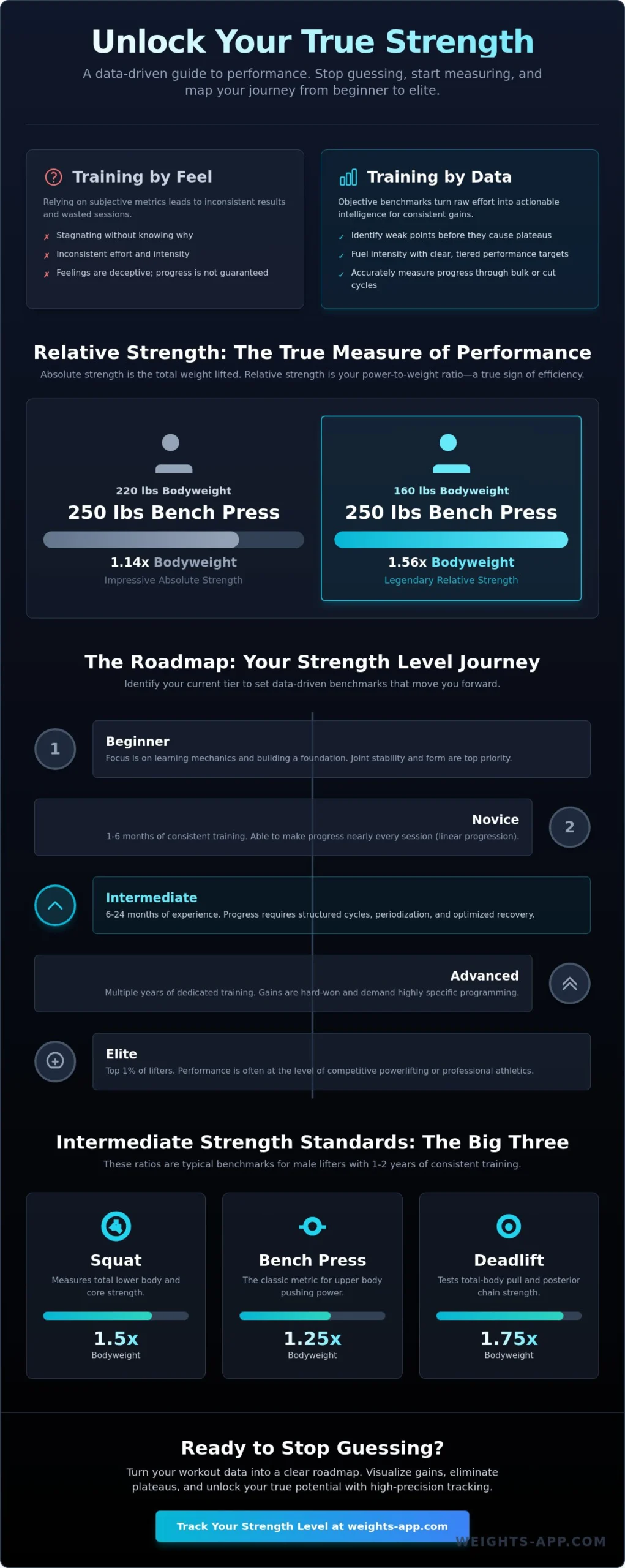
Your strength level is more than a badge. It is a precise metric of your physical capacity relative to your bodyweight. While absolute strength measures the total weight moved, relative strength reveals your true efficiency as an athlete. A 250 lb bench press is heavy; a 250 lb bench press at a 160 lb bodyweight is legendary. Tracking this specific ratio allows you to compare your performance against global standards regardless of your size. It turns raw effort into actionable intelligence. Use these benchmarks to:
- Eliminate training plateaus by identifying lagging muscle groups.
- Fuel intensity with objective, tiered performance targets.
- Compare progress accurately even during weight cut or bulk cycles.
Objective benchmarking is the only way to kill stagnation. Without data, you are just guessing. You might feel strong one day and weak the next, but feelings are deceptive. Data is permanent. By establishing a clear baseline, you identify weak points in your kinetic chain before they stall your progress. This data-driven approach transforms your workout from a routine into a mission. It demands focus. It rewards precision. It builds momentum.
The Psychology of Benchmarking
Stop training based on a “feeling.” Subjective metrics lead to inconsistent results and wasted sessions. Moving from vague perceptions to objective data shifts your mindset. Seeing your rank climb among your peers boosts training intensity. It creates a sense of urgency. You aren’t just lifting; you are leveling up. Minimalist tracking beats mental math every single time. It removes the friction of calculation so you can keep your head in the game. Consistency follows clarity. When you see the numbers move, you stay in the hunt.
Strength Level vs. One Rep Max
Understand the distinction between a data point and a classification. Your one-repetition maximum is the highest weight you can move for a single rep. It is a snapshot of peak output. In contrast, your strength level is the broader classification derived from that data. It places your performance into a category like Intermediate or Advanced. You don’t always need to test your limits to know where you stand. You can use a one rep max calculator to project your ceiling based on sub-maximal sets. This protects your joints while keeping your profile updated. A complete analysis requires looking at multiple lifts. Squat, bench, and deadlift numbers must work together to create a balanced athletic profile. Don’t settle for a single high number. Aim for a comprehensive elite status.
Understanding Strength Standards: From Beginner to Elite
Your strength level isn’t a static number. It is a moving target that evolves with your training age and consistency. Standards categorize your performance relative to your bodyweight, providing a roadmap for your athletic career. Most lifters can expect to reach intermediate strength standards within 12 to 24 months of dedicated training. However, moving beyond that requires a shift from general effort to technical precision. Age and gender act as critical modifiers in this calculation. A 50 kg female hitting a 50 kg bench press is performing at an intermediate level, while an 80 kg male needs to push closer to 100 kg to claim the same rank. Use these tiers to identify your current position:
- Beginner: You are learning the mechanics. Focus is on form and the initial Benefits of Strength Training like improved joint stability.
- Novice: You have trained for 1 to 6 months. You can still make progress nearly every session.
- Intermediate: You have 6 to 24 months of experience. Progress requires structured cycles and better recovery.
- Advanced: You have trained for multiple years. Gains are hard-won and require highly specific programming.
- Elite: You are in the top 1 percent of lifters. This level often involves competitive powerlifting or professional athletics.
The Big Three Benchmarks
The squat, bench press, and deadlift remain the primary metrics for total body power. Squat standards measure your lower body engine. A typical recreational male lifter can often squat 1.0 to 1.5 times their bodyweight after one year of consistency. The bench press is the classic upper body metric. While an untrained man typically starts at 135 lbs, reaching an intermediate strength level usually requires hitting 185 to 225 lbs. The deadlift tests your total body pull and posterior chain. It should be your heaviest lift, with intermediate standards often ranging from 1.25 to 1.75 times your bodyweight. Tracking these three lifts provides a comprehensive view of your physical ceiling.
Transitioning Between Levels
Moving from Novice to Intermediate requires more than just trying harder. You must embrace progressive overload through calculated volume and intensity. When linear gains stall, you need data to identify the bottleneck. Reaching Advanced or Elite status demands hyper-specific programming and a “zero friction” approach to your logs. You can’t rely on memory or messy notebooks at this stage. You must track every set, rep, and rest interval to ensure you are moving the needle. Using a professional workout tracker allows you to visualize these transitions in real time. Precision is the only way to bridge the gap between being strong and being elite. Stop guessing and start analyzing your data to fuel your next PR.
Relative Strength: The True Measure of Performance
Absolute strength is a vanity metric. Relative strength is the truth. A 500 lb deadlift sounds impressive until you realize the lifter weighs 350 lbs. That is barely a 1.4x bodyweight pull. Meanwhile, a 150 lb lifter pulling 300 lbs has a 2x bodyweight ratio. They are more efficient. They are more powerful. They have a superior strength level. Measuring your capacity relative to your size is the only way to compare yourself to the global standard. It turns raw numbers into a competitive profile. It separates the efficient athletes from the simply large ones.
Calculating your strength-to-weight ratio is simple. Divide the weight lifted by your total body mass. This decimal reveals your pound-for-pound capacity. It is the most objective way to measure progress during a fat loss phase or a lean bulk. If your bodyweight drops while your lifts stay the same, your relative power is skyrocketing. You are becoming a more efficient machine. This is the hallmark of a high-performance athlete. Body composition plays a massive role in this equation. Muscle is functional tissue; fat is just cargo. Adding lean mass improves your output without necessarily pushing you into a heavier weight class. This is why following American Heart Association guidelines for resistance training is vital for long-term health and peak performance.
High-level competitors use Wilks or DOTS scores to compare themselves across different weight classes. These coefficients normalize the data. They provide a level playing field for the 140 lb lifter and the 300 lb titan. They account for the diminishing returns of muscle mass on larger frames. If you want to know how you actually rank, these scores are the gold standard for your strength level analysis.
Pound-for-Pound Performance
Identifying Muscular Imbalances
Your data should tell a story of symmetry. Use strength standards to audit your physique. Is your bench press nearly equal to your squat? You have a problem. Your posterior chain should lead the charge. Looking at a deadlift world record helps you understand the extreme end of human potential and sets a ceiling for your own goals. If your pull is weaker than your push, adjust your routine. Use your data to bridge these gaps. Balanced strength prevents injury. It ensures longevity. It makes you a complete athlete.
How to Accurately Track Your Strength Level Progress
Precision is the enemy of plateaus. You need a rigorous testing protocol to master your strength level. Don’t wait for a random good day to test your limits. Establish a recurring schedule for 1RM or rep-max sets every 4 to 8 weeks. This structured approach ensures your data reflects true progress rather than a fluke of high caffeine intake or extra sleep. Log every variable without exception. You need the weight, the reps, and your Rate of Perceived Exertion (RPE). RPE provides context to the numbers. It tells you if that bench was a grind or a breeze. Digital tools eliminate the friction of this process. They handle the complex math of one rep max calculator projections so you can focus on the next set.
Visual charts are your most powerful diagnostic tool. Daily fluctuations are noise; the trendline is the signal. A single bad session doesn’t mean you are getting weaker. Conversely, one lucky rep doesn’t mean you have leveled up. You need to see the 6 month growth curve to understand your true trajectory. High-precision visualization helps you spot the exact moment a program stops working. It allows you to pivot before you waste weeks in a stagnant cycle. Stop looking at your last workout in isolation. Start looking at your evolution as an athlete.
Consistency in Data Entry
Accuracy dies with delay. Log your sets immediately after the bar hits the rack while the RPE is fresh in your mind. This prevents memory drift and keeps your data honest. Eliminate ego-lifting from your logs. If your form broke down, that rep doesn’t count toward your benchmark. Using an exercise tracker app automates the heavy lifting of data management. It backs up your history and calculates your volume instantly. You get the insights of a data scientist with the speed of a high-end personal trainer.
Visualizing the Trendline
Read your progress through volume charts and strength progression graphs. These tools reveal the relationship between the work you put in and the results you get out. Identifying noise like temporary fatigue versus actual strength gains is vital for long-term success. Seeing your growth on a single screen builds undeniable confidence. It proves your method is working. If you want to see your data come to life, get started with Weights Pro to access advanced analytics today.
Visualizing Gains: Why Weights Pro is Your Strength Level Companion
Data is useless if it stays buried in a spreadsheet. You need a platform that matches your intensity and delivers insights in real time. Weights app is the minimalist solution for data-hungry lifters who value precision over social validation. It removes the barriers between your lift and your analytics. No fumbling with cell formatting. No waiting for pages to load. You get a zero-friction logging process designed specifically for the gym floor. This speed ensures you stay focused on your rest intervals while your strength level data is captured with surgical accuracy.
Most fitness platforms are bloated with distractions. They want your attention for their social feeds. We want your focus on the bar. Weights app is an iOS-native, ad-free experience that prioritizes your privacy and your performance. It feels like a high-end tool because it is one. You get instant access to volume charts, history logs, and personal records without the clutter of unwanted features. This efficiency is what allows serious athletes to maintain momentum across months of training. It turns your iPhone into a performance lab. You don’t have to fight the interface to see your growth. If you want to understand the full blueprint for building a data-driven strength gains system with the right exercise tracker app, the principles behind fast set entry and seamless Apple Watch integration are what separate elite tracking from amateur logging.
Minimalist Design, Maximum Data
Focus is your greatest training partner. Our design philosophy is simple: no social feeds, no distractions, and no friction. You get a clean interface that puts your numbers front and center. Custom routines allow you to build a plan that adapts to your specific goals. Whether you are targeting a 2x bodyweight deadlift or a new overhead press benchmark, the app scales with you. Your history is a valuable asset. iCloud sync ensures your data is secure and accessible across all your Apple devices. Your progress is permanent. You won’t lose years of hard-earned data to a server error or a device change.
Unlock Your True Potential
Elite-level tracking requires advanced metrics. Upgrading to Weights Pro Monthly, Weights Pro Yearly, or Weights Pro Lifetime provides the tools needed to visualize your journey from beginner to elite. Seeing your personal records on a high-precision graph helps you push past mental barriers. It proves you are capable of more. You can track every variable we discussed earlier, from RPE to rep-max projections, in a single, streamlined view. This isn’t just a logbook; it is a roadmap to your next PR. Stop guessing where you stand. Start tracking your strength level with Weights app today and take control of your data.
Own Your Evolution
Your journey from beginner to elite depends on the quality of your data. Stop relying on guesswork or messy notebooks that slow you down. You have learned that relative power is the true measure of performance and that objective benchmarks are the only way to kill stagnation. By focusing on your pound-for-pound capacity, you ensure every rep builds toward a superior strength level. It is time to treat your training with the technical precision it deserves.
Weights app provides the streamlined utility you need to dominate the gym floor. It is built exclusively for iOS with seamless iCloud sync to keep your history secure across all devices. You won’t find distracting social feeds or intrusive ads here. You get high-precision visual progress charts for every exercise, allowing you to see your momentum in real time. Download Weights app and Visualize Your Gains to start your data-driven transformation. The bar is waiting. Now, go prove what you are capable of.
Frequently Asked Questions
What is a good strength level for a beginner?
A beginner is typically someone in their first month of training who is focusing on mechanics. For an average untrained man, a 135 lb bench press is a common starting point. An untrained woman often starts with a bench press between 45 and 65 lbs. At this stage, your priority is perfecting form and building the neurological foundation for future gains rather than chasing maximal weight.
How do I calculate my strength level relative to my bodyweight?
Divide the total weight lifted by your current bodyweight to find your relative strength ratio. If you weigh 180 lbs and squat 270 lbs, your ratio is 1.5. This decimal is the most objective way to track your strength level across different weight classes. It reveals how much of your total mass is functional tissue versus non-contributing weight, allowing for fair comparisons between lifters.
What are the Big Three strength standards?
The Big Three standards consist of the squat, bench press, and deadlift. These movements measure your lower body power, upper body push, and posterior chain pull. After one year of consistent training, a recreational male lifter often aims to squat 1.5x bodyweight, bench 1.1x, and deadlift 1.75x. These specific ratios provide a comprehensive snapshot of your total physical capacity and identify any significant athletic imbalances.
How often should I test my strength level?
Test your maximal or rep-max capacity every 4 to 8 weeks to ensure your programming is effective. Testing too frequently causes excessive central nervous system fatigue and can stall your progress. Testing too rarely leaves you guessing about your current capabilities. Use sub-maximal sets and RPE data to project your ceiling between these formal testing windows. This keeps your data current without risking burnout or injury.
Can I improve my strength level without gaining weight?
You can absolutely increase your strength level while maintaining or even losing bodyweight. This is achieved through neurological adaptations, where your brain learns to recruit more muscle fibers more efficiently. Improved technique and increased muscle density also play massive roles in this process. If your lifts stay the same while your bodyweight drops, your relative strength is actually improving. Focus on lean mass and movement efficiency.
Why is my bench press strength level lower than my squat?
Your bench press is naturally lower than your squat because the legs and glutes are much larger and more powerful muscle groups. Lower body movements also benefit from larger bones and more robust joint structures designed for heavy loads. A typical balanced lifter will always have a squat that is significantly heavier than their bench. If these numbers are too close, you likely have a muscular imbalance that requires attention.
Is there an app that tracks strength level automatically?
Weights app is built for iOS to track your performance with zero friction and total precision. It automatically calculates your projected one-rep max and visualizes your progress over time using high-quality charts. It eliminates the need for manual math and messy spreadsheets so you can stay focused on your training. With iCloud sync and an ad-free interface, it is the most efficient tool for data-driven athletes.
What is the difference between intermediate and advanced strength levels?
An intermediate lifter has 6 to 24 months of experience and requires structured cycles to see consistent gains. An advanced lifter has trained for multiple years and must use highly specific, individualized programming to move the needle. At the advanced stage, progress is measured in small increments over much longer periods. You must move from general strength programs to hyper-focused, data-driven training protocols to continue evolving.
Ready To Get Started?
Everything you need. Nothing you don’t.
Weights adapts to your goals today and scales with the strength you’ll have tomorrow.