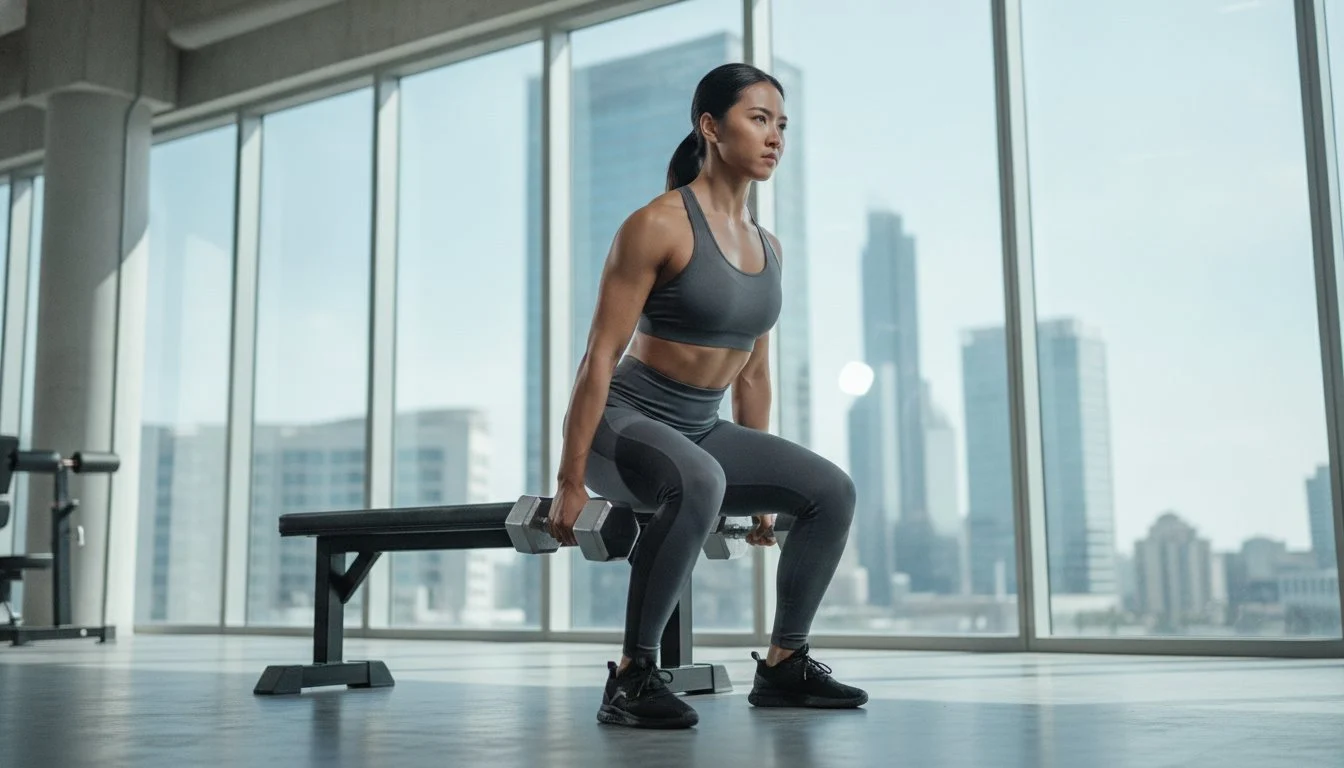
The Bulgarian split squat is the most effective lower-body builder you probably hate. It’s a brutal, high-output movement that exposes every weakness in your kinetic chain. You’ve likely felt the frustration of losing your balance mid-set or dealing with nagging knee pressure that stalls your progress. It’s a common bottleneck. Most athletes struggle with foot placement and stability, turning a powerhouse exercise into a shaky, inefficient mess. You want the gains without the wobbling.
Master this lift to unlock massive glute and quad hypertrophy. We’re stripping away the friction of improper form to give you a streamlined, technical blueprint for success. You’ll learn how to stabilize your base, protect your joints, and load the movement safely for consistent strength gains. This guide covers everything from setup precision to elite tracking strategies. We’re providing the roadmap to move from guesswork to measurable results. Stop wasting energy on unstable reps and start building a foundation of single-leg power today.
Key Takeaways
- Fix strength imbalances and build unilateral power with the bulgarian split squat. This high-output movement exposes weaknesses and forces growth.
- Execute the “Sit and Kick” method for perfect foot placement. Proper setup eliminates knee friction and stabilizes every single rep.
- Reduce spinal compression by switching from traditional barbell squats to this deep-stretch alternative. Maximize your range of motion while protecting your back.
- Scale your intensity using the Hatfield variation and advanced loading strategies. Move beyond bodyweight to trigger serious hypertrophy and strength gains.
- Track your progress with Weights Pro to visualize strength curves. Stop guessing and start hitting data-driven PRs with zero friction.
Why the Bulgarian Split Squat Dominates Your Leg Day
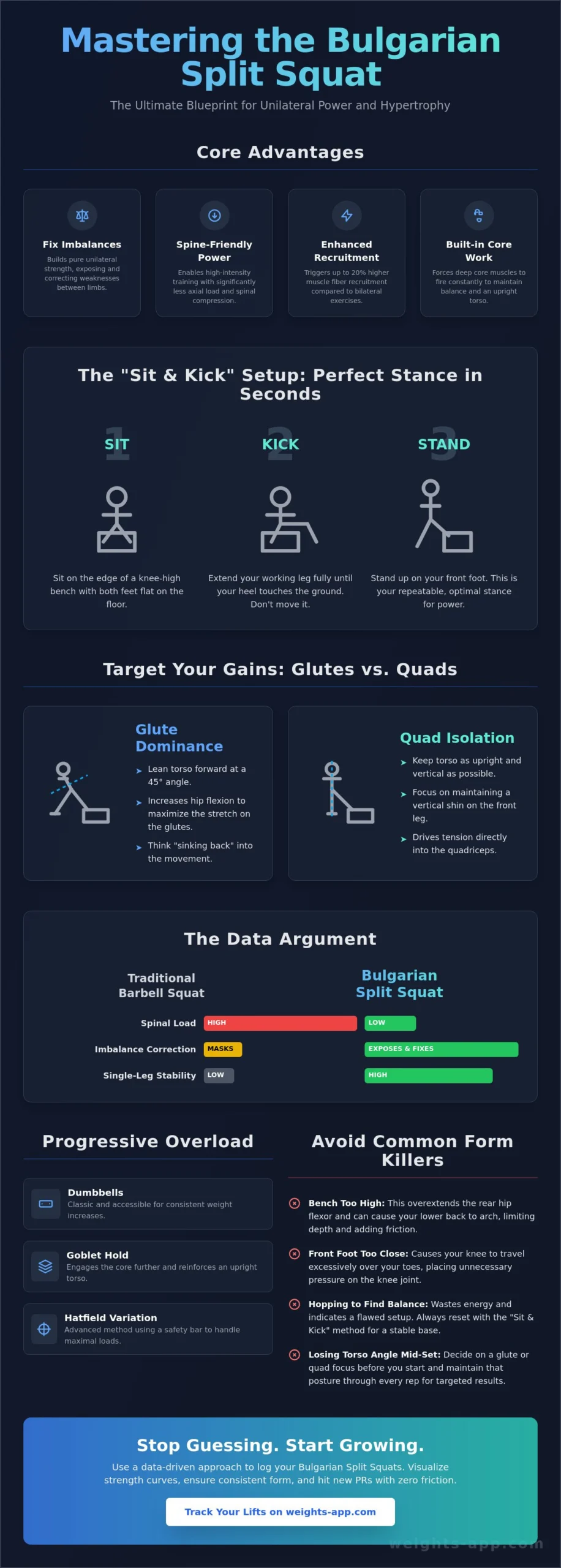
The Bulgarian split squat is a technical powerhouse designed for athletes who value precision over ego. It’s a unilateral movement where you elevate the rear foot on a bench or rack, forcing the lead leg to handle the vast majority of the load. While traditional squats allow you to move more total weight, they often mask deep-seated imbalances. This exercise strips away those hiding places. It’s a brutal, high-output tool that demands total focus and rewards you with elite level strength.
Building massive legs shouldn’t come at the cost of your spine. Heavy barbell squats create intense axial loading, which can lead to lower back fatigue or injury over time. The bulgarian split squat offers a high-intensity alternative with minimal spinal compression. You’re able to push your muscles to failure without your lumbar spine becoming the limiting factor. It’s about training smarter and removing the friction that stops your progress. Your legs will quit long before your back does.
Core stability is a built-in feature of this lift. Because your base is narrow and the load is often offset, your midsection must work overtime to prevent rotation. Your obliques and deep stabilizers fire constantly to keep your torso upright. This isn’t just a leg move; it’s a full-body stabilization test that builds a functional, athletic frame. Athletes serious about tracking their midsection development alongside their leg training will benefit from using a dedicated ab workout tracker app to log core progress with the same precision they apply to their lower body lifts.
The Science of Unilateral Loading
Efficiency is driven by the bilateral deficit. This physiological phenomenon shows that the force produced by one leg alone is often greater than half the force produced by both legs together. Research suggests unilateral training can trigger 20% higher muscle fiber recruitment in the target limb compared to bilateral moves. You’re essentially teaching your brain to unlock more motor units. It’s a no-nonsense way to maximize your output per rep. You don’t need a heavy rack to see professional level gains.
Glute vs. Quad Emphasis
Target your weaknesses by adjusting your geometry. Small changes in your setup shift the tension exactly where you need it. Choose your objective before you start the set to ensure every rep counts.
- Glute Dominance: Lean your torso forward at a 45-degree angle. This position increases the stretch on the gluteus maximus at the bottom of the movement.
- Quad Isolation: Maintain a vertical torso and a vertical shank. Keeping your shin upright drives the load directly into the quadriceps for maximum hypertrophy.
Decide your target, lock in your form, and execute. This movement is about data-driven results, not mindless movement. Master these angles to optimize your training sessions for speed and power.
Mastering the Setup: Perfect Form Without the Friction
Setup is the silent killer of gains. Most lifters spend more time hopping around for balance than actually lifting. Eliminate that friction. The bulgarian split squat demands a rigid foundation before the first rep begins. If your launchpad is shaky, your power output drops. You’re here to build muscle, not practice a balancing act. Precise positioning ensures every ounce of effort goes into your quads and glutes, not into staying upright.
Start with your bench height. It’s a non-negotiable variable. Aim for a height just below your knee level. If the bench is too high, you’ll overstretch your hip flexors and arch your lower back. This creates unnecessary tension and limits your range of motion. Use a standard weight bench or a dedicated single-leg squat stand to keep the elevation consistent. Once you’ve locked in the height, you need to find your distance.
The Three-Step Stability Hack
Stop guessing where your front foot goes. Use the “Sit and Kick” method to find your ideal stance in seconds. It’s the most efficient way to How To Do a Bulgarian Split Squat with technical precision. Follow these steps to remove the guesswork:
- Sit: Sit on the edge of the bench with both feet on the floor.
- Kick: Extend your working leg fully in front of you until your heel touches the ground.
- Stand: Stand up on that front foot without moving it. This is your optimal distance.
Elevate your rear foot and engage your core immediately. You’ve just created a stable, repeatable setup that works every time. If you find yourself losing this position between sets, try logging your setup notes to ensure your next session starts with the same precision.
Common Form Killers to Avoid
Precision requires discipline. Avoid the “Tightrope” mistake by keeping your feet hip-width apart. If your front foot is directly in front of your back foot, you’ll tip. Think “tracks,” not “strings.” This wider base provides the lateral stability needed to handle heavy loads. Anchor your front foot by creating a “tripod.” Press your big toe, pinky toe, and heel into the floor simultaneously. This roots you to the spot and prevents the ankle roll that ruins sets.
Watch your spine. Excessive arching shifts the load from your legs to your lumbar spine. Maintain a neutral pelvis and keep your ribs tucked. As you descend, focus on your back knee. It should travel straight toward the floor, not back toward the bench. If the knee moves backward, you’re likely too far away from the bench, which puts a dangerous stretch on the trailing leg’s hip. Keep the movement vertical to keep the tension where it belongs.
Bulgarian vs. Traditional Squats: The Data Argument
Data doesn’t lie. Traditional back squats are the gold standard for moving maximum mass. But the bulgarian split squat wins on technical precision and joint longevity. While bilateral squats allow for heavier absolute loads, they often introduce “weak link” syndrome. Your lower back or spinal erectors might fail long before your quads are fully exhausted. This exercise removes that bottleneck. It forces your legs to be the limiting factor, ensuring every set drives maximum hypertrophy.
Spinal health is the biggest differentiator. A Biomechanical analysis of Bulgarian split squats shows that you can achieve elite level muscle activation with significantly less axial loading. By holding dumbbells at your sides instead of a barbell on your neck, you eliminate heavy compressive forces on your vertebrae. This is a massive win for athletes who want to push their limits without the risk of lumbar fatigue. You’re trading raw weight for targeted intensity.
Range of motion is the second data point to consider. The rear foot elevation creates a deeper stretch in the hip flexors of the trailing leg. This isn’t just about flexibility; it’s about muscle recruitment. A deeper stretch under load often leads to superior growth. However, tracking this progress is more complex. You aren’t just logging one set of data. You’re managing two independent limbs. Use a dedicated exercise tracker to ensure your left and right legs are progressing at the same rate. This eliminates the friction of manual logging during high intensity sessions.
When to Choose the Split Squat
Athletes with lower back sensitivity should prioritize this move over bilateral versions. It is also an elite choice for a “finisher” after your primary compounds are done. If you notice one leg is stronger or larger than the other, use this movement to correct those aesthetic asymmetries. It’s the most efficient way to balance your physique with surgical precision.
The Benchmarking Challenge
Don’t fall into the trap of comparing these numbers to your back squat. The physics are different. Lifting 50kg on a single leg is a massive feat of strength that doesn’t translate 1:1 to a 100kg back squat because of the stabilization requirements. You need a clear plan for benchmarking your gym progress to see where you truly stand. Focus on zero friction data entry. Your energy should go into the rep, not the math. Stop guessing and start measuring your unilateral power.
Progressive Overload Strategies for Split Squats
Stagnation is the enemy of growth. To keep seeing results, you must apply systematic pressure to your muscles. Progressive overload for the bulgarian split squat goes beyond just adding plates to a bar. You have multiple levers to pull: intensity, volume, density, and tempo. Mastering these variables ensures your central nervous system and muscle fibers never adapt to the point of plateauing. Destroy your quads by manipulating the time under tension. A three-second eccentric (lowering) phase creates massive mechanical tension and metabolic stress. This slow descent forces every fiber to fire, turning even moderate weights into a serious challenge.
Density is your next weapon. Shorten your rest periods to 60 seconds to increase the workload within the same timeframe. This builds work capacity and keeps your heart rate elevated, turning a strength move into a metabolic powerhouse. If you’ve mastered standard reps, move to the “Hatfield” variation. Hold onto a power rack for balance while loading a safety squat bar or heavy dumbbells. This eliminates the stability bottleneck and allows you to push toward absolute muscular failure with zero friction. You’re no longer limited by your balance; you’re limited only by your grit.
Variations for Every Level
Start where you are and scale with data. Every athlete has a different entry point for the bulgarian split squat. Use these tiers to guide your progression:
- Beginner: Perform bodyweight reps with one hand on a wall for balance. Focus on the “tripod foot” and neutral spine discussed in the setup section.
- Intermediate: Introduce external load. Use a goblet-style hold for core engagement or dual dumbbells to challenge your grip and stabilizers.
- Advanced: Execute deficit Bulgarian split squats. Elevate your front foot by two to four inches using a weight plate or aerobic step. This increases the range of motion and puts the glutes under an extreme stretch.
How to Log Your Sets Efficiently
Data integrity is vital for unilateral training. You cannot manage what you do not measure. Always start your set with your weaker leg. This ensures your dominant side doesn’t outpace your progress, maintaining symmetry and preventing future injury. Log each leg as a separate entry to identify specific strength gaps over time. This level of detail is impossible with old-school notebooks. Use a minimalist gym log to capture your data without losing focus between grueling sets. Stop wasting time on manual entry and start hitting PRs. Upgrade your training with Weights Pro for advanced analytics that track your unilateral growth automatically.
Tracking Your Bulgarian Progress with Weights Pro
Leg day is a battlefield. When you finish a grueling set of the bulgarian split squat, the last thing you want to do is fumbled with a pen and a sweat-soaked notebook. Manual logging is slow. It creates friction. It breaks your momentum and pulls you out of the zone. You need a digital tool that matches the intensity of your training. Weights Pro is designed to eliminate that friction. It allows you to log your reps and sets in seconds, ensuring your focus remains on the next set, not the math.
Unilateral training requires double the data entry of bilateral moves. You have two independent limbs to track, each with its own strength curve and fatigue level. Weights Pro simplifies this process by allowing you to create custom routines that prioritize unilateral dominance. You can log each leg separately to identify strength gaps and ensure your symmetry is on point. The zero-distraction interface means there are no ads or social feeds to clutter your session. It’s just you, the weights, and your data. The same philosophy applies to core training — athletes who want to track weighted ab work with equal precision should explore a purpose-built ab workout tracker app that handles every exercise without friction.
The Power of Visual Data
Raw numbers are hard to digest in the heat of a workout. Visual data transforms those numbers into actionable insights. By using the advanced analytics in Weights Pro, you can visualize your strength curves to see exactly when you hit a PR. These charts help you predict your next personal record by identifying trends in your volume and intensity. Seeing the “momentum” of your training through history logs provides the psychological edge needed to push through plateaus. Data visualization validates your hard work in the gym by turning invisible effort into a measurable trajectory of growth.
Upgrade to Weights Pro for Unlimited Gains
Serious athletes don’t let their tools limit their potential. Upgrading to Weights Pro unlocks unlimited routine storage and advanced progress tracking that grows with you. If you’re tired of subscription fatigue, the Weights Pro Lifetime option offers a one-time purchase for permanent access to elite features. It’s a long-term investment in your performance. You can also choose Weights Pro Monthly or Weights Pro Yearly if you prefer a flexible plan. With full Apple Watch integration, you can even leave your phone in the locker and track your entire session from your wrist. Stop guessing and start winning. Download Weights app and start logging your split squats today.
Dominate Your Next Leg Session
Success in the bulgarian split squat isn’t just about grit. It’s about technical precision and data-driven execution. You’ve mastered the “Sit and Kick” setup. You understand how to shift load between your glutes and quads with surgical accuracy. You know that single-leg power is the fastest way to correct imbalances while protecting your spine. Now, it’s time to put that knowledge into action with a system that tracks every single rep.
Don’t let your progress get lost in a cluttered notebook or a social-heavy fitness app. You need a streamlined tool built for serious athletes who value efficiency. Experience a zero-friction training environment with a streamlined iOS design and visual progress charts that show your growth in real time. There are no social distractions to break your focus. Master your training with Weights app and start visualizing your gains today. You’ve got the blueprint. Now, go out and earn the results. Your strongest version is waiting.
Frequently Asked Questions
Are Bulgarian split squats better than traditional squats?
Bulgarian split squats are superior for muscle isolation and lower back health. Traditional squats allow for more total weight, but the bulgarian split squat forces each leg to work independently. This removes the “weak link” of a tired lower back. Use them to target hypertrophy without the heavy axial loading of a barbell. They aren’t better in a vacuum; they’re a different tool for specific athletic goals.
How high should the bench be for a Bulgarian split squat?
Set your bench height just below your knee level. A bench that’s too high forces your lower back to arch and puts excessive strain on the trailing leg’s hip flexors. This limits your range of motion and kills your power. If you feel a sharp pull in your back leg, lower the platform. Consistency in height is key for tracking your strength gains accurately over time.
Why do Bulgarian split squats hurt my knees?
Knee pain usually stems from improper weight distribution or a stance that’s too narrow. Ensure your front foot is flat and firmly rooted. Your front knee should stay tracked over your mid-foot, not caving inward. If your back knee hurts, you’re likely placing too much weight on the rear leg. Shift 80% of the load to the front leg to protect your joints.
How far should my front foot be from the bench?
Your front foot should be far enough away to allow a deep descent while keeping your heel on the floor. Use the “Sit and Kick” method to find this distance instantly. Sit on the bench, extend your leg fully, and stand up where your heel lands. This creates a repeatable, stable base that ensures your mechanics remain consistent across every single training session.
Can I do Bulgarian split squats every day?
Avoid daily split squats due to the high metabolic stress they place on your central nervous system. These are high-intensity movements that require significant recovery time for muscle repair. Aim for two to three times per week. Quality reps drive hypertrophy; overtraining just drives fatigue. Listen to your data and rest when your strength curves start to dip in your logs.
Should I use a barbell or dumbbells for split squats?
Dumbbells are the gold standard for most athletes. They allow for a lower center of gravity and easier balancing. Use a barbell only if you have elite level stability and want to push extreme loads. Dumbbells also allow you to drop the weight safely if you hit failure. For most, the “Hatfield” variation with a safety bar is the ultimate compromise for heavy loading.
What muscles do Bulgarian split squats work the most?
This movement primarily targets the quadriceps, glutes, and adductors. Your torso angle dictates which muscle group takes the lead. Lean forward to hammer the glutes or stay upright to isolate the quads. Your core and stabilizers also fire constantly to maintain balance. It’s a comprehensive lower body builder that leaves no muscle untouched during your session.
How do I stop falling over during split squats?
Stop treating the movement like a tightrope walk. Widen your stance to hip-width to create a stable base of support. Root your front foot using the “tripod” technique: press your big toe, pinky toe, and heel into the ground simultaneously. If you’re still wobbling, keep one hand on a wall or rack until your stabilizers catch up to your prime movers.
Ready To Get Started?
Everything you need. Nothing you don’t.
Weights adapts to your goals today and scales with the strength you’ll have tomorrow.