
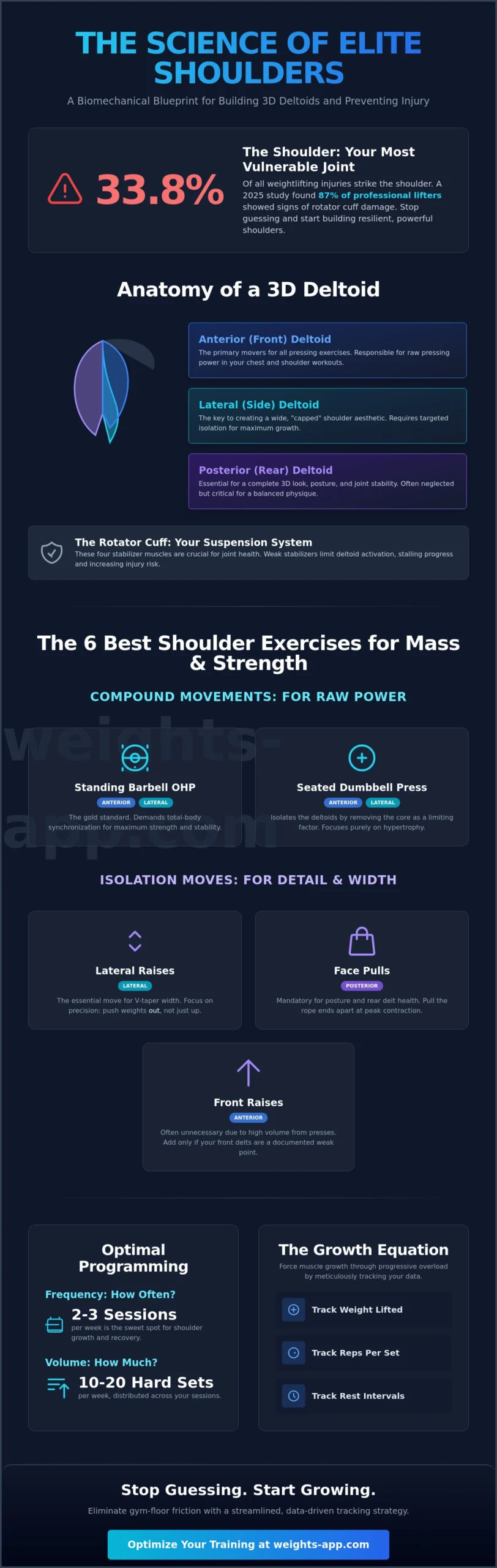
33.8% of all weightlifting injuries strike the shoulder. It’s the most vulnerable joint in the weight room. A 2025 study of professional lifters even found that 87% showed signs of rotator cuff damage. You want the capped look and the raw pressing power, but your current shoulder workouts might be doing more harm than good. Most programs fail because they’re built on guesswork instead of biomechanics.
You know that building elite shoulders requires more than just spamming lateral raises. You need a strategy that balances heavy compound tension with surgical isolation. This article delivers the precise science of modern training. You’ll master the three-headed anatomy of the deltoid, select the most efficient exercises for 2026, and learn to track your volume with zero friction. It’s time to stop guessing and start growing. We’re diving into the mechanics of width, the secrets of stability, and the data-driven habits that turn stalled lifts into new personal records.
Key Takeaways
- Target all three deltoid heads to unlock a 3D, capped aesthetic.
- Master the overhead press for raw power and lateral raises for maximum width within your shoulder workouts.
- Optimize frequency and volume with 2-3 sessions and 10-20 hard sets weekly.
- Force muscle growth through progressive overload by tracking weight, reps, and rest intervals.
- Eliminate gym-floor friction with a streamlined, data-driven tracking strategy.
Understanding Shoulder Anatomy for 3D Growth
Precision training starts with a clear blueprint. You can’t build a high-performance machine without knowing how the gears turn. Mastering Understanding Shoulder Anatomy is the difference between aesthetic mastery and a nagging injury. The deltoid is a complex, three-headed muscle system designed for multi-planar movement. To build shoulders that look powerful from every angle, you must target each head with specific intent.
- Anterior (Front) Deltoid: These are your primary movers. They drive every pressing variation in your shoulder workouts. If you’re benching, dipping, or overhead pressing, these muscles are under significant tension.
- Lateral (Side) Deltoid: This head is the key to shoulder width. It creates the “capped” look that defines a wide, athletic frame. Because it’s less active in compound presses, targeted isolation is the only way to maximize its growth potential.
- Posterior (Rear) Deltoid: Often ignored, but absolutely essential. These muscles pull the shoulders back and provide the thickness required for a complete 3D look. They act as the anchor for the entire joint during heavy lifts.
The Role of the Rotator Cuff
Your deltoids are the engine, but the rotator cuff is the suspension system. This group consists of four stabilizing muscles: the supraspinatus, infraspinatus, teres minor, and subscapularis. They work in unison to hold the humerus bone firmly in the shoulder socket. The rotator cuff is the dynamic stabilizer of the joint. You must prioritize stability before you chase heavy loading. If these stabilizers are weak, your body will actually limit deltoid activation to prevent injury. It’s a built-in safety mechanism that can stall your progress if ignored.
Why Balance Matters in Shoulder Programming
Most lifters suffer from “front-loading” their physique. They hammer the bench press and overhead press while neglecting the rear of the joint. This creates a massive mechanical imbalance. Over-developed front delts pull the humerus forward, leading to a “hunched” posture and eventual impingement. Effective shoulder workouts require a calculated balance of pulling and pressing volume. Balancing your training ensures your posture stays upright and your joints stay fluid. It’s about longevity and leverage. A balanced deltoid isn’t just about aesthetics; it’s about maintaining the structural integrity needed for lifetime gains.
The 6 Best Shoulder Exercises for Mass and Strength
Anatomy is the map. Exercise selection is the vehicle. High-impact shoulder workouts rely on a core group of movements that deliver maximum stimulus with zero wasted effort. We’re prioritizing lifts that build structural integrity and raw mass. You need a calculated mix of heavy compounds and surgical isolation to achieve the capped look. Integrating these specific moves into your shoulder workouts ensures you hit every muscle fiber from the front to the back.
Compound Movements for Raw Power
The Standing Barbell Overhead Press is the gold standard for upper body strength. It demands total-body synchronization. You aren’t just pushing weight; you’re stabilizing your entire kinetic chain. Squeeze your glutes. Brace your core. Drive the bar in a straight line. This stability provides a foundation that dumbbells simply can’t match.
Seated Dumbbell Presses offer a different advantage. They remove the core as the primary limiting factor. This allows you to focus purely on deltoid hypertrophy. Dumbbells also allow for a more natural, individualized path of motion. This versatility makes them a staple in any Best Shoulder Exercises for Mass and Strength routine. For those seeking variety, the Arnold Press adds a rotational element. It increases the time under tension for the anterior head and forces the muscle to work through a deeper range of motion.
Isolation Moves for Detail and Width
Side delt growth creates the V-taper. To achieve this, you must master lateral raises. Most lifters fail here by using excessive weight and shrugging with their traps. Keep your shoulders depressed. Think about pushing the weights out toward the walls rather than just pulling them up. Precision beats ego every time.
Posterior health depends on the rear delts. Use face pulls to target the back of the joint and your external rotators. Pull the rope toward your forehead. Pull the ends apart at the peak of the contraction. This movement is mandatory for counteracting the forward-shoulder lean caused by heavy benching. Finally, consider front raises. These are often unnecessary because your anterior delts handle massive volume during compound presses. Only add them if your front delts are a documented weak point. Don’t add clutter to your program. Focus on the big movers. If you want to see exactly how these lifts impact your strength curve, use a streamlined workout log to monitor your daily output.
Programming Your Shoulder Workout: Volume and Frequency
Frequency is the ultimate lever for growth. Muscle protein synthesis typically returns to baseline within 48 to 72 hours. If you only train shoulders once a week, you’re leaving growth on the table for four days. Hit your shoulder workouts 2-3 times per week to keep the anabolic signal high. Aim for a total weekly volume of 10-20 hard sets. Distribute these sets across all three heads to ensure balanced development. Don’t cram all 20 sets into a single marathon session. Your intensity will crater. Split the volume. Stay sharp.
Choosing between a “Push Day” and a dedicated “Shoulder Day” depends on your recovery. A dedicated day offers localized focus but often sacrifices frequency. An integrated approach is usually superior for natural lifters. It allows you to hit the delts more often without burning out. Use intensity techniques like rest-pause sets for the lateral delts. They recover fast. Shorten the rest. Keep the tension high. This is how you force adaptation when Programming Your Shoulder Workout for elite results. It’s about data-driven decisions, not ego-driven lifting.
Designing a Push Day Integration
Integrate your deltoid training into a push day workout to maximize your time. Efficiency is the priority. Always perform your overhead compound work before moving to chest isolation. Your triceps and front delts are freshest at the start of the session. Use that energy for heavy presses. Balance your horizontal and vertical volume. For every set of chest pressing, ensure you’re matching it with vertical or lateral work. This prevents the postural imbalances discussed in the anatomy section. It also ensures your physique stays symmetrical and functional. Since your triceps are heavily recruited during all pressing movements, pairing your shoulder sessions with focused tricep workouts is a smart way to maximize upper arm development on push days.
Rep Ranges for Hypertrophy vs. Strength
Target different adaptations with varied rep ranges. Use 5-8 reps for heavy barbell or dumbbell presses. This builds a foundation of raw power. Move to the 12-20 rep range for isolation work like lateral raises and face pulls. This range maximizes metabolic stress and cell swelling. Lateral delts thrive on high-volume, high-rep finishers. Don’t be afraid to push into the 20-30 rep range with drop sets. The goal is to maximize the pump and drive nutrients into the tissue. This combination of heavy tension and metabolic fatigue is the secret to 3D growth. It’s a calculated assault on the muscle fibers.
Progressive Overload: Tracking Your Shoulder Gains
Progressive overload is the biological requirement for growth. It isn’t a suggestion. Your body won’t build new muscle tissue unless you force it to adapt to increasing demands. Effective shoulder workouts require a relentless pursuit of better numbers. If you aren’t tracking your lifts, you’re just guessing. Guessing leads to plateaus. You need a system that captures every variable in real-time to ensure you never waste a single set. Success in the gym is a data problem. Solve the data, and the results follow.
You have three primary levers to drive progress in your shoulder workouts. The first is load. Add weight to the bar or grab heavier dumbbells. The second is volume. Perform more reps with the same weight. The third is density. Shorten your rest intervals to do the same work in less time. For compound moves like the overhead press, focus on adding weight. For isolation moves like lateral raises, focus on reps and density. Manipulating these levers prevents stagnation and keeps your central nervous system engaged.
The Problem with Paper Logs and Social Apps
Paper logs are relics. They’re slow. They make data visualization impossible. You can’t see a trend line on a crumpled notebook page. Social-heavy apps are even worse. They distract you with feeds, likes, and ads when you should be focused on your next set. Every second spent scrolling is a second of lost intensity. You need a minimalist approach that removes friction. High-performance training requires a tool that stays out of your way while capturing the metrics that matter most. Efficiency is the only priority. A dedicated exercise tracker built for performance eliminates these distractions and keeps your focus locked on the iron.
Visualizing Your Strength Level
Charts reveal the truth. They show exactly when your strength curve flattens. Use historical data to set targets before you even touch the bar. Knowing you hit 85 pounds for 8 reps last week gives you a clear objective for today. Tracking Personal Records (PRs) is your primary motivational driver. It turns every session into a competitive challenge against your past self. Data-driven training eliminates ego lifting by replacing subjective feelings with objective performance metrics. You stop chasing a “pump” and start chasing measurable output. If you’re ready to professionalize your progress, start tracking with a precision workout log today. Your future gains depend on the data you collect right now.
Optimize Your Training with Weights app
Execution is only half the battle. The other half is management. Weights app is built for efficiency. It’s designed for the serious lifter who treats the gym like a laboratory. You won’t find bloated social feeds or intrusive ads here. There are no distractions. It’s just you and your data. iCloud Sync keeps your workout history secure and accessible across your entire ecosystem. This isn’t a social network; it’s a high-performance utility built to handle the intensity of your shoulder workouts without getting in the way.
Customization is the core of the experience. You can build the exact routines we’ve discussed and save them as reusable templates. Map out your pressing and isolation work in advance. When you hit the gym floor, your only job is to execute. The app handles the math. It remembers your last set. It highlights your progress. It turns a chaotic training session into a streamlined, data-driven operation. Stop wasting time with generic programs. Build a routine that fits your specific mechanical needs and log it in seconds.
Frictionless Logging on iOS
Speed defines the interface. Creating a custom routine on iOS is intuitive and fast. You don’t want to be fumbling with a phone between heavy sets. The Apple Watch advantage takes this a step further. Log your reps and weight directly from your wrist. It’s the ultimate way to stay in the zone. You keep your phone in your bag and your focus on the iron. The streamlined interface is engineered for fast-paced training where rest intervals are strictly managed. Every tap is intentional. Every screen is optimized for the gym environment.
Weights Pro: Unlock Your Full Potential
Professional results require professional tools. Weights Pro Monthly, Weights Pro Yearly, and Weights Pro Lifetime offer tiered access to our most powerful features. Unlock advanced data visualization to identify exactly when your strength curve is ready for a new peak. See your progress through clean, actionable charts that show the reality of your growth. These Pro tiers provide unlimited routines for every training phase. Whether you are in a high-volume hypertrophy block or a heavy strength cycle, your data stays organized and protected.
Precision is the path to the capped look you’re chasing. Don’t leave your shoulder development to chance or memory. Use a tool that values your time as much as you value your gains. Start tracking your shoulder progress with Weights app and professionalize your approach to the iron. Your data is the most valuable asset you own. Start treating it that way today. Let’s get to work.
Master Your Mechanics
Eliminate the guesswork. Your future gains depend on the precision of your current sessions. Experience a highly-rated iOS workout tracker designed specifically for serious lifters. You get a minimalist design with zero ads. You get secure iCloud sync for all your gym data. It’s time to professionalize your progress and own your results. Download Weights app on iOS and log your first workout today. The iron doesn’t lie. The numbers don’t either. Stay focused. Stay data-driven. Go get it.
Frequently Asked Questions
How often should I do shoulder workouts for mass?
Aim for 2-3 sessions per week to maximize muscle protein synthesis. Spacing your shoulder workouts every 48 to 72 hours ensures the tissue recovers and grows. High frequency beats a single “shoulder day” for most natural lifters. It keeps the anabolic signal active throughout the entire week and allows for higher total weekly volume.
Can I build big shoulders with only dumbbells?
Absolutely. Dumbbells are elite tools for hypertrophy because they allow a deeper, more natural range of motion. They also force each side to work independently. This fixes strength imbalances and creates a more symmetrical look. You don’t need a barbell to build a powerhouse physique if you prioritize heavy pressing and high-rep isolation with dumbbells.
Why do my shoulders click when I do overhead presses?
Clicking is usually a sign of poor joint tracking or weak stabilizers. It often happens when the humerus isn’t seated properly in the socket during the lift. Focus on your rotator cuff stability and adjust your elbow path slightly forward. If the clicking is painful, stop immediately. Never push through sharp joint pain; it’s a signal to check your mobility.
What is the best exercise for the side delts?
Lateral raises are the gold standard for side delt isolation. Use cables or dumbbells to drive blood into the muscle and create width. Focus on pushing the weight away from your body toward the walls rather than just lifting it up. This cue minimizes trap involvement and maximizes the tension on the lateral head for that 3D look.
How many exercises should I do in a shoulder workout?
Target 3-5 high-quality exercises per session. Start with one heavy compound press for raw power. Follow up with 2-4 isolation moves to hit the lateral and posterior heads specifically. Quality always beats quantity in shoulder workouts. Stop doing junk volume and start focusing on the intensity of every single rep to see real results.
Should I train shoulders before or after chest?
Prioritize the muscle group you want to grow most. If you want bigger shoulders, train them first when your energy and focus are at their peak. Many lifters find that training shoulders after chest leads to fatigue and compromised form. Split your volume across different days to ensure you hit every set with maximum intensity.
Is the behind-the-neck press safe for beginners?
Avoid this move if you lack elite shoulder mobility. It places the joint in an extremely vulnerable position at the bottom of the rep. Most beginners don’t have the thoracic flexibility to perform it safely without risking a rotator cuff tear. Stick to traditional overhead presses to build a strength base without the unnecessary injury risk.
How do I know if I am overtraining my shoulders?
Watch for stalled strength and persistent joint aches. If your overhead press numbers are dropping week after week, your central nervous system needs a break. Persistent pain in the front of the joint often signals overuse or poor recovery. Track your training data to spot these negative trends before they turn into long-term injuries.
Ready To Get Started?
Everything you need. Nothing you don’t.
Weights adapts to your goals today and scales with the strength you’ll have tomorrow.