Your heaviest lift is useless if your data is light. What if the most vital workout tool in your arsenal isn’t a barbell, but the digital precision you’re currently ignoring? You’ve felt the sting of a plateau. You’ve forgotten the exact weight used in your last session. You’ve fought with cluttered apps that distract you from the iron. It’s exhausting. By May 2026, nearly 50% of gym-goers have turned to fitness trackers to eliminate this friction. You don’t need more gear. You need better systems.
We know you’re tired of the guesswork and the noise. You deserve a training environment where every movement is measured and every session builds on the last. This guide promises to show you how to combine physical gear with digital precision to maximize every rep and accelerate your strength gains. We’ll explore the essential minimalist setup, the shift toward invisible tech like the Ultrahuman Ring AIR, and the streamlined workflows that keep your focus on the lift. Let’s build your most efficient training year yet.
Key Takeaways
- Redefine your gear as instruments of adaptation. Master the “Big Three” hardware essentials and use grip tools to shatter stubborn strength plateaus.
- Weaponize your data to eliminate the guessing game of what weight to lift next. A digital workout tool provides the roadmap you need to manage resistance and ensure every set leads to growth.
- Build a high-performance stack based on your specific training goals. Discover why a minimalist, objective-driven gear selection outperforms a cluttered gym bag every time.
- Transition to a zero-friction tracking workflow. Shift your focus from managing complex software to crushing reps with a “log and go” philosophy designed for the gym floor.
Beyond the Dumbbell: Defining the Modern Workout Tool
Stop thinking of your gear as just cold iron. In 2026, a workout tool is any instrument, physical or digital, that facilitates physical adaptation. It’s the bridge between your current state and your peak performance. Traditionally, exercise equipment was defined by what you could touch and move. Today, that definition has expanded. Your phone is now as vital as your squat rack. You aren’t just “lifting” anymore. You’re managing resistance through a sophisticated system of load and logic.
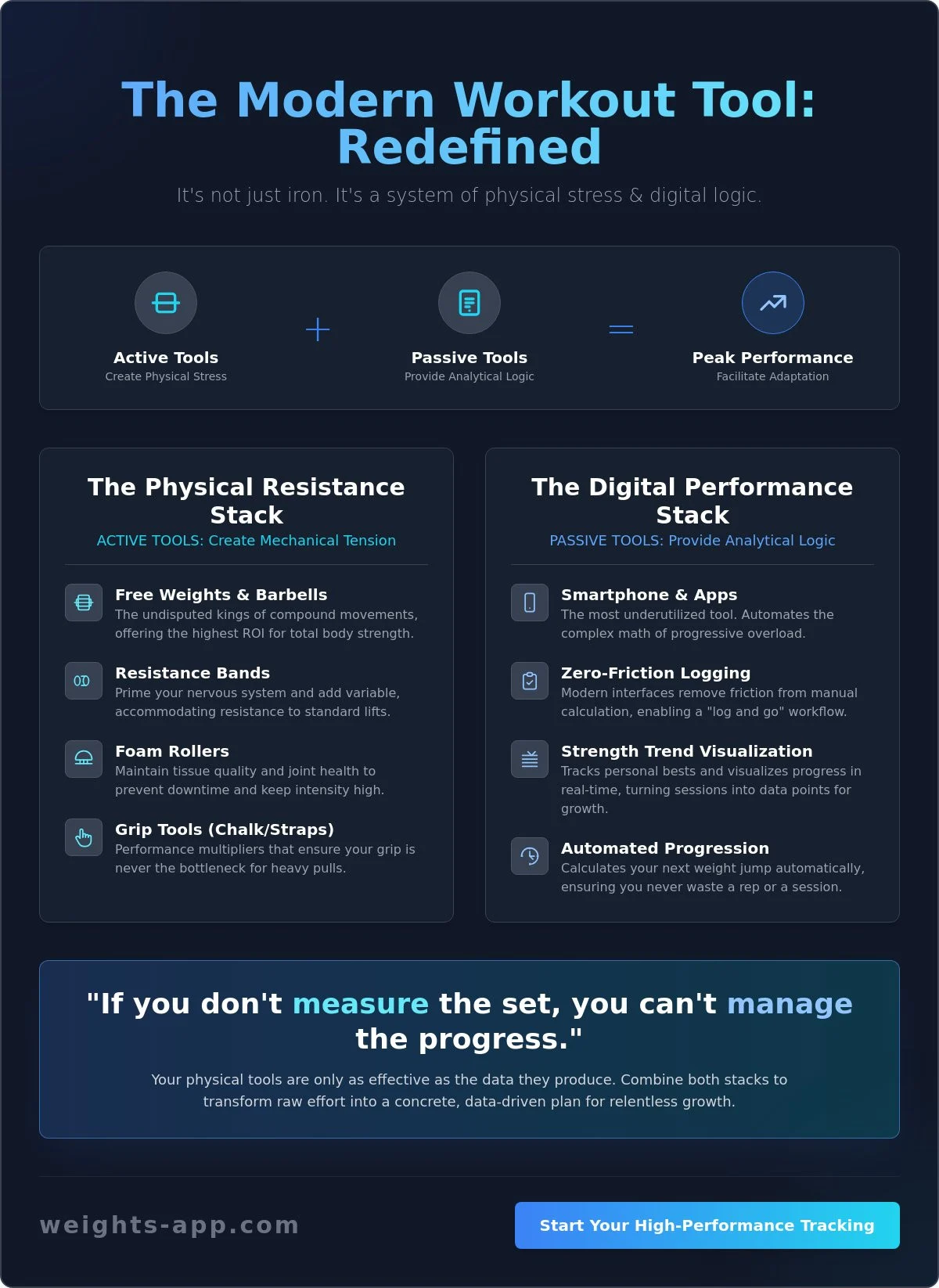
Active tools create the physical stress. Passive tools provide the analytical logic. A barbell is an active tool; it creates the mechanical tension required for growth. A digital log is a passive tool; it ensures that tension is applied correctly over time. Without the data, your effort is just noise. Your tools are only as effective as the data they produce. If you don’t measure the set, you can’t manage the progress.
The Physical Resistance Stack
Efficiency starts with your primary resistance tool. Free weights offer the highest ROI for total body strength. Machines provide targeted isolation for specific muscle groups. For raw power, the barbell remains the undisputed king of compound movements. It forces the most muscle fibers to fire simultaneously and builds a foundation of functional strength. Don’t ignore accessory tools that keep your primary hardware operational:
- Resistance Bands: Prime your nervous system and add variable resistance to standard lifts.
- Foam Rollers: Maintain tissue quality and joint health to prevent downtime.
- Grip Tools: Use chalk or straps to ensure your grip isn’t the bottleneck for heavy pulls.
These aren’t just for recovery. They’re essential for maintaining the intensity required for adaptation.
The Digital Performance Stack
Your smartphone is the most underutilized workout tool in your gym bag. Use it to automate the complex math of progressive overload. The gym log has evolved from messy paper notebooks to minimalist iOS interfaces. These digital tools remove the friction of manual calculation and memory. Digital software like Weights app allows you to log and go. It tracks your personal bests, calculates your next weight jump, and visualizes strength trends in real time. This automation ensures you never waste a rep. It turns every session into a concrete data point for future growth. High-end training requires high-end tracking.
Essential Hardware: The Tools That Build Raw Strength
Raw strength requires heavy resistance. You can’t hack biology; you have to challenge it. The Big Three hardware tools, barbells, dumbbells, and squat racks, remain the foundation of every elite program. The barbell is your primary instrument for total load. The squat rack is your insurance policy for safety and intensity. Without these, you’re just playing at fitness. Muscle-strengthening activities depend on this high-level physical tension to trigger hypertrophy and bone density gains.
Don’t let your grip be the bottleneck. If your back can pull 400 lbs but your hands fail at 300, you’re leaving gains on the table. Use chalk or straps. These aren’t crutches. They are performance multipliers that allow your larger muscle groups to reach true failure. Pair them with fractional plates. These small tools allow for micro-loading, adding as little as 0.25 lbs to the bar. It is the only way to sustain progress when the standard 5 lb jump becomes impossible. An adjustable bench completes the set. It turns a single corner of your room into a versatile training hub for hundreds of pressing and rowing variations.
Free Weights vs. Calisthenics Tools
Prioritize dumbbells for hypertrophy and structural symmetry. They force each limb to work independently. This exposes weaknesses that barbells often hide. If you prefer bodyweight, gymnastic rings and pull-up bars are your best friends. They offer a unique stimulus through instability and vertical pulling. Mechanical tension is the primary driver of muscle growth. Whether you use iron or your own mass, the resistance must be absolute and progressive.
The Home Gym Minimum Viable Product (MVP)
You don’t need a commercial warehouse to get results. Start with three tools: an adjustable bench, a set of dumbbells, and a pull-up bar. Space-saving innovations have changed the game in 2026. Adjustable dumbbells like the NÜOBELL range from 5 to 80 lbs in a single footprint. Folding racks allow you to reclaim your garage after the session. One versatile workout tool can serve ten different movement patterns if you are smart. Efficiency is about maximizing utility per square foot. Keep your setup lean and your data cleaner by using a minimalist tracking interface to log every session. This ensures your physical effort translates into measurable strength trends.
Choosing the right workout tool for your primary lift is only half the battle. The other half is ensuring you actually beat your previous numbers. By focusing on these hardware essentials, you remove the fluff and leave only the work that matters.
The Data Tool: Why Tracking is Your Ultimate Performance Multiplier
Measurement is the prerequisite for mastery. If it isn’t measured, it isn’t managed. In the pursuit of elite strength, your most powerful workout tool is the data you generate during every set. Many lifters rely on “feel,” but feel is a liar. It’s influenced by sleep, caffeine, and ego. Data is objective. It provides a cold, hard look at your actual output versus your perceived effort. By May 2026, nearly 50% of gym-goers have adopted fitness trackers to eliminate the “guessing game” of what weight to lift next. They aren’t just recording history; they’re engineering their future.
Visual momentum is a psychological weapon. Progress charts create a sense of accomplishment that the mirror cannot provide on a daily basis. Seeing a steady upward trend in your squat volume is more motivating than a subjective mirror check. This data also acts as your primary safety net. When your performance metrics dip across multiple sessions, the data signals a need for recovery. It identifies fatigue before it turns into an injury or a long term plateau. Tracking turns a chaotic gym session into a streamlined, scientific process.
Progressive Overload Automation
Muscle growth is a math problem. Modern tracking tools automate this calculation by analyzing your volume, intensity, and frequency. They determine exactly when to add weight to the bar to keep the stimulus high. This automation reveals plateau warning signs early. If your total tonnage hasn’t increased in three weeks, the data demands a change in your program. To master this logic, consult The Ultimate Workout Tracker Guide and learn how to stop guessing and start growing.
Visualizing the Gains
Raw numbers are only useful when they are actionable. Data visualization transforms a list of sets and reps into a clear trajectory of growth. A 10% increase in weekly volume is a verifiable victory. It proves your program is working even when your body weight remains the same. Use your history logs to audit your training intensity. Reviewing your past three months of data allows you to spot patterns of success or failure. This audit ensures that every hour spent in the gym contributes to your ultimate goal. Don’t just lift. Analyze, adapt, and accelerate.
Building Your Tool Stack: A Goal-Based Selection Guide
More gear often leads to less progress. It’s called the Tool Fatigue trap. You spend more time adjusting straps and scrolling through bloated apps than actually moving weight. A cluttered gym bag kills intensity. In 2026, the elite athlete prioritizes a minimalist stack. You need a workout tool that serves a specific purpose, not a gadget that collects dust. Effectiveness is found in selection, not accumulation. Cut the noise and build a stack that matches your specific objective.
Address the phone objection early. You don’t want to spend your entire session staring at a screen. We agree. A high-performance digital tool should be a “log and go” utility. It functions like a stopwatch or a belt. It is there when you need it and invisible when you don’t. Use your device as a precision instrument to automate the data while your mind stays on the iron. This approach ensures your digital workout tool supports your training rather than distracting from it.
The Bodybuilders Toolset
Hypertrophy requires volume and isolation. Your stack should prioritize dumbbells, cables, and adjustable benches. Tracking for this group isn’t just about weight; it’s about Time Under Tension (TUT). You need a log that allows for custom routine creation to target specific muscle groups from multiple angles. If your software doesn’t let you build a unique routine for isolation movements, it is a bottleneck. Focus on high-volume metrics to ensure you are fatiguing the muscle, not just moving the load. Visualizing volume trends is your primary way to confirm growth.
The Powerlifter’s Precision Kit
Powerlifting is a game of percentages. Your stack centers on the barbell, the rack, and the bench. Every set is governed by the Big Three. Accuracy is non-negotiable here. Use digital tools to track your Rate of Perceived Exertion (RPE) and calculate your one-rep max percentages on the fly. This prevents overreaching during heavy, taxing cycles. Zero-friction logging is essential during a 90% load set. You need a system that handles the math so you can focus on the lockout. Precision beats effort every single time.
Stop guessing your numbers and start engineering your strength. Build your perfect stack today by upgrading to Weights Pro for the ultimate minimalist training experience.
Weights app: The Zero-Friction Tool for Serious Training
Bloated apps are the enemy of intensity. Most fitness software is designed for the couch, filled with social feeds and unnecessary distractions that pull you away from the iron. Weights app is the minimalist antidote. It is built for the gym floor. Our “Log and Go” philosophy ensures that your phone remains a high-performance workout tool, not a digital trap. You enter your numbers, see your target, and get back to the work. No fluff. No scrolling. Just progress. If you’ve ever wondered whether a premium workout tracker truly outperforms free apps, the answer lies in the friction you eliminate every single session.
Eliminate the friction of complex interfaces. When you are deep into a heavy session, you don’t have the cognitive bandwidth to navigate three sub-menus just to log a set of squats. You need speed. You need reliability. By focusing on a streamlined, utility-first design, we ensure that every interaction takes seconds. This keeps your heart rate up and your focus sharp. You’ve already built your physical resistance stack; now it’s time to finalize your digital one with a tool that respects your time and your effort.
Designed for iOS Efficiency
Speed is a feature. Weights app is built with a native iOS design to ensure maximum performance and seamless integration with your device. This isn’t a slow, web-based wrapper. It is a fast, responsive instrument that handles your data with precision. Create custom routines that match your specific goals, whether you are chasing hypertrophy or raw power. Your training is unique. Your workout tool should be too. Build your own path without the clutter of pre-packaged, generic programs. Explore the interface at the Weights app home and see how simplicity drives results.
Your Progress, Visualized
Data is only powerful if you can see it. Weights app transforms your raw logs into high-impact growth charts, allowing you to visualize strength trends instantly. You don’t need to be a data scientist to understand if you are getting stronger. The app does the heavy lifting, showing you exactly where you’ve peaked and where you’re ready to break a new personal record. This is the ultimate performance multiplier for the disciplined athlete who values logic over guesswork.
Invest in your long-term growth. We offer Weights Pro Monthly and Weights Pro Yearly for those who want consistent, data-driven updates. For the ultimate commitment to your craft, Weights Pro Lifetime provides the “Lifetime Access” advantage. This is the last training utility you will ever need to buy. Stop guessing and start growing. Choose your plan and turn your phone into the ultimate minimalist tool today.
Execute Your Evolution
You have the hardware. You have the goal. Now you need the system to bridge the gap. Physical resistance builds the muscle, but digital precision ensures that effort isn’t wasted on a plateau. Every rep you track is an investment in your future strength. Your smartphone is no longer a distraction. It is the most critical workout tool in your possession when equipped with the right software. Efficiency is the only way forward in 2026.
Stop settling for bloated apps that bury your gains under social feeds and generic advice. You deserve a platform built for the gym floor. Experience iOS native speed and a custom routine builder that adapts to your unique training style. Turn your raw logs into visual progress charts that prove your growth. It is time to remove the friction and find your edge. Lock in your progress with Weights Pro Monthly, Yearly, or Lifetime access. This is about more than just lifting; it is about mastering the math of muscle.
Master your data and your reps with Weights app. The iron doesn’t lie. Now your data won’t either. Step up and execute.
Frequently Asked Questions
What is the most important workout tool for a beginner?
The most vital tool for a beginner is a reliable digital log. Before you invest in heavy iron, you must master the logic of progressive overload. Recording every set ensures you aren’t just guessing your way through the gym. It builds the habit of data-driven training which is the foundation of long term muscle growth.
Can a workout app really replace a personal trainer?
A high-quality app replaces the analytical side of coaching by automating your programming and weight jumps. It handles the math and volume tracking that most lifters pay trainers to manage. While it won’t physically adjust your stance, it provides the objective data needed to make informed decisions about your intensity and recovery.
Do I need expensive equipment to build muscle at home?
No. Muscle tissue only recognizes mechanical tension, not the price tag of your gear. A basic set of adjustable dumbbells or high-tension resistance bands can trigger significant hypertrophy if used correctly. Your focus should be on the quality of the movement and the consistency of your tracking rather than the cost of your hardware.
How does a tracking tool help with progressive overload?
A tracking workout tool calculates your total tonnage and volume to identify exactly when you are ready for a weight jump. It removes the ego from the equation. By looking at your historical performance, the tool signals when you have hit the required reps to safely increase the load. This ensures constant, measurable adaptation.
What is the difference between a workout tool and gym equipment?
Gym equipment provides the physical resistance, while a workout tool facilitates the adaptation process. Think of a barbell as the hardware and your tracking app as the software. Equipment is what you lift; the tool is how you manage, measure, and maximize that lift for actual results.
Why should I use a minimalist app instead of a free social workout app?
Minimalist apps prioritize your training intensity by removing social media distractions. Free social apps are designed to keep you scrolling, which kills your focus and extends your rest periods unnecessarily. A streamlined utility is built for the gym floor. It values speed and “zero friction” so you can get back to the iron immediately.
Is an Apple Watch a necessary workout tool for weightlifting?
An Apple Watch is helpful for monitoring rest intervals and heart rate, but it isn’t strictly necessary for strength gains. The most critical data points for lifters are load, sets, and reps. These metrics are more efficiently managed on a phone interface where you can quickly audit your history and adjust your routine on the fly.
How often should I update my workout routines in my tracking tool?
Update your routines every 8 to 12 weeks to prevent plateaus and mental burnout. This timeframe is long enough to realize significant strength gains on a specific program but short enough to keep the stimulus fresh. Use your tracking history to identify when your progress has stalled before making any major changes to your exercise selection.
Ready To Get Started?
Everything you need. Nothing you don’t.
Weights adapts to your goals today and scales with the strength you’ll have tomorrow.