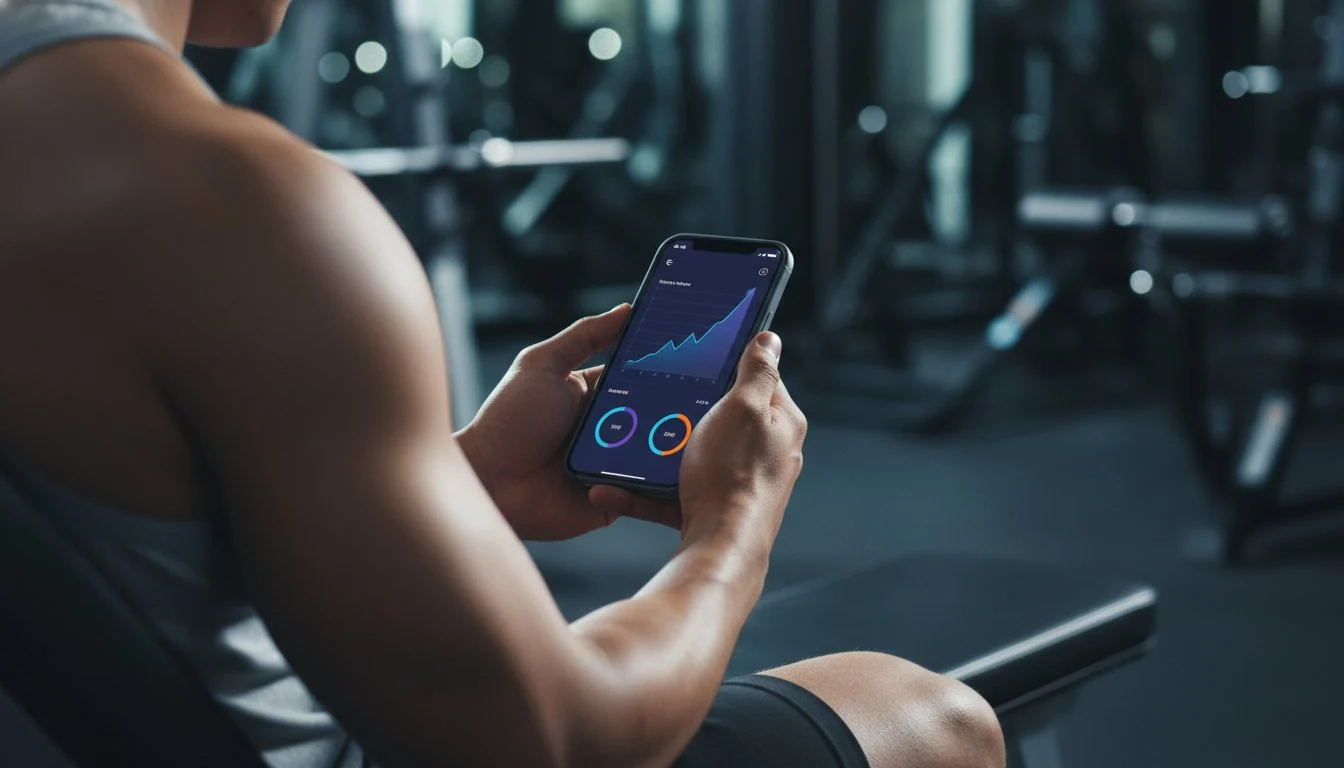
Most lifters treat their exercise tracker like a digital scrapbook instead of a performance engine. If your logging process takes longer than your rest period, you aren’t training; you’re just scrolling. You want results, not a social feed full of distractions. You’re tired of cluttered apps that bury your personal records under notification noise. You need a tool that works as hard as you do. Stop guessing. Start measuring.
Data is the only way to guarantee progressive overload. Use this guide to master your exercise tracker, eliminate friction, and force growth. Learn to log sets in seconds. Decode your performance metrics. Crush every plateau standing in your way. We’re breaking down the exact workflow for rapid logging, visual data analysis, and the science of 2026-level training precision. Your next PR is waiting in the data. Let’s get to work.
Key Takeaways
- Replace intuition with hard metrics to force consistent strength gains and long-term muscle growth.
- Build your routine framework before hitting the gym floor to ensure every set aligns with your specific hypertrophy or strength goals.
- Deploy the “Five-Second Rule” with your exercise tracker to log sets instantly without losing training momentum or focus.
- Master progressive overload by monitoring total volume and tracking PRs to validate your programming in real time.
- Eliminate digital clutter and social distractions to reclaim your time for faster, more intense training sessions.
Why an Exercise Tracker is Your Secret Weapon for Growth
Stop training by feel. Feeling is subjective, but the numbers on your screen are an undeniable record of your physical capability. If you want to dominate your lower body sessions, you need an exercise tracker that acts as your digital blueprint. Most lifters walk into the squat rack and guess their last working set. They rely on memory. Memory fails when your central nervous system is fried after a heavy set of triples. Objective metrics don’t. By logging every rep, you move from hoping for growth to forcing adaptation. It’s the difference between a gym hobbyist and a performance athlete.
Consistency is the foundation of every elite physique. You can’t build massive quads or a powerful posterior chain without a verifiable history of effort. A modern Fitness tracker provides the baseline data needed to scale your intensity. It prevents the “plateau trap” by highlighting exactly when your progress has stalled. If your leg press hasn’t moved in three weeks, the data screams for a change. You see the stagnation instantly. You adjust the load, you pivot the volume, and you keep growing. There is no guesswork; there is only execution.
The psychological edge of data is massive. When you’re staring down a brutal set of Bulgarian split squats, seeing your visual history fuels the fire. Knowing you hit 50-pound dumbbells for eight reps last week makes hitting nine reps today a requirement. It isn’t a suggestion. It’s a mission. This visual feedback loop creates a sense of constant momentum that “training by feel” can never replicate.
The Problem with Manual Logging
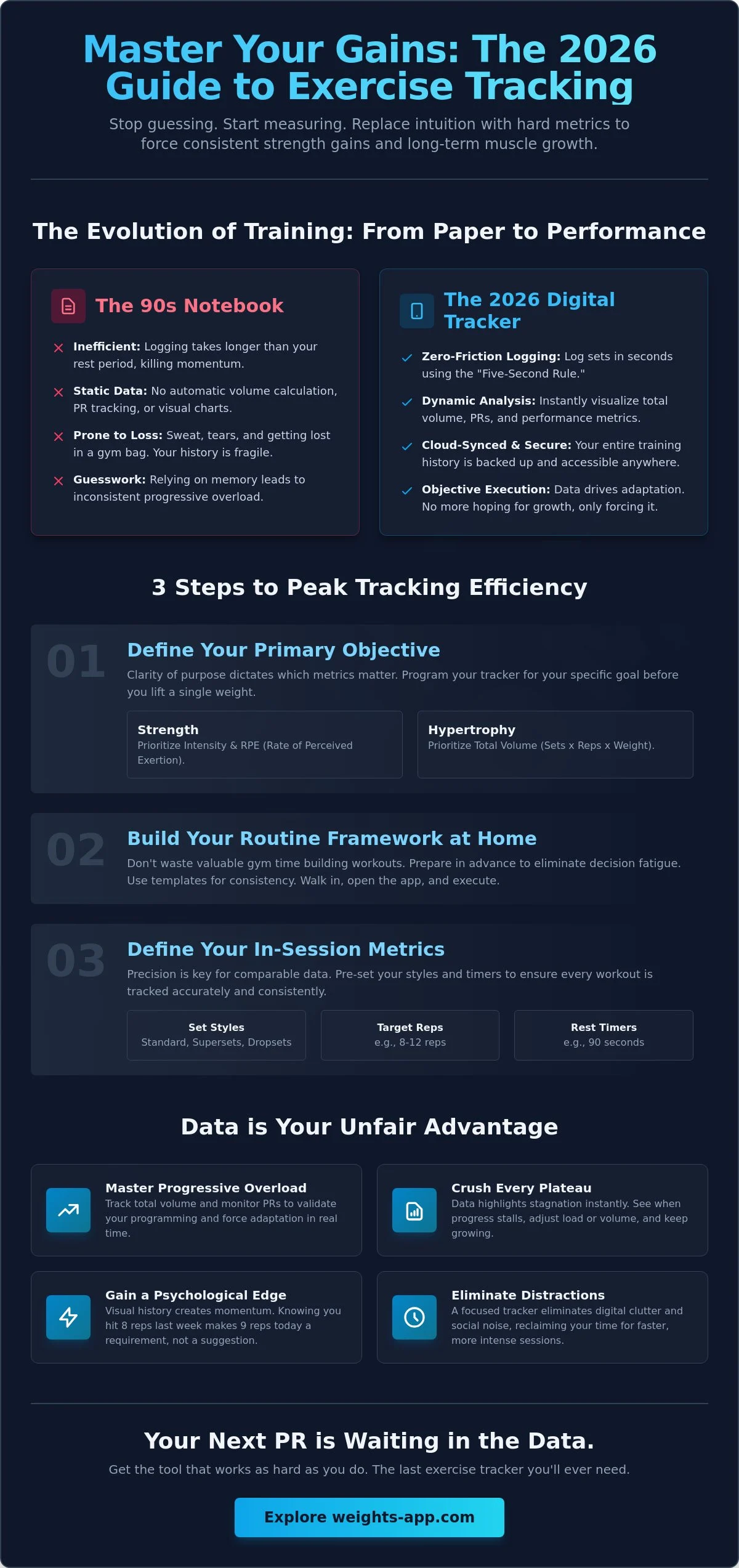
Notebooks belong in the 90s. They’re fragile and messy. They get soaked in sweat and lost in gym bags. Beyond the clutter, paper is static. It won’t calculate your total volume for the session or track your fatigue levels. Manual entry leads to guessing. You spend your rest periods flipping through pages instead of recovering. You need speed, not a pen that runs out of ink mid-set. If your logging method creates friction, you’ll eventually stop doing it. Efficiency is the only way to stay consistent.
Digital Efficiency: The 2026 Standard
In 2026, manual math is a waste of your training time. Speed is your greatest asset in the weight room. Use a one rep max calculator to pivot your strategy mid-workout without doing mental gymnastics. If your top set of squats feels light, recalculate your percentages and push the limit. Cloud backups ensure your training history is never lost, even if you upgrade your hardware. Visual charts turn raw numbers into a map of your success. You aren’t just lifting weights; you’re building a legacy of performance. Get the data. Get the gains.
Step-by-Step: Setting Up Your Tracker for Peak Efficiency
Efficiency starts before you touch a barbell. You don’t just “use” an exercise tracker; you program it. Your tracker is the digital architect of your physical potential. Start by identifying your primary objective. Strength athletes need to track intensity and RPE. Hypertrophy seekers must prioritize total volume. Endurance junkies need to monitor session density. Define your target before you log a single rep. This clarity of purpose dictates which metrics matter and which are just noise.
Build your routine framework at home. Don’t waste time scrolling through exercise libraries while your heart rate drops in the gym. Organize your session by movement patterns. Group your squats, hinges, and lunges to ensure total lower body dominance. Set your starting weights based on your last known maximums. Establish your target rep ranges. This preparation eliminates decision fatigue. You walk in, you see the plan, and you execute. Speed is the priority. Friction is the enemy of a high-intensity session.
Building Custom Routines
Structure creates freedom. Start with a foundational split like Push-Pull-Legs to ensure every muscle group gets hit with optimal frequency. While the focus here is lower body, a balanced physique requires attention to detail. Integrate specific shoulder workouts to build that elite V-taper that complements a powerful lower half. Save these routines as templates. Templates are your secret weapon for consistency. They remove the friction of manual setup every Monday morning. Open the app. Select your leg day. Start the clock. To get the most out of these templates, you can explore Weights Pro Yearly for unlimited routine saving and seamless session management.
Defining Your Metrics
Precision is the difference between a good workout and a great one. Select your set styles before you begin. Are you doing standard sets, high-intensity super-sets, or metabolic-stress-inducing drop-sets? Your exercise tracker should reflect these nuances to provide accurate volume data. Set your rest timers. Consistency in rest intervals is the only way to ensure your data is comparable week-over-week. If you rest two minutes today and five minutes next week, your PR is a lie. Control the variables to master the outcome. Input your body weight regularly. Tracking relative strength ensures you’re actually getting stronger, not just moving more weight because you’ve gained mass. High-performance training requires high-performance data. Logic over luck. Every time.
Zero-Friction Logging: How to Track Without the Distraction
The gym floor is a battlefield. You aren’t there to curate a lifestyle or scroll through a feed. You’re there to move weight. A cluttered app is a liability in this environment. Your exercise tracker must be a silent partner, not a distraction. We use the “Five-Second Rule” to maintain intensity. Rack the bar. Log the reps. Put the device down. This five-second window is critical. It preserves the accuracy of your data before fatigue-induced amnesia sets in. Speed is non-negotiable. If it takes longer than five seconds to log a set, the tool is broken.
Leverage haptic feedback to stay locked in. Subtle vibrations on your wrist or in your pocket tell you exactly when your rest is over. You don’t need to check a screen. You don’t need to look at a clock. You just wait for the signal and go. This keeps your head in the game. It maintains the athletic grit required for high-performance training. By removing the need to constantly monitor a timer, you free up mental energy for the next heavy set. Focus on the iron; let the tech handle the clock.
Minimalist design is a performance feature. Many fitness apps are bloated with social feeds and notification badges. They want your attention. We want your effort. A streamlined UI ensures you spend less time looking at pixels and more time looking at the rack. If you’re an Apple Watch user, phone-free tracking is the ultimate goal. Leave the phone in the locker. Sync your session directly to your wrist. Zero distractions. Pure focus. This is the 2026 standard for elite training. If you’re evaluating your options, a dedicated workout routine planner app built for zero-friction logging can be the difference between stalled progress and consistent PRs. For lifters who train in areas with unreliable connectivity, an offline workout tracker app iOS ensures your data is captured instantly without loading spinners or dropped sessions killing your momentum.
The In-Gym Workflow
Log your set the moment the weight hits the rack. Don’t wait. Don’t wander. Use the rest timer as a countdown to your next peak effort. If the set felt like an RPE 7 but was programmed as a 9, adjust the load for the next round immediately. This real-time agility is what separates data-driven athletes from the rest. Your exercise tracker should allow these pivots with a single tap. Precision isn’t just about recording history; it’s about optimizing the present.
Eliminating Digital Noise
Social feeds kill momentum. They invite comparison and procrastination. Your training space should be a vacuum. Focus on the “Next Set” view. It tells you exactly what’s coming: the weight, the reps, and the goal. Leverage iCloud sync to ensure your data is waiting for you on your other devices when you get home for a deeper analysis. Your progress is the only priority. Logic over luck. Every time.
Analyzing the Data: Mastering Progressive Overload
Data is useless without analysis. Your exercise tracker is a goldmine of performance insights, but only if you know how to mine it. Stop looking at single sets in isolation. Look at the aggregate. Monitor your total volume (Weight x Reps x Sets) per session. This is your primary growth metric. If this number isn’t trending upward over time, you aren’t building muscle; you’re just exercising. Training requires progress. Progress requires measurement. Master the math to master the muscle.
Track your Personal Records (PRs) to validate your programming. A PR isn’t just a heavy one-rep max squat. It’s hitting ten reps with a weight you previously only moved for eight. It’s completing the same volume in less time. Use your data to prove your routine works. Analyze your frequency across different muscle groups. The data doesn’t lie. If you think you’re hitting legs twice a week but the log shows three sessions in fourteen days, you’ve found your bottleneck. Consistency is the only path to lower body dominance. Fix the frequency to fix the results.
Interpreting Strength Charts
Visual growth charts turn abstract numbers into a roadmap. Look for upward trends in your estimated one-rep max to ensure your strength curve is climbing. Identify “plateau zones” immediately. If your volume has stalled for three consecutive weeks, your body has adapted. It’s time to change the stimulus. Compare your current performance to your history from six months ago. Real growth is a long game. Use the long-view data to stay motivated when the daily grind feels stagnant. Charts provide the perspective that a mirror cannot.
Applying the Data
Turn insights into immediate action. Use the 2.5% rule for guaranteed progression. When you hit the top of your target rep range for all prescribed sets, increase the weight by 2.5% in the next session. This is calculated progression, not ego lifting. Reduce rest periods to increase metabolic stress if you can’t add weight. This is another form of progressive overload that many lifters ignore. Use your history logs to choose your starting weight for every session. Eliminate the “guess-and-check” warm-up. Know your numbers. Execute the plan. Ready to master your metrics? Upgrade to Weights Pro Lifetime for advanced analytics and permanent access to your training history.
Weights app: The Last Exercise Tracker You Will Ever Need
Weights app isn’t just another digital notebook. It’s a high-performance engine for your training. We’ve stripped away the bloat. No ads. No social feeds. No distractions. This exercise tracker is built for the gym floor, where every second counts. You need a tool that moves as fast as your heart rate. By focusing exclusively on iOS optimization, the experience is fluid, responsive, and reliable. It’s the technical precision you deserve for your physical effort. Most trackers try to be social networks. We choose to be a streamlined utility. Your time is valuable. Your progress is the only priority.
Your training style is unique. Your tracker should be too. Build routines that adapt to your specific goals, whether you’re crushing a leg day featuring the Bulgarian split squat or a full-body split. The advanced visualization tools turn your raw data into undeniable proof of progress. See your volume climb. Watch your PRs stack up. When the data is this clear, growth is the only logical outcome. You aren’t just logging reps; you’re documenting a transformation. For lifters serious about upper body development, pairing your lower body data with precision-tracked tricep workouts ensures no muscle group is left behind in your pursuit of a complete physique. The app handles the complex calculations so you can focus on the iron. Logic over luck. Every single session.
Minimalism Meets Power
Experience a streamlined UI designed to survive the chaos of the weight room. While other apps bury your stats under notification noise, Weights app keeps your data front and center. The interface is intuitive. It’s fast. It stays out of your way. Access unlimited routines and advanced strength charts with Weights Pro Monthly or Weights Pro Yearly. It’s time for a cleaner gym log that actually helps you hit your peak. Switch to the Weights app and reclaim your focus. Speed is a performance feature. Don’t settle for bloated alternatives that slow you down between sets.
The Lifetime Advantage
Stop paying for the same features every month. Subscription fatigue is real, and it kills your momentum. Avoid the cycle of recurring payments. Secure the Weights Pro Lifetime plan for a one-time purchase. This gives you permanent access to every future update and feature. No recurring fees. No surprises. Your data stays safe and accessible with private, seamless iCloud backups. You’ve invested in your body; now invest in the tool that measures your success. Own your data. Own your progress. This is the last exercise tracker you will ever need to download. Start your legacy today.
Own Your Performance Legacy
Training without a plan is just sweating. You’ve seen how objective data is the only way to force growth and avoid the plateau trap. By mastering the “Five-Second Rule” and focusing on total session volume, you turn every workout into a verifiable step toward your peak. Your exercise tracker should be the engine of this progress, not a source of distraction. Stop guessing your starting weights. Start analyzing your visual growth charts to make every rep count.
You need a tool that works as hard as you do. Weights app delivers a zero-friction experience with no social distractions and advanced 1RM visualization. It’s built specifically for iOS and Apple Watch to ensure your focus stays on the rack. Reclaim your training time and dominate your goals with the ultimate performance partner. Logic over luck. Every session.
Download Weights app and start tracking your gains today.
The numbers don’t lie. Your next PR is waiting in the data. Go get it.
Frequently Asked Questions
What is the best way to track my gym progress?
Use a digital log that calculates your training volume in real time. Consistency is the only metric that matters for long term growth. Digital tools eliminate the math and human error associated with manual tracking. You need a system that provides instant feedback on your strength trends so you can adjust your intensity mid session. Data driven training is the fastest path to a dominant physique.
Should I use a digital exercise tracker or a paper notebook?
Digital wins for speed and technical precision. Paper logs are static, fragile, and impossible to search during a high intensity set. An exercise tracker offers cloud backups and visual charts that turn raw numbers into a roadmap for success. You can’t calculate your estimated one rep max on a piece of sweat soaked paper. Efficiency drives results; choose the tool that stays out of your way.
How do I track progressive overload in an app?
Monitor your total session volume and your personal records for every movement. If your weight, reps, or sets increase while maintaining the same rest intervals, you’ve achieved overload. Use built in strength charts to identify plateau zones before they stall your progress. Most apps automate this by highlighting when you’ve outperformed your previous best. Trust the data to force the adaptation.
Can I use an exercise tracker with my Apple Watch?
Yes, elite apps offer dedicated watch interfaces for phone free logging. This is the ultimate setup for zero distraction training. You log your sets directly on your wrist and sync the data via iCloud. It keeps your head in the game and your phone in the locker. This seamless integration ensures your rest periods remain focused and your data stays accurate without the digital noise.
Does an exercise tracker help with muscle growth?
It acts as a performance engine for hypertrophy. By providing an objective record of your effort, an exercise tracker ensures you’re actually increasing the stimulus over time. You can’t grow if you’re just repeating the same weights every week. Tracking forces you to beat your previous self. It turns every workout into a mission to outperform the data from your last session.
What metrics should I focus on in my workout log?
Prioritize total volume, intensity, and rest duration. These are the primary variables that dictate your physical adaptation. Tracking your personal records for specific movement patterns validates your programming. Focus on the numbers that prove you’re getting stronger or more efficient. If a metric doesn’t help you make a training decision, it’s just noise. Keep your log lean and your focus sharp.
Is it worth paying for a premium exercise tracker app?
Investing in your tools is an investment in your results. Premium versions unlock unlimited routines and advanced visualization that free versions often restrict. Options like a lifetime purchase or a yearly plan provide permanent access to the best features without subscription fatigue. If a premium app removes five minutes of friction from every workout, it pays for itself in performance gains within a month.
Ready To Get Started?
Everything you need. Nothing you don’t.
Weights adapts to your goals today and scales with the strength you’ll have tomorrow.