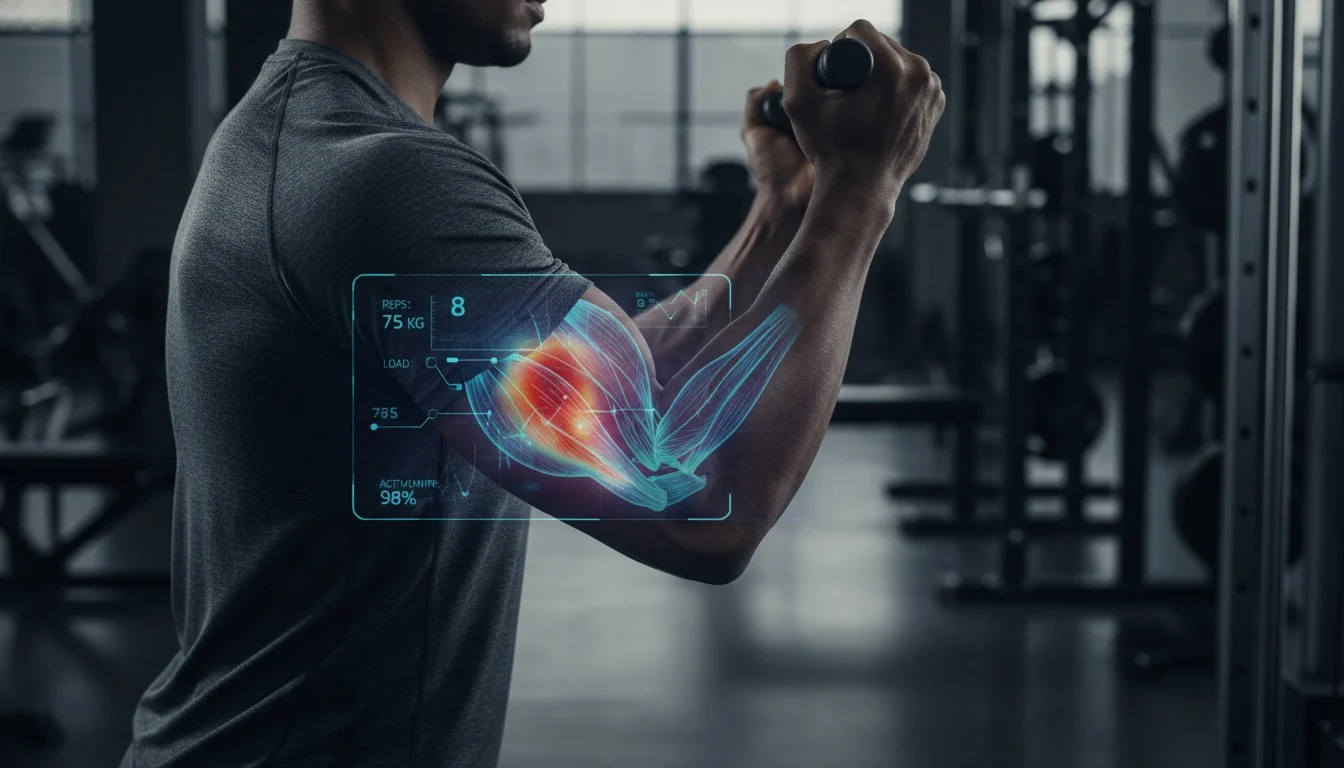
Stop chasing arm growth with random volume. Two-thirds of your upper arm mass is your triceps. If you aren’t hitting all three heads with data-backed precision, you’re just burning daylight. Most tricep workouts fail because they lack the mechanical focus needed to trigger real hypertrophy. You want the horseshoe. You want the power. It’s time to stop guessing and start measuring.
You’ve done the heavy reps and felt the burn. Yet, the mirror shows the same flat results and your elbows ache from improper form. It’s frustrating to work hard and see zero return on your effort. You deserve a routine that actually translates to visible gains without the joint pain or wasted movement.
This guide will teach you to master the mechanics of tricep growth. You’ll learn how to track your way to sleeve-splitting arm definition and massive lockout strength. We’re breaking down the anatomy of the long, lateral, and medial heads to build a streamlined, trackable routine that removes all friction from your training progress.
Key Takeaways
- Target all three muscle heads to unlock the two-thirds of your arm mass hidden in the triceps.
- Maximize your tricep workouts by prioritizing heavy compound movements and strategic arm positioning.
- Trigger consistent growth by hitting the optimal frequency of 2-3 high-intensity training sessions per week.
- Eliminate guesswork by tracking total volume and forcing progressive overload every single session.
- Build custom routines in seconds using Weights Pro for a zero-friction, data-driven training experience.
The Anatomy of Horseshoe Arms: Understanding Your Triceps
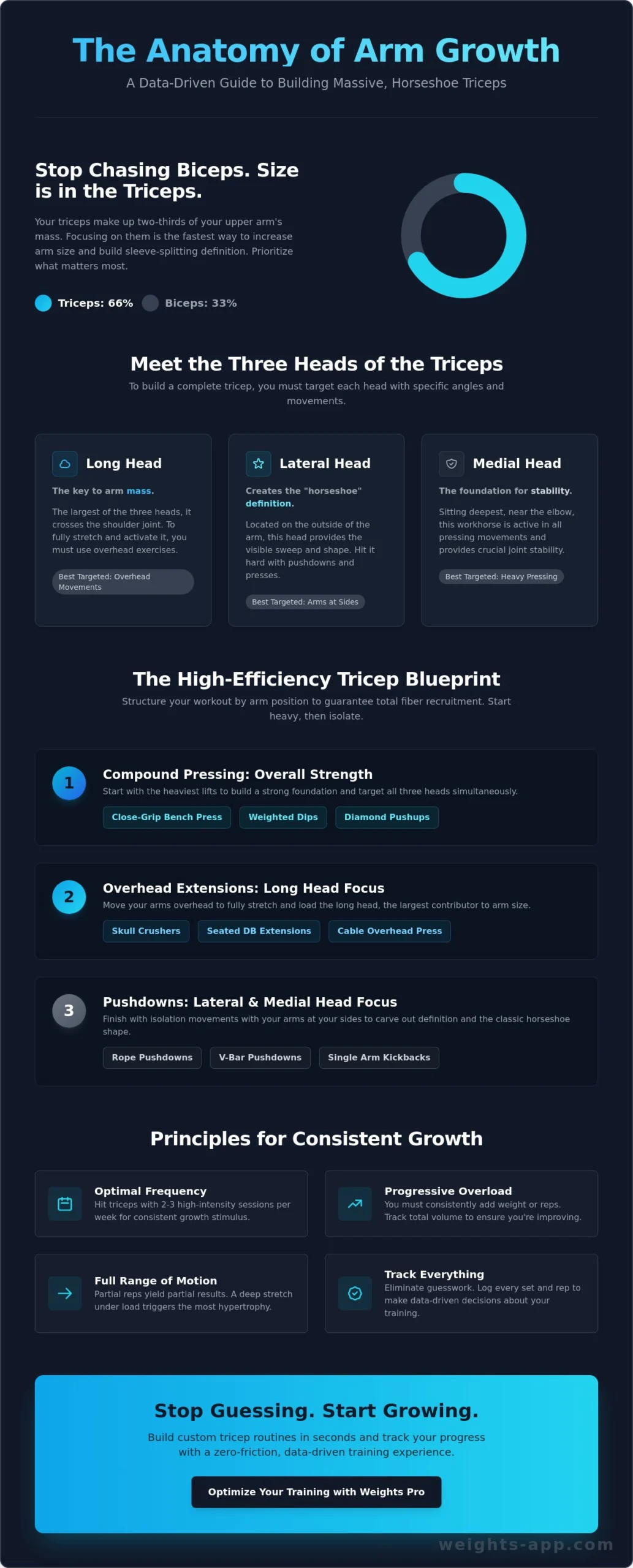
Size starts here. Forget the biceps for a second. Your triceps are the real engine of arm mass. They occupy roughly two-thirds of the real estate on your upper arm. Building horseshoe definition requires a surgical approach to the three distinct heads. You cannot simply push weight and hope for the best. You need to manipulate joint angles to force growth. Mechanical tension is your primary lever. High tension triggers muscle protein synthesis. Effective tricep workouts focus on loading the muscle where it’s most vulnerable and strongest.
Many lifters confuse heavy benching for dedicated tricep work. While pressing helps, it rarely provides the isolation needed for the lateral head’s peak. You need specific elbow extension movements. Your goal is to isolate the joint. Lock the shoulder in place. Drive through the palm. This ensures the triceps take the load, not the anterior delts. Precision is the difference between a sore shoulder and a growing arm. Studying the Anatomy of the triceps shows why variety in your movement patterns is non-negotiable for total development.
The Long Head: The Secret to Arm Mass
The long head is the heavyweight. It sits on the inner back of your arm and provides the most bulk. It’s the only head that crosses the shoulder joint. This is a critical mechanical detail. Because it attaches to the scapula, you must move your arm overhead to fully stretch it. Extension from a stretched position creates maximum tension. This is how you fill out t-shirt sleeves. Ignore this head, and your arms will always look thin from the side. Skull crushers and overhead cable extensions are the foundation of this mass.
Lateral and Medial Heads: Definition and Stability
The lateral head provides the “sweep.” It’s on the outside of your arm. This creates the visible curve that defines the horseshoe look. The medial head is the workhorse. It sits deeper and closer to the elbow. It provides thickness and vital joint stability. Both heads are active during heavy pressing and standard pushdowns. They don’t cross the shoulder. Their job is simple: extend the elbow. You hit them hardest when your arms are at your sides using a neutral or overhand grip.
Tracking these movements is essential for progress. You can’t manage what you don’t measure. If your overhead extension weight goes up, your long head is growing. It’s simple logic applied to physical performance. Use a tool like Weights Pro to log every set and rep. Keep your data clean. Eliminating the guesswork allows you to focus entirely on the intensity of your tricep workouts. Consistency in your tracking leads directly to consistency in your gains.
The Best Tricep Exercises for Targeted Growth
Efficient tricep workouts require a clear hierarchy. You don’t start a session with light kickbacks. You start with heavy, multi-joint movements that allow for maximum mechanical load. Categorizing your exercises by arm position is the only way to guarantee total fiber recruitment. If you aren’t changing the angle of your humerus relative to your torso, you’re leaving gains on the table. Move from heavy compounds to targeted isolation to finish with a metabolic pump. This structure ensures you hit the muscle when it’s fresh and finish it off when it’s fatigued.
Always prioritize a full range of motion. Partial reps lead to partial results. Deep stretches under load trigger the most hypertrophy. This is especially true for the long head, which is often neglected in standard routines. Research supports this precision-based approach. An ACE study using EMG data identified the most effective tricep exercises based on actual muscle activation. Use this data to build your routine rather than following outdated gym myths. Science doesn’t lie; your results will reflect the data you follow.
Compound Pressing (Overall Strength)
Overhead Extensions (Long Head Focus)
Address the long head to build real mass. This is the largest part of the muscle. You must get your arms overhead to stretch it properly. Seated dumbbell overhead extensions allow for a deep, productive stretch at the bottom. Cable overhead presses provide constant tension that dumbbells can’t match. Skull crushers remain the gold standard for building the “meat” of the arm. Keep your elbows tucked. Lower the bar slowly to your forehead. This ensures the muscle stays under tension throughout the entire eccentric phase.
Pushdowns and Kickbacks (Lateral and Medial Focus)
Finish with isolation. These moves focus on the “sweep” and the “pump.” Rope pushdowns are superior because they allow you to pull the rope apart at the bottom for a peak contraction. Straight bar pushdowns let you move more weight to tax the lateral head. Dumbbell kickbacks provide the highest tension at the lockout. Focus on the mind-muscle connection here. Squeeze hard at the end of every rep. You can log these isolation sets to ensure you’re still progressing on the small details that create the horseshoe look.
Designing Your High-Efficiency Tricep Routine
Growth isn’t accidental. It’s programmed. You need a blueprint that maximizes every minute in the gym. High-efficiency tricep workouts demand a precise balance of frequency, volume, and intensity. If you’re only training arms once a week, you’re leaving growth on the table. Muscle protein synthesis typically returns to baseline after 48 hours. You need to re-trigger that growth signal before it fades. Consistency is your most valuable asset.
Hit your triceps 2-3 times per week for optimal hypertrophy. This frequency allows you to accumulate high-quality volume without the junk reps that plague marathon arm sessions. Aim for 10-15 hard sets per week as your starting point. These shouldn’t be easy reps. Train within 1-2 reps of technical failure. If your form breaks or you have five reps left in the tank, the set doesn’t count toward your growth total. Intensity is what separates a casual lifter from a minimalist athlete.
The “Push Day” Integration
Pairing triceps with chest and shoulders is the most efficient way to organize your training. Perform your heavy chest and shoulder presses first. Your triceps act as the secondary movers in these lifts. Use that momentum. Once the heavy compound work is done, add two tricep-specific movements to finish the session. Alternate your focus each time you hit a push day. Focus on the long head with overhead work on Monday. Target the lateral head with pushdowns on Thursday. This ensures total development without overtraining the joint.
The Dedicated Arm Day Approach
A dedicated arm day allows for maximum blood flow and metabolic stress. Superset your tricep movements with bicep exercises to keep the intensity high and the rest periods short. This antagonist training style improves recovery between sets. Start the session with a heavy compound move like the Close-Grip Bench Press. This allows you to load the muscle with maximum mechanical tension while you’re fresh. Finish the workout with high-rep cable work. High-rep sets drive blood into the muscle and trigger metabolic growth factors. If you’re also looking to build a complete lower-body program with the same level of precision, the Bulgarian split squat is one of the most effective single-leg movements for exposing and correcting weaknesses in your kinetic chain.
Tracking these variables is the only way to ensure you’re actually improving. If you don’t know your volume from last week, you can’t beat it this week. Use Weights Pro to log every set and rep. Clear data removes the friction from your progress. It turns a guessing game into a streamlined path toward horseshoe arms. Focus on the numbers. The results will follow the data.
Breaking Plateaus: Tracking Volume and Progressive Overload
Growth is a mathematical response to stress. Your body only adapts when it’s forced to. If your training load remains static, your muscle mass will too. This is the primary reason many tricep workouts fail to deliver results after the initial “newbie” gains phase. You hit a wall because you stop increasing the mechanical demand. You need to track your total volume. This is the product of your Sets x Reps x Weight. If this total number doesn’t trend upward over your training blocks, you aren’t building new tissue. It’s that simple.
Stop guessing in the gym. Use a dedicated exercise tracker to document every single lift. This removes the mental friction of memory and replaces it with the clarity of technical data. When you know exactly what you lifted last session, you have a concrete target to beat today. This is how you force the horseshoe definition you’re chasing. Precision beats raw effort every single time. Every rep must have a purpose.
Why Visual Data Matters
Charts reveal the cold truth. They highlight stalls before you even feel them in your workout. A visual representation of your volume allows you to identify plateaus before they become months of wasted effort. Compare your current 1RM to your performance from 12 weeks ago. If the line is flat, your current routine has lost its effectiveness. This data helps you isolate which specific movements are actually driving your strength gains. You might find that your weighted dips are soaring while your pushdowns have stalled. Use this insight to pivot your focus and keep the momentum moving forward.
Implementing Progressive Overload
Small, frequent gains lead to massive results. Increase your weight by 1-2kg once you consistently hit the top of your target rep range with perfect form. This incremental approach ensures long-term adaptation without overloading your elbow joints. You can also increase training density to break a plateau. Reduce your rest times by 10-15 seconds to keep the metabolic tension high. This forces the muscle to recover faster and work harder in a shorter window. Focus on perfecting your form before you chase “ego” weights. A controlled eccentric rep with slightly less weight builds more muscle than a sloppy, momentum-driven rep with a heavy stack. Mastery of the movement is the prerequisite for adding load.
Don’t let your progress stall out. Unlock Weights Pro and turn your training data into visible muscle growth.
Optimising Your Training with Weights Pro
You’ve mastered the mechanics. You know the anatomy. Now you need the infrastructure to sustain your progress. High-performance tricep workouts require high-performance tracking. The Weights app is engineered specifically for the minimalist athlete who values speed and technical precision. It’s built for those who want results without the clutter. You don’t need a social media feed while you’re training. You need a streamlined interface that gets out of the way so you can focus on the iron. Precision is the ultimate utility.
Efficiency is the core of the experience. Create custom tricep routines in seconds using our intuitive interface. There is zero friction between your plan and your performance. Log your sets directly on your Apple Watch to stay focused on the weight, not your phone. Constant scrolling kills training intensity. Moving your logging to your wrist keeps your heart rate up and your mind in the zone. It’s a professional tool for a professional mindset. Secure your data with iCloud sync to ensure you never lose a PR. Your history is your roadmap; keep it safe.
Minimalist Logging, Maximum Results
Ditch the distractions. Most fitness apps are bloated with ads and social features that drain your battery and focus. Weights Pro offers a clean slate. Log your shoulder workouts and tricep sets in one seamless flow. High-speed logging means more time for recovery and less time staring at a screen. Quickly view your history logs to see exactly what you lifted last session. Having this data at your fingertips allows you to make informed decisions about your next set. Beat your previous volume. Force the adaptation. Move forward.
Ready to Level Up?
Own your progress. Unlock the full potential of your training with Weights Pro. We offer flexible options to fit your lifestyle and long-term goals. Choose Weights Pro Monthly or Weights Pro Yearly to access unlimited routines and advanced tracking features. For the athlete committed to the long game, the Weights Pro Lifetime purchase ensures you own your data forever with no recurring fees. It’s a one-time investment in your physical peak. Download the Weights app on the App Store today to start tracking your tricep workouts with surgical precision. Stop guessing. Start growing.
Take Command of Your Arm Growth
Precision targeting and data-driven tracking are the only paths to elite arm development. You understand the anatomy of the three heads. You have the tactical exercise selection. Now you need the discipline to execute. Effective tricep workouts are built on the foundation of relentless progressive overload. If you aren’t beating your past self, you’re standing still. Growth is a choice made in every set. Master the mechanics and the results will follow the data.
Eliminate the noise and focus on the iron. Weights app provides a minimalist design with zero distractions, keeping your momentum high throughout the session. Log every set seamlessly with Apple Watch integration to stay locked in. Visualize your gains through clear charts that track your volume in real-time. This is the technical edge you’ve been missing. Don’t leave your horseshoe arms to chance. Download Weights app and start logging your tricep PRs today. The blueprint is ready. It’s time to build.
Frequently Asked Questions
Can I get big triceps with just dumbbells?
Yes, dumbbells are fully capable of building massive horseshoe arms. You can perform overhead extensions, skull crushers, and close-grip dumbbell presses to hit every head of the muscle. Dumbbells also allow for a more natural range of motion, which can reduce the risk of elbow strain during heavy sessions. Focus on a full range of motion and increase the weight as you get stronger to ensure consistent growth.
How many times a week should I do tricep workouts?
Target your triceps 2 to 3 times per week to maximize the growth window. Muscle protein synthesis typically peaks and then fades within a 48-hour period. By hitting the muscle multiple times a week, you keep the growth signal active. Spacing these sessions out prevents joint fatigue while allowing you to accumulate the 10 to 15 hard sets required for optimal arm thickness.
Why are my triceps not growing despite heavy training?
Lack of growth usually stems from a plateau in training volume or a failure to target the long head. If you’ve been lifting the same weight for months, your body has already adapted and stopped growing. You must track your tricep workouts to ensure you are adding weight or reps every week. Additionally, ensure you aren’t just doing pushdowns; you need overhead work to fill out the inner arm.
What is the best tricep exercise for the long head?
The overhead cable or dumbbell extension is the most effective move for the long head. This specific head attaches to the scapula, meaning it only reaches a full stretch when your elbow is positioned above your head. Maximizing the stretch at the bottom of the movement triggers the most muscle fiber recruitment. Focus on a controlled eccentric phase to keep the tension on the muscle, not the joint.
Is it better to do triceps before or after chest?
Execute your tricep movements after your heavy chest and shoulder pressing. Your triceps are essential assist muscles for the bench press and overhead press. If you fatigue them first, your primary lifts will stall, and your overall training volume will drop. Save the isolation work for the end of the session to finish the muscle off after it has already been taxed by compound movements.
Do pushups build triceps effectively?
Pushups are excellent for tricep development when you use a narrow hand placement. Diamond pushups specifically force the triceps to handle the majority of the load, making them a top-tier bodyweight exercise. They are particularly effective for building the lateral head sweep. Incorporate them at the end of a workout as a high-rep finisher to drive maximum blood flow and metabolic stress into the arms.
Should I use high reps or low reps for tricep growth?
How do I track my tricep workout progress effectively?
Record every metric from your session to identify performance trends. Tracking Sets x Reps x Weight gives you a volume load number that must trend upward over time. Use the Weights Pro ab workout tracker app to automate this process and view your progress through visual charts across all your muscle groups, including triceps and core. Having a digital history of your PRs eliminates the friction of manual logging and keeps you focused on beating your previous best every time you train.
Ready To Get Started?
Everything you need. Nothing you don’t.
Weights adapts to your goals today and scales with the strength you’ll have tomorrow.