
YOUR ROUTINE. YOUR RECORD.
A powerlifting training log
Keep squat, bench press and deadlift records clear with lift variations, setup notes, warm-up sets and comparable history.
Weights can record your powerlifting training as individual sets with weight, repetitions and notes. Keep competition-style lifts and their variations identifiable so a change in movement is not mistaken for a strength record.
Download for iOS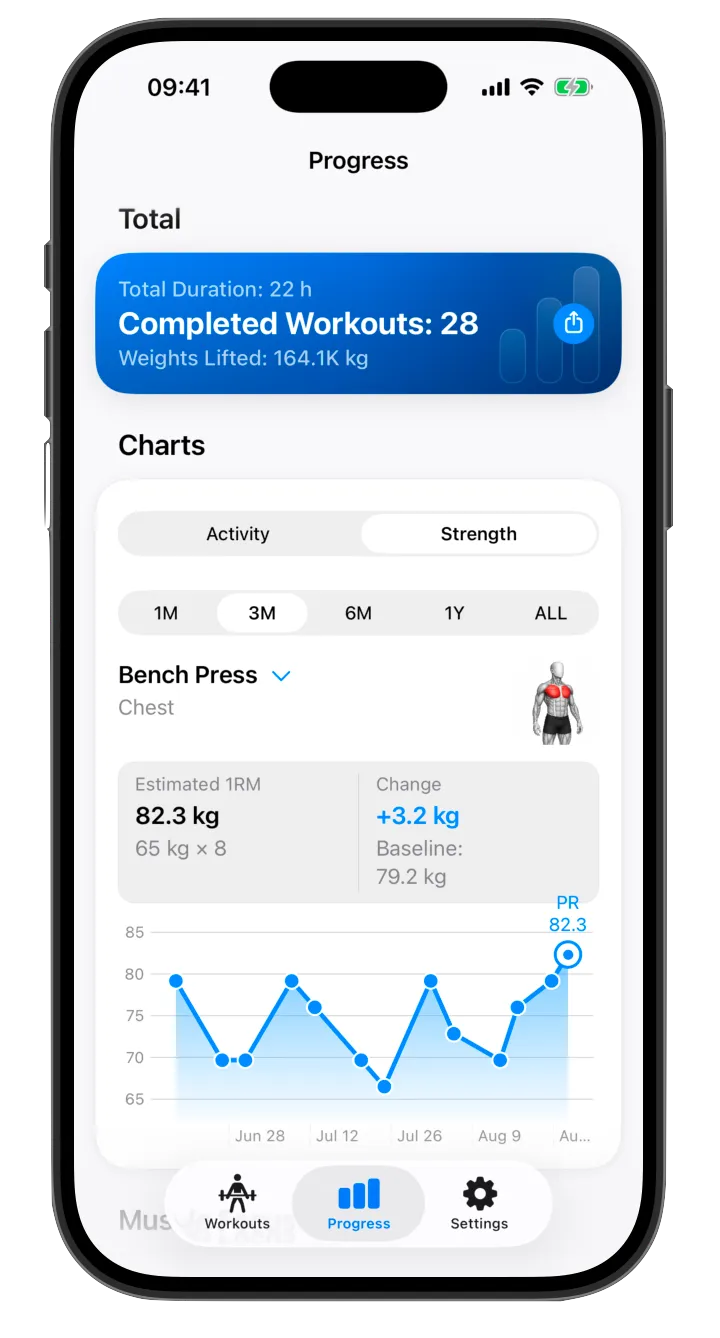
Name the exact lift you want to compare
A paused bench press and a touch-and-go bench press answer different questions in a training log. Choose a consistent exercise name and use custom exercises for variations that need their own identity. Record setup details that matter to your comparison, such as grip or equipment. Avoid creating a new name every week for the same movement.
Keep top sets and back-off sets visible
Enter each completed result, even when your session uses different weights and repetition counts. A single workout total cannot tell you what happened on the heaviest set. Keep warm-up sets separate from working sets and write a brief note when the planned session changes. The sample rows are hypothetical entries, not a prescription or an attempt-selection recommendation.
Read estimated strength carefully
Weights documents strength charts and workout history. An estimated one-rep max is a calculation from recorded performance, not a verified competition result. Look at the entries and notes behind a chart, particularly when the repetition count, equipment or variation changes. Do not merge records from different lifts solely because their names share the word squat or bench.
Take a readable record to your review
The released app listing documents PDF and CSV export. A dated export lets you inspect completed-set rows alongside a summary outside the app. Export does not promise a coach dashboard, automatic programming, federation scoring or cloud synchronization. Use the barbell calculator for equipment arithmetic and the app for recording what you actually completed.
A record you can interpret later
Illustrative entries only. These numbers are not a training recommendation.
| Record | Load | Reps |
|---|---|---|
| Paused bench, working set | 70 kg | 3 |
| Paused bench, back-off | 62.5 kg | 5 |
| Note | Same pause and setup | Comparable variation |
Common questions
Does this calculate a competition total or score?
No. This page describes a training log. It does not verify lifts, apply federation rules or calculate a competition score.
Can I keep accessories in the same routine?
Use your saved routine to organize the exercises you follow. Keep accessory names distinct so their history remains understandable.