
THE TRAINING NOTEBOOK
Workout log terms: sets, reps, volume and personal records
Understand the fields in a lifting log and the difference between recorded performance, arithmetic summaries and training advice.
A repetition is one recorded repetition of a movement; a set groups repetitions. A workout log records the exercise, weight, repetitions and context. Volume load and estimated strength summarize those records, but cannot describe every aspect of performance.
Download for iOS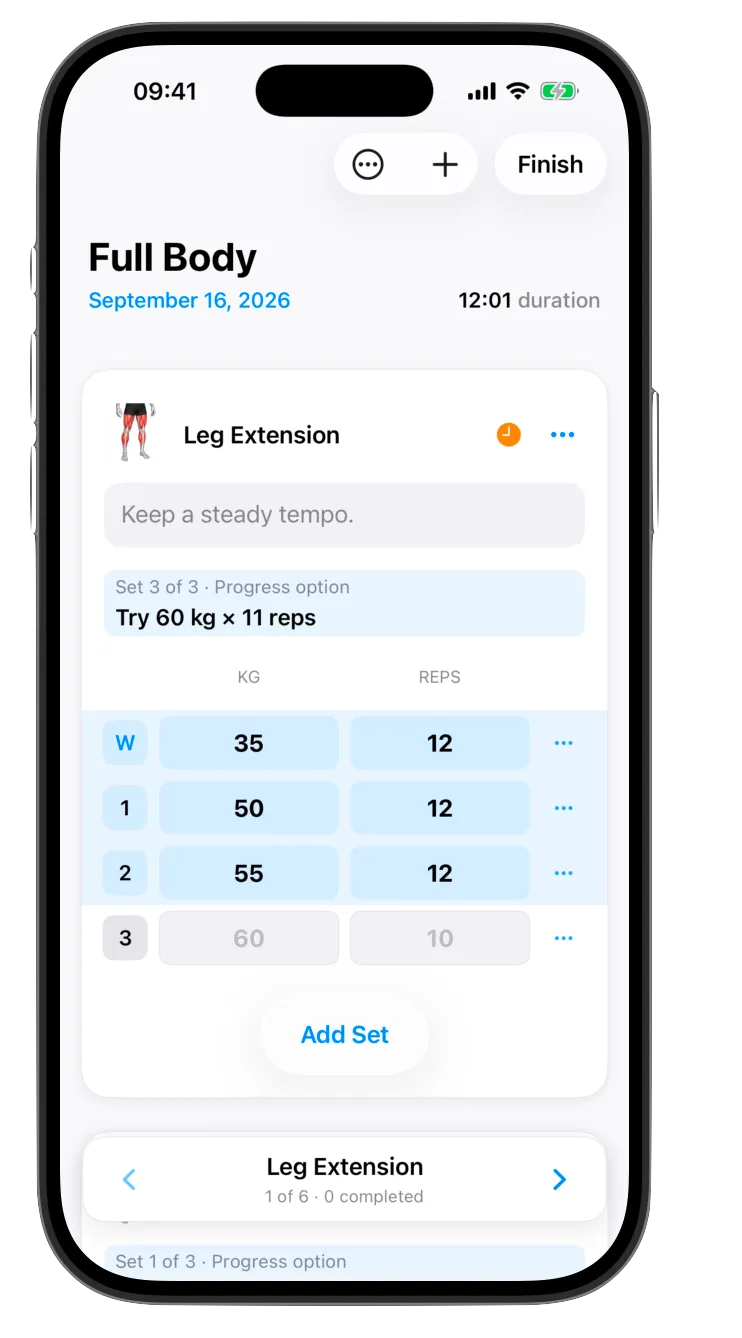
Repetitions and sets
If you record three sets containing 8, 8 and 7 repetitions, your total is 23 repetitions. Do not replace that with 3 × 8 unless all three sets contained eight. A routine can contain a target; the completed session should preserve the actual result. Keep preparation sets identifiable when reviewing the main work.
Weight and its convention
The number needs a unit and a meaning. A barbell figure may include the bar and both sides. A dumbbell figure might mean one dumbbell or a pair. Machine-stack labels are not automatically comparable across machines. Write the convention in your notes and keep it stable so a change in bookkeeping does not look like a strength gain.
Volume load
A simple volume-load calculation adds weight × repetitions for each set. At 50 kg for 8, 8 and 6 repetitions, that is 1,100 kg·reps. This arithmetic does not measure mechanical work in joules, effort, movement quality or muscle growth. Compare the underlying exercises and conventions before comparing totals.
Personal records and estimated one-rep max
A personal record needs a clear definition: the heaviest recorded weight, most repetitions at a given weight, or another explicitly defined result. An estimated one-rep max is a model-derived value, not a successfully performed single. Keep the same variation and setup when comparing records and inspect the source sets behind a chart.
A record you can interpret later
Illustrative entries only. These numbers are not a training recommendation.
| Term | Example | What it tells you |
|---|---|---|
| Set | 50 kg × 8 | One recorded result |
| Total reps | 8 + 8 + 6 = 22 | Counted repetitions |
| Volume load | 50 × 22 = 1,100 kg·reps | Load-and-repetition sum |
Common questions
Is volume load the same as effort?
No. It omits factors such as technique, range of motion and proximity to fatigue.
Is a calculated 1RM a tested maximum?
No. It is an estimate based on recorded performance and a calculation.